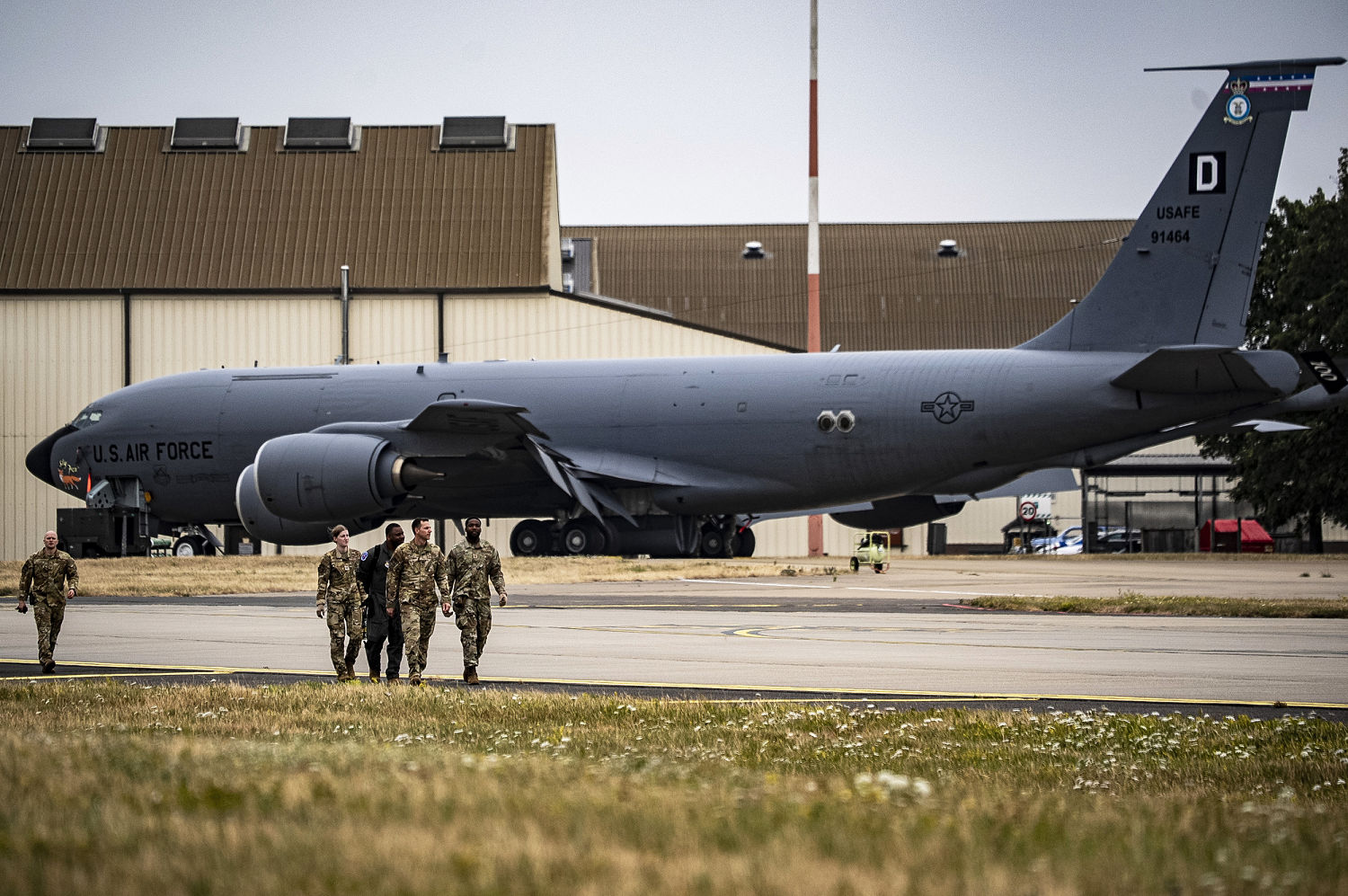
Military commentators love a romantic origin story. Ask the average defense blogger how RAF Mildenhall became indispensable to the United States Air Force, and you will get the same tired, Wikipedia-skimmed timeline. They will tell you about the 1934 MacRobertson Air Race to Melbourne. They will wax poetic about Bomber Command, the Cold War Berlin Airlift, and how a sleepy patch of Suffolk farmland organically morphed into the "Gateway to Europe."
That narrative is lazy, nostalgic, and dangerously misleading.
RAF Mildenhall did not become crucial because of its rich heritage or some mystical strategic geography. It became crucial because the Pentagon spent thirty years addicted to cheap, centralized convenience during an era of uncontested air superiority. What mainstream defense analysts celebrate as a triumph of forward-deployed logistics is actually a textbook case of institutional inertia. By cramming its European aerial refueling, special operations, and intelligence wings onto a single, unhardened runway in eastern England, the US Air Force built a magnificent peacetime hub that doubles as a catastrophic wartime liability.
If you want to understand Mildenhall's real role in modern airpower, stop reading press releases from Public Affairs. Look at the ramp space, the fuel bladders, and the cold math of modern long-range precision strike.
The Myth of Geographic Destiny
The standard argument goes like this: Mildenhall sits in East Anglia, positioned perfectly to bridge North America, Europe, and the Middle East. Therefore, it was destined to be the beating heart of US Air Forces in Europe (USAFE).
Wrong. Geography gave England an advantage in 1943 when B-17 Flying Fortresses had a combat radius of roughly 800 miles and needed every inch of proximity to reach Schweinfurt or Berlin. Geography also mattered during the Cold War when Soviet tank divisions sat less than 500 miles away across the North German Plain, and Mildenhall served as a vital rear-echelon staging base safely behind the immediate front lines.
After 1991, that logic evaporated. The Warsaw Pact collapsed, and the Air Force had a golden opportunity to rethink its European posture. Instead of dispersing assets to survive modern threats, defense planners took the path of least resistance. They consolidated. Why pay to maintain five austere, dispersed airfields across the continent when you can park everything at Mildenhall, share the administrative overhead with neighboring RAF Lakenheath, and operate like a domestic stateside base?
I have watched defense contractors and base planners fall into this exact trap for decades. You optimize for peacetime efficiency—consolidating supply chains, centralizing maintenance hangars, and co-locating command nodes—until the spreadsheet looks glorious. Then a peer adversary develops precision-guided ballistic and cruise missiles with 2,000-mile ranges, and your "efficient hub" suddenly looks like a bullseye painted in neon.
What Actually Happens on That Ramp
To see why Mildenhall is both operationally vital and structurally fragile, you have to strip away the ceremonial fluff and look at the three distinct missions crammed onto those 1,100 acres:
- The Gas Station (100th Air Refueling Wing): Operating the KC-135 Stratotanker, the "Bloody Hundredth" is the sole permanent US aerial refueling wing in the entire European theater. Without these tankers, American fighters out of Lakenheath, Spangdahlem, and Aviano are tethered to short leashes.
- The Shadow Warriors (352nd Special Operations Wing): Flying the CV-22B Osprey and MC-130J Commando II, this unit handles clandestine infiltration, exfiltration, and resupply for US European Command (EUCOM) and US Africa Command (AFRICOM).
- The Vacuum Cleaners (95th Reconnaissance Squadron): Operating RC-135 Rivet Joint and Cobra Ball aircraft, these crews siphon up electronic signals and telemetry data along the borders of rival states.
Look at that combination. Aerial refueling, special operations, and strategic signals intelligence. In military doctrine, these are not merely "support" functions; they are the crown jewels of high-end warfare. Without tankers, the strike packages do not launch. Without Rivet Joint intelligence, commanders fly blind.
And where did the Air Force put all three? On a single base with one primary runway (Runway 10/28), surrounded by flat fenland, with zero hardened aircraft shelters capable of protecting wide-body tankers or reconnaissance jets.
The 2015 Closure U-Turn Nobody Wants to Talk About
If Mildenhall was truly an unassailable strategic masterpiece, the Pentagon would never have tried to abandon it.
Yet in January 2015, under the European Infrastructure Consolidation (EIC) review, the Department of Defense announced it was shutting down RAF Mildenhall entirely. The plan was to move the KC-135 tankers to Ramstein Air Base in Germany and relocate the 352nd Special Operations Wing to Spangdahlem. The Pentagon projected saving $500 million a year across Europe by trimming excess real estate.
Five years later, in 2020, the Pentagon reversed course and canceled the closure.
Mainstream pundits framed that reversal as a sudden awakening to Russian aggression following the 2014 annexation of Crimea and the subsequent buildup in Eastern Europe. That is half the story. The real reason the closure died was brutal logistical friction. Ramstein was already choking on air traffic and cargo throughput as the primary evacuation and logistics hub for the Middle East. Germany's strict environmental and noise-abatement laws made expanding tanker operations a bureaucratic nightmare. Moving the units turned out to be far more expensive and disruptive than the 2015 spreadsheets predicted.
Mildenhall survived not because it was invulnerable, but because moving the furniture had become too expensive. The Air Force stayed put out of sunk-cost necessity, even as the strategic environment turned violently against centralized bases.
Why You Are Asking the Wrong Question
When people search for how Mildenhall became crucial, they are usually trying to validate the status quo. They want to know why this specific base is great. The real question—the one planners inside the Pentagon and RAND Corporation war-gaming rooms actually lose sleep over—is completely different: How does the US Air Force fight in Europe when RAF Mildenhall is knocked out in the first twenty minutes of a conflict?
Imagine a scenario where a high-intensity conflict erupts in Eastern Europe. An adversary does not need to invade Britain to neutralize Mildenhall. A salvo of conventional cruise missiles launched from submarines in the North Atlantic, or long-range air-launched ballistic missiles fired from bombers over the Barents Sea, only needs to crater Runway 10/28 and rupture the bulk fuel storage tanks.
You do not even have to destroy the KC-135s on the tarmac. If the fuel farm is burning and the runway has six craters in it, those tankers are functionally dead for days. And if the tankers cannot get airborne, the F-35As and F-15Es sitting five miles down the road at RAF Lakenheath lose their ability to project power deep into contested airspace.
This is the exact vulnerability that drove the Air Force to invent Agile Combat Employment (ACE).
Developed initially for the Pacific theater to counter Chinese missile threat rings, ACE is the formal admission that massive "super-bases" like Kadena in Okinawa and Mildenhall in the UK are death traps in a peer fight. Under ACE doctrine, the Air Force stops relying on massive main operating bases and instead scatters small teams of multi-capable airmen and aircraft across dozens of austere, civilian, or allied airfields—operating from highway strips, regional airports, and bare concrete pads with minimal footprint.
Dismantling the Common Myths About Mildenhall
- Myth 1: "The 'Special Relationship' guarantees Mildenhall's security."
- Reality: Diplomatic goodwill does not intercept hypersonic glide vehicles or long-range drones. While the UK provides unmatched political latitude—allowing the US to launch sensitive operations out of Britain with far fewer diplomatic headaches than in continental Europe—British air and missile defense over East Anglia remains painfully thin. Political permission is not physical protection.
- Myth 2: "Mildenhall is vital because it is close to the fight."
- Reality: Mildenhall is roughly 1,100 miles from the Suwalki Gap and over 1,400 miles from the Black Sea. For a KC-135 tanker flying at 530 mph, that is a two-to-three-hour transit just to reach the refueling track, burning precious fuel before it ever passes a single drop to a fighter. Mildenhall is actually too far from the eastern flank for optimal tanker efficiency, yet well within the reach of modern enemy strike systems.
- Myth 3: "Upgrading Mildenhall solves the problem."
- Reality: Pouring concrete and building new hangars at Mildenhall increases peacetime capacity, not wartime survivability. Unless you bury the fuel reserves underground, build massive hardened shelters for 320-foot-wingspan aircraft (which costs billions), and surround Suffolk with layered ballistic missile defense batteries, every dollar spent on Mildenhall simply raises the value of the target.
The Contrarian Verdict
Let us be intellectually honest here. You cannot simply bulldoze RAF Mildenhall tomorrow and scatter the 100th Air Refueling Wing across twenty dirt strips in Poland and Romania. There are severe downsides to aggressive dispersal.
Peacetime training collapses when you break up a wing. Maintenance efficiency plummets when spare parts, engine test cells, and specialized avionics technicians are split across ten countries. Command and control becomes a nightmare when communications are degraded, and host-nation diplomatic clearances in Europe remain a bureaucratic minefield compared to the seamless authority the US enjoys in the United Kingdom. Mildenhall exists because centralization works brilliantly right up until the moment the shooting starts.
Even so, treating Mildenhall as an eternal, untouchable cornerstone of American airpower is strategic malpractice. Its historical rise was an accident of post-Cold War budget cuts and peacetime convenience. Its continued dominance is a symptom of an Air Force that still struggles to break its addiction to mega-bases.
True resilience in Europe will not come from celebrating Mildenhall's past or pouring more money into its perimeter. It will come when the US Air Force treats Mildenhall not as a permanent fortress, but as a peacetime staging garage that must be completely emptied the moment a crisis begins.
Stop asking how Mildenhall became crucial. Start asking how fast we can get the jets off its runway before the first sirens go off.