The red dust of the Pilbara does not care about diplomatic communiqués. It settles onto boots, coats the windshields of three-hundred-ton haul trucks, and stains the cuffs of high-visibility shirts a stubborn, rusty orange that never quite washes out. Three thousand miles north, across the South China Sea, the air in Shenzhen smells of salt, ozone, and wet concrete after a subtropical downpour, humming with the electric urgency of a city that built itself out of fishing villages in a single human lifetime.
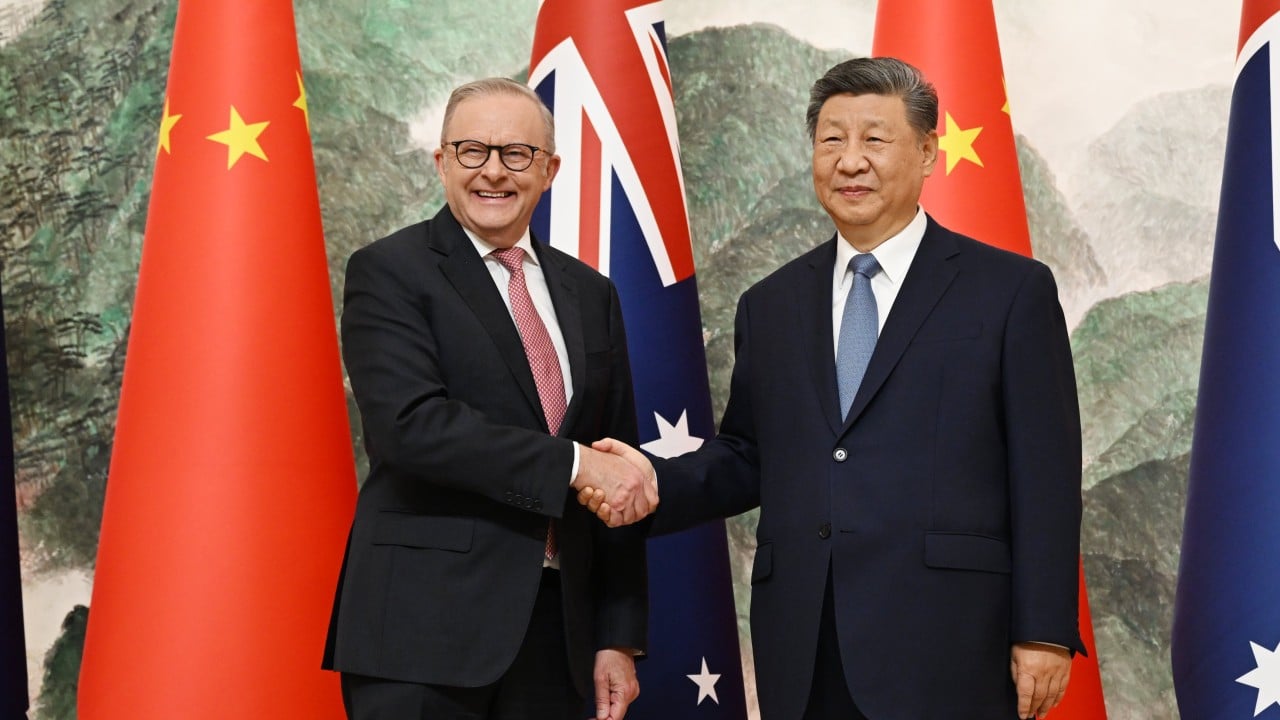
On the surface, these two places share nothing. Yet when Chinese President Xi Jinping sat down with Australian leadership in Shenzhen for bilateral talks, urging a relationship built on mutual trust, the invisible thread connecting the red dirt of Western Australia to the glass towers of Guangdong pulled tight. Recently making news in this space: The Real Reason Nepal PM Balendra Shah Is Heading to India on November 22.
Diplomacy usually reads like an obituary for human interest. News wires spit out phrases like "bilateral mechanisms," "mutually beneficial cooperation," and "regional stability." You read them, your eyes glaze over, and you scroll past. We treat geopolitics as a board game played by distant giants moving wooden pieces across a map.
That is a mistake. Because behind the stiff handshakes in Shenzhen lies a fragile, deeply personal arithmetic that dictates whether a vineyard owner in the Barossa Valley keeps the family farm, whether a university lecture hall in Melbourne stays solvent, and whether two nations bound by geography and economics can step back from the brink of permanent estrangement. More details regarding the matter are covered by The New York Times.
The Weight of a Broken Promise
To understand why the word trust carried so much heavy freight in that Shenzhen meeting room, you have to remember what the silence felt like.
Consider a hypothetical character—let us call him Marcus—who runs a mid-sized rock lobster export operation out of Geraldton, on Australia’s western coast. For fifteen years, Marcus’s business ran on a simple, lucrative clock. Boats hauled pots out of the Indian Ocean before dawn; refrigerated trucks raced the catch to Perth Airport; by dinner the next evening, those lobsters were swimming in tanks inside high-end restaurants in Shanghai and Guangzhou. Marcus mortgaged his house to buy a second boat. He hired four local deckhands. He trusted the permanence of the trade winds.
Then came 2020.
When Canberra called for an independent international inquiry into the origins of COVID-19, Beijing did not respond with a polite diplomatic note. It responded with a sledgehammer. Punitive tariffs and informal bans slammed shut the gates on Australian barley, wine, coal, timber, beef, and Marcus’s rock lobsters. Twenty billion Australian dollars in trade evaporated almost overnight.
Marcus watched millions of dollars of live catch sit on airport tarmacs with nowhere to go. Prices crashed. He sold his second boat at a loss and laid off two of his crew. For three years, the phones stopped ringing.
When diplomatic thaw finally began—slowly, awkwardly, through ministerial meetings in Beijing and Canberra—it felt less like a warm reunion and more like two neighbors who had spent years shouting over a fence cautiously agreeing to repair the latch. By the time Xi Jinping welcomed Australian counterparts to Shenzhen, most of those crushing tariffs had been lifted. Wine was flowing back into Chinese ports. Barley shipments had resumed. Rock lobsters were finding their way back into restaurant tanks.
Yet Marcus still hesitates to take out another loan.
Why? Because tariffs can be erased with the stroke of a pen, while trust erodes like coastline in a storm—fast in the moment, painfully slow to rebuild. When Xi spoke in Shenzhen about anchoring China-Australia relations in mutual trust and looking past differences, he was addressing the exact hesitation keeping business owners from Sydney to Shenzhen awake at night.
Why Shenzhen Matters More Than Beijing
Location in Chinese statecraft is never an accident. Hosting bilateral talks in Shenzhen rather than the solemn, imperial halls of Beijing sends a deliberate, unmistakable signal.
Beijing is the seat of ideology, history, and rigid protocol. Shenzhen is the laboratory of Chinese capitalism. Designated as China’s first Special Economic Zone in 1980 under Deng Xiaoping, it transformed from a quiet border town across from Hong Kong into the beating heart of global hardware, electric vehicles, telecommunications, and green technology. Walk down Huaqiangbei, Shenzhen’s sprawling electronics market, and you can watch prototypes turn into mass-produced consumer goods before lunch.
By bringing Australian leaders to Shenzhen, Xi Jinping framed the relationship around commerce, innovation, and forward momentum rather than historical grievances.
Think of the China-Australia relationship as an old, heavily loaded cargo ship. For years, the hull took on water from security disputes, human rights criticisms, and strategic anxieties over the Pacific. If you try to steer that ship solely by arguing about who caused the leaks, you sink. Shenzhen represents an attempt to fire up the engines—trade, energy transition, clean tech—and hope the forward velocity keeps the vessel afloat.
The numbers explain why neither side can afford to abandon ship. China remains Australia’s largest two-way trading partner by an enormous margin, accounting for roughly a third of Australia’s total global trade. Australian iron ore literally built the skylines of modern China, including the steel skeletons of Shenzhen’s own skyscrapers. In return, Chinese manufacturing supplied Australian households with everything from smartphones to solar panels, keeping inflation lower than it otherwise would have been.
Even during the darkest freeze of diplomatic relations, when ministers refused to take each other’s phone calls, iron ore ships kept steaming north from Port Hedland. The economic gravity between the two countries proved stronger than political hostility.
The Elephant in the Boardroom
Still, pretending that trade alone solves everything would be naive. Honestly, it is hard to look at the geopolitical map of the Indo-Pacific right now without feeling a knot of unease.
Australia is not just a giant quarry and farm selling commodities to Asia. It is a treaty ally of the United States, a member of the Quad alongside Washington, Tokyo, and New Delhi, and a partner in AUKUS—the trilateral security pact designed to equip the Royal Australian Navy with nuclear-powered submarines.
From Beijing’s perspective, AUKUS looks like an American-led containment ring tightening around China’s maritime doorstep. From Canberra’s perspective, China’s rapid military buildup, its assertiveness in the South China Sea, and its expanding security footprint among Pacific Island nations look like direct threats to the open sea lanes Australia depends on for survival.
How do you build "mutual trust" when one side is buying nuclear submarines to deter the other?
You don't. Not completely. And anyone telling you otherwise is selling diplomatic fairy tales.
What you build instead is predictability. In international relations, trust rarely means warmth or shared values. It means knowing where the guardrails are. It means establishing reliable communication channels so that when a naval sonar incident happens in international waters, or when a cyberattack triggers alarms in Canberra, leaders pick up the phone instead of letting nationalist rhetoric spiral out of control.
Xi’s push for a trust-based partnership in Shenzhen is an acknowledgment of that reality. Beijing faces its own domestic headwinds: a sluggish property sector, local government debt, youth unemployment, and intensifying trade friction with both Washington and Brussels. China needs stable, reliable suppliers of critical minerals—lithium, copper, rare earths, iron ore—to power its electric vehicle and renewable energy dominance. Australia holds vast reserves of nearly every one of those minerals beneath its soil.
The Next Frontier Is Green—and Complicated
Look closely at what Shenzhen produces today, and you see the next chapter of this bilateral story taking shape.
Companies headquartered in Shenzhen, like BYD, now dominate the global electric vehicle market. Battery supply chains run straight through the city. Those batteries require lithium, and Australia is the world’s largest producer of raw lithium spodumene.
A decade ago, the relationship was simple: Australia dug up rocks, put them on boats, and China turned them into steel. Today, Canberra wants to move up the value chain, refining critical minerals domestically rather than shipping raw dirt abroad. Meanwhile, Western allies are urging Australia to "de-risk" its supply chains and reduce reliance on Chinese processing facilities, which currently refine the vast majority of the world’s lithium and rare earths.
Imagine the dilemma sitting on the desk of an Australian mining executive right now.
If she partners with a Shenzhen battery giant, she gets immediate capital, unmatched technical expertise, and a guaranteed buyer. If she turns away to satisfy Western security concerns, she risks losing years of market access while competitors lock in contracts. Yet if she leans too heavily on Chinese buyers, she exposes her shareholders to the exact kind of sudden geopolitical freeze that ruined Marcus’s lobster business four years ago.
This is the invisible tension beneath every polite toast in Shenzhen. Both countries are trying to navigate a world where economics and national security have fused together. You can no longer separate the price of lithium from the placement of submarines, or the sale of barley from the alliances of Washington.
Learning to Live With the Paradox
I remember standing on the docks in Fremantle years ago, watching massive container cranes swing overhead like iron giraffes against a bruised evening sky. A retired dockworker leaning against a bollard pointed out toward the horizon and said, "We spend half our time worrying about the ships coming in, and the other half worrying about what happens if they stop."
That single sentence captures Australia’s permanent condition. Geography gave Australia proximity to Asia’s economic engine; history and culture tied it to the Western alliance system. For thirty years after the Cold War, Canberra enjoyed the luxury of never having to choose between its biggest customer and its closest security guarantor.
That era is gone.
The Shenzhen talks do not signal a return to the carefree optimism of the early 2010s, when Australian leaders spoke effortlessly of a "comprehensive strategic partnership" without wondering what happens when strategies collide. Both sides carry scars now. Australian policymakers learned how painfully exposed their exporters were to single-market dependence, prompting a frantic, ongoing push to diversify trade toward Southeast Asia and India. Chinese policymakers learned that economic coercion did not force Canberra to abandon its alliances; instead, it hardened Australian public opinion and accelerated the AUKUS submarine deal.
Strange as it sounds, that mutual bruising might actually make this new phase sturdier than the last.
When relationships are built on illusions, a single shock shatters them. When they are built on clear-eyed realism—an honest recognition of deep ideological differences paired with undeniable economic interdependence—they become harder to break. Stabilizing ties does not mean ignoring human rights concerns, cyber espionage, or regional security disputes. It means refusing to let those disputes burn down the entire house.
The View From the Harbor
Late afternoon in Shenzhen brings a metallic glare off the waters of Shenzhen Bay. Across the narrow stretch of water sits Hong Kong; beyond it lies the open Pacific, carrying bulk carriers heavy with Australian ore south and container ships packed with Chinese electronics north.
Inside the meeting rooms, diplomats carefully weigh every adjective in their joint statements, debating whether to call the relationship "constructive," "stable," or "trust-based." Words matter in diplomacy because they set the boundaries of what is permissible when the next crisis inevitably arrives.
Outside, down on the docks and out in the red dust of the Pilbara, the calculus is much simpler. People watch the ships. They watch the weather. And they wait to see whether promises spoken in air-conditioned halls can survive the next storm out at sea.