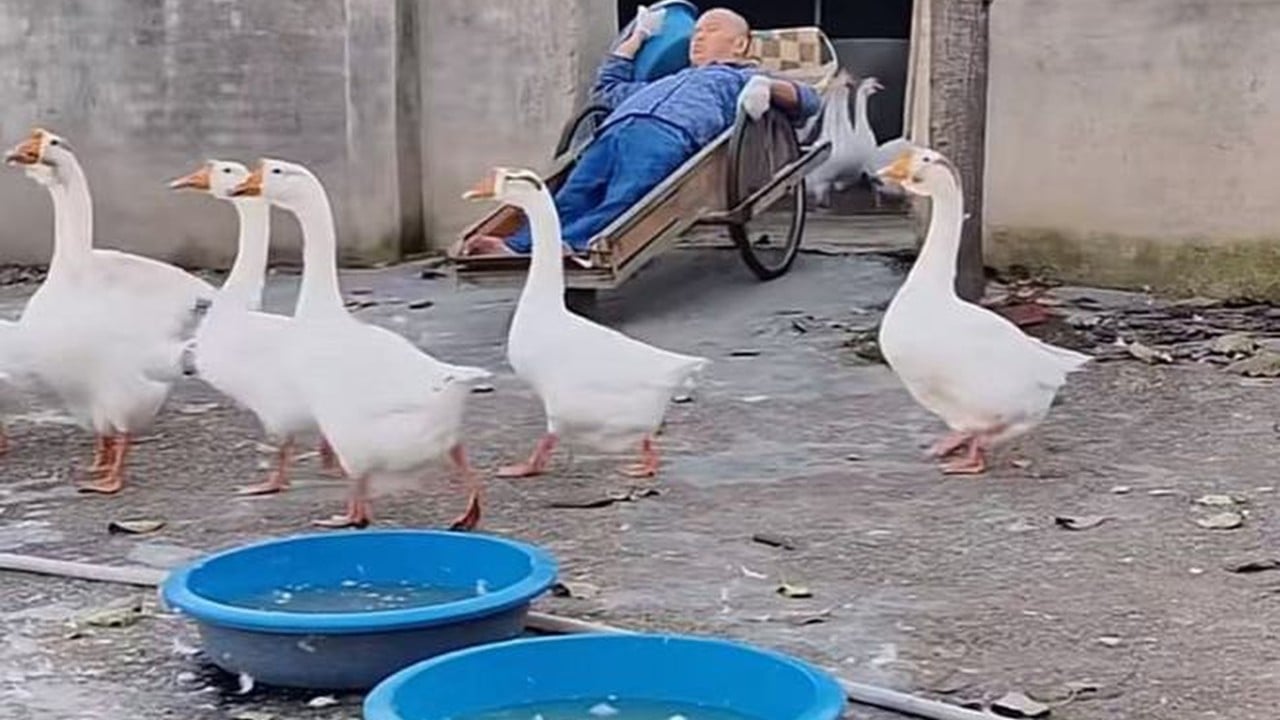
Five hundred geese make a sound like tearing canvas when they decide to run at the same time.
If you have never stood in a wet pasture at five in the morning while a small army of white birds charges toward a plastic trough, you might think of farming as quiet work. It is not. It is loud, relentless, and smells sharply of wet earth, crushed corn, and ammonia. For most people, that sensory overload is a reason to stay inside. For a man sitting in a wheelchair at the edge of a muddy pen in rural China, that noise is the sound of survival.
Wait. Look closer at that image.
When news broke about a paralyzed Chinese man building a thriving goose farm from the ground up, the headlines treated it like a charming curiosity. A human-interest filler piece. Something you read over morning coffee, smile at briefly, and forget by lunch. They called it an "unusual start-up path." They framed it as a heartwarming exception to the rules of modern business.
They missed the point entirely.
What happened in that pasture is not a cute anomaly. It is an indictment of how we design work, how we define disability, and what happens when someone refuses to wait for an economy that was never built to include them.
The Architecture of Exclusion
To understand why a wheelchair-bound entrepreneur in rural China would bet everything on waterfowl, you first have to understand the invisible wall that drops the second a human spine breaks.
I have spent years watching people navigate the aftermath of sudden physical trauma, both in rehabilitation wards and in the sterile offices where disability benefits are calculated. There is a specific kind of silence that settles over a room when a working-age adult realizes their body can no longer perform the tasks the market pays for. First comes the medical crisis. Then comes the financial suffocation.
According to data from the China Disabled Persons' Federation, there are over 85 million people living with disabilities in China today. Millions of them live in rural areas where the economy still runs on muscle, endurance, and standing on two feet for twelve hours a day. In cities, the standard prescription for a paralyzed worker is a desk job—customer service, data entry, or assembly-line piecework where only the hands need to move. In the countryside, even those narrow doors are bolted shut.
Consider a hypothetical worker—let us call him Chen—living in a village three hours outside a major provincial capital. Before an accident on a construction site leaves him paralyzed from the waist down, Chen is the primary earner for four people. Overnight, his income drops to zero. His medical bills climb into the tens of thousands of yuan. The local safety net offers a monthly stipend that barely covers rice, cooking oil, and basic medication.
Now, picture the advice Chen receives from well-meaning relatives and local officials. Rest. Stay inside. Let your aging parents take care of you. Maybe learn to weave baskets or assemble small electronics at home for a few fen per piece.
That advice is a slow death sentence. Not because the work is dishonorable, but because the math does not work. You cannot pay off catastrophic medical debt on five dollars a day. Worse, the psychological toll of being reduced to a dependent—a passive recipient of charity—eats away at a person's will to live faster than any physical ailment.
This is the invisible stake behind the headline. When a paralyzed man starts a farm, he is not chasing a hobby. He is staging a jailbreak.
Why Geese? The Cold Logic Behind an Unlikely Choice
At first glance, choosing poultry farming when you cannot walk sounds like madness. Chickens require constant temperature control, fragile vaccinations, and endless bending over. Pigs are massive, dangerous, and require heavy physical labor to clean and move.
Geese are different.
If you look at agricultural economics through the lens of physical limitation, the domestic goose is a masterpiece of biological engineering. Unlike chickens, which are prone to respiratory diseases and panic easily, geese are tough. They have strong immune systems. They can regulate their own body temperature remarkably well once past the delicate gosling stage. Most importantly, they are grazers.
Think of a flock of geese as a self-propelled harvesting machine.
A traditional crop farmer has to till the soil, plant the seed, weed the rows, harvest the grain, and haul it to market. Every step demands spinal leverage and leg strength. A goose farmer, by contrast, manages grass and water. Geese eat weeds, grass, and simple grain mixes. They walk themselves out to pasture in the morning and walk themselves back to the shelter at dusk. They require less concentrated, expensive feed than almost any other commercial livestock, which keeps startup capital low—a critical factor when banks refuse to lend money to someone without a steady paycheck.
Still, biology only solves half the problem. Gravity remains undefeated.
Mud is the natural enemy of the wheelchair. Standard hospital-grade chairs sink within inches on soft ground, their small front casters jamming into ruts while the rear tires spin uselessly in wet clay. To run a farm from a seated position, you have to redesign the terrain—or redesign the machine.
In the real-world cases emerging from rural provinces like Anhui, Henan, and Sichuan—where disabled farmers have quietly built profitable cooperatives over the last decade—success almost always comes down to relentless, unglamorous adaptation. Concrete pathways laid narrow enough to save money, wide enough for two wheels. Feeding troughs mounted at thirty-two inches off the ground so bags of corn can be slid rather than lifted. Water lines fitted with simple lever valves instead of twist knobs that demand upper-body torque.
It is messy. It breaks down. Wheels snap axles in freezing mud. Rain turns a manageable courtyard into a swamp where every ten feet of movement leaves the shoulders burning like fire.
There is nothing romantic about dragging yourself across wet concrete at dawn because a drainage pipe clogged during a thunderstorm. Anyone who tells you otherwise has never had to clean grease and manure off their own hands before eating breakfast.
The Economics of Stubbornness
Let us talk about money, because sentiment does not buy feed.
A single commercial meat goose in China reaches market weight in roughly seventy to ninety days. Depending on the breed—such as the prolific Wanxi white goose or the heavy Lion-head goose—a mature bird weighs between four and six kilograms. In regional wholesale markets, live geese regularly fetch between 18 and 26 yuan per kilogram, with peak demand driving prices higher around festivals.
Do the math on a modest flock of five hundred birds.
Even after accounting for gosling purchase costs, supplemental grain, vaccines, and a realistic mortality rate of five to eight percent, a single three-month cycle can generate several thousand yuan in net profit. Run three or four cycles a year, add revenue from goose eggs—which command a premium in local markets—and suddenly the paralyzed farmer is out-earning the able-bodied factory workers in the nearest industrial park.
More than that, he becomes an employer.
This is the part of the story that rarely makes the evening news. When a disabled entrepreneur scales an agricultural operation past the five-hundred-bird mark, he inevitably hires neighbors to help with the heavy lifting—loading crates onto trucks, hauling bulk feed sacks, repairing fencing. The power dynamic in the village flips entirely. The man people pitied two years ago is now signing their paychecks.
I remember speaking with an agricultural extension officer years ago who had worked with rural disability cooperatives. He told me something I have never forgotten: "Able-bodied young men leave the villages for the cities because farming feels like a dead end to them. Disabled men stay because they have nowhere else to go. Because they stay, they pay attention. They notice when a bird's droppings look slightly off. They watch the weather. They become better farmers than the people who ran away."
Attention is an asset that requires no legs.
The Myth of the Inspiring Exception
Here is where we need to be brutally honest about the danger of stories like this.
Society loves a hero in a wheelchair. It makes us feel good to clap for the individual who conquers impossible odds through sheer grit. The danger is that we use the exception to excuse the system. We point at one man raising geese in the mud and say, "See? Anyone can make it if they just try hard enough."
That is a lie. And it is a cruel one.
For every paralyzed farmer who manages to turn a profit, dozens more fail quietly behind closed doors. They fail because an unseasonable cold snap wipes out three hundred goslings overnight. They fail because a middleman cheats them on weight at the wholesale market, knowing the farmer cannot physically follow the truck to the scales. They fail because rural e-commerce logistics—the very thing supposed to connect remote farms to wealthy city buyers—still charge prohibitive cold-chain shipping fees for small producers.
Starting an agricultural business with a spinal cord injury is not a level playing field. It is climbing a mountain with a fifty-pound pack while everyone else takes the ski lift.
Yet, despite the brutal odds, a quiet shift is happening across rural Asia. Disabled entrepreneurs are increasingly bypassing local middlemen altogether. Armed with nothing more than a smartphone mounted to a wheelchair armrest, they are livestreaming their farms directly to urban consumers on platforms like Douyin and Kuaishou.
Think about what that changes.
In a traditional wholesale market, the buyer holds all the cards. On a livestream, the story is the product. City dwellers exhausted by food safety scandals and anonymous supermarket packaging watch a farmer roll through green grass surrounded by healthy, noisy birds. They see what the geese eat. They see the clean water. They see the calluses on the farmer's hands. Trust forms in real time, and orders flow directly from Shanghai and Beijing apartments to a mud-splattered courtyard in the interior.
What We Get Backward About Work
We spend billions of dollars globally talking about workplace inclusion, ergonomic accommodations, and accessible corporate pathways. Usually, that conversation stays trapped inside glass office towers. We assume that inclusion means fitting disabled bodies into existing white-collar boxes.
A goose farm in rural China proves the opposite. True inclusion happens when people are given capital, land access, and the freedom to build an enterprise around the body they actually have—not the body a human resources manual wishes they had.
It is an uncomfortable truth for policymakers. Micro-loans for disabled rural entrepreneurs consistently show higher repayment rates than standard rural credit programs, largely because the borrowers cannot afford to default; their reputation in the village is their only collateral. Yet securing a fifty-thousand-yuan agricultural loan without physical property to mortgage remains an administrative nightmare.
The paralysis is rarely in the spine. Most of the time, it is in the imagination of the institutions holding the money.
Dusk in the Pasture
Return for a moment to that wet pasture as the sun drops behind the ridge.
The frantic energy of the morning is gone. The feed troughs are scraped clean. Five hundred white birds are settling down for the night, their low, rhythmic muttering blending with the sound of crickets starting up in the tall grass along the drainage ditch.
The farmer sits at the edge of the concrete path, wiping mud from the steel rims of his wheels with a rag. His shoulders ache. His lower back—the part he can still feel—throbs with a dull, persistent heat. Tomorrow morning at four-thirty, the alarm will ring, the frost will be back on the grass, and the whole exhausting cycle will start over again.
He does not look like a corporate pioneer. He does not have a business card, a pitch deck, or a five-year growth projection printed on glossy paper.
He has five hundred geese, a ledger book stained with rain, and a family that eats because he refused to disappear.