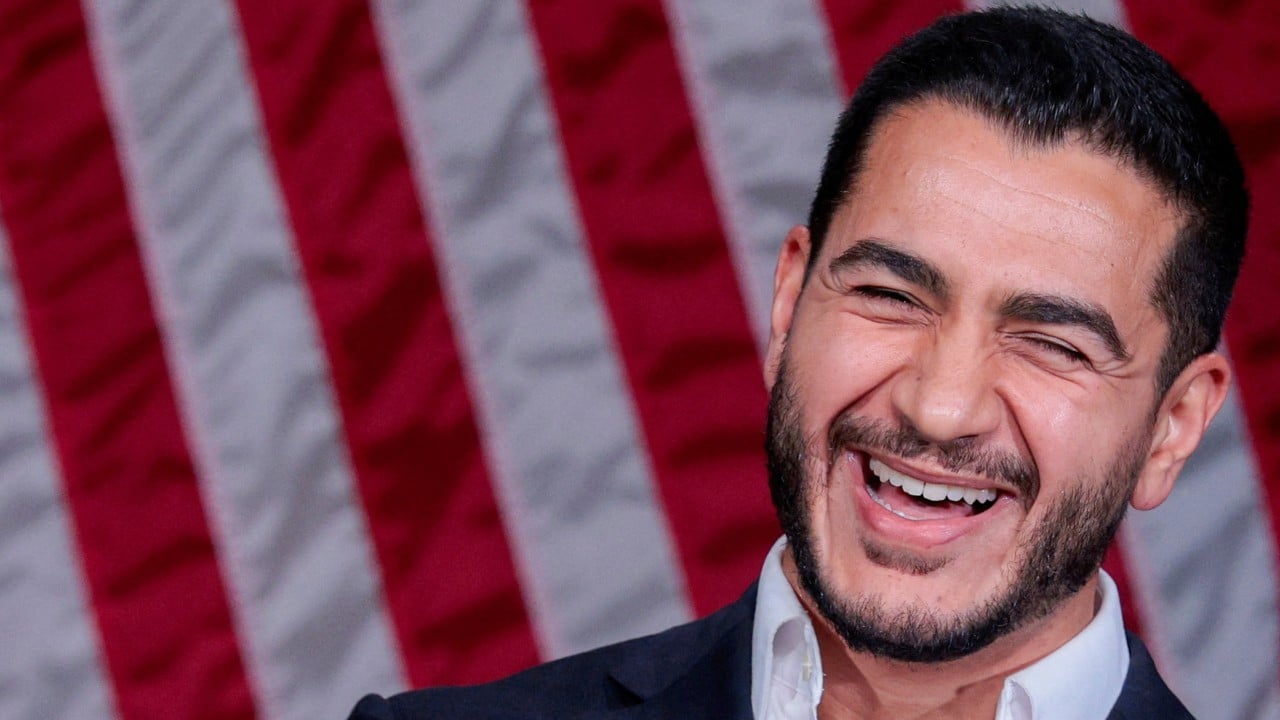
One word. Two syllables. A breath of warm air pushing back against years of cold political frost.
When Abdul El-Sayed, the former Detroit health director and progressive political figure, stepped into the digital crossfire to address J.D. Vance and his ideological allies, nobody expected a linguistic judo flip. Politics in the American Midwest usually sounds like steel grinding against concrete. It is sharp. It is defensive. It is calculated to wound without leaving fingerprints. Yet, when El-Sayed looked at the rhetoric aimed at his community and responded with a casual, pointed "J.D., habibi," something shifted in the atmosphere of Michigan. Discover more on a related issue: this related article.
Laughter.
Not the nervous chuckle of a crowd trying to defuse a bomb, nor the bitter sneer of partisan tribalism. It was the deep, belly-aching relief of millions of Arab Americans who had spent two decades watching their native tongue get weaponized on cable news. More journalism by NPR highlights similar perspectives on this issue.
To understand why three syllables sent shockwaves from Dearborn coffee shops to Washington campaign war rooms, you have to sit at a kitchen table in Southeast Michigan. Imagine—purely as a composite of thousands of real households across Wayne County—a family gathering on a Sunday afternoon. The smell of cardamom coffee hangs heavy in the air, mingling with the sharp tang of sumac and warm pita. For years, when the television in the corner flickered with political debates, the language spoken at that table was treated like contraband in the public square. Arabic words on broadcast networks were almost exclusively reserved for chyron graphics about distant conflicts, security threats, or cultural anxieties.
Habibi means "my love" or "my dear." In the Levant, in Egypt, across the sprawling diaspora from Beirut to Metro Detroit, it is the linguistic glue of daily life. A grandmother says it to a toddler scraping a knee. A frustrated mechanic mutters it to a rusted bolt that refuses to turn. A friend uses it to tell you, gently, that you are completely out of your mind.
When El-Sayed aimed that word squarely at J.D. Vance—a politician whose brand is built on rugged, populist grievance and sharp cultural demarcations—he didn't just mock an opponent. He hijacked the entire framing of American political combat.
The Anatomy of Linguistic Disarmament
Political insults usually follow a predictable architecture. You attack a rival’s competence, question their patriotism, or mock their origins. This style of warfare requires both sides to agree on the rules of engagement: loud, angry, and perpetually outraged.
El-Sayed refused to sign the contract.
By calling Vance habibi, the Michigan Democrat deployed what linguists call "pragmatic inversion." Think of it like a seasoned aikido master stepping aside just as a heavyweight charges forward, using the attacker's own momentum to send them sprawling onto the mat. If you scream at a bully, you validate their power. If you pat them on the cheek and call them sweetheart in a language they historically treat with suspicion, you strip away their armor in front of the entire room.
I remember the first time I heard an Arabic word spoken aloud in a high school hallway in the early 2000s without someone flinching. It was a small, mundane moment—a boy dropping his binder and muttering under his breath—yet the sudden silence around him felt heavy, like waiting for thunder after a flash of lightning. For an entire generation of Arab Americans, code-switching wasn't just a social habit; it was a survival mechanism. You kept the warmth of your culture behind closed doors and wore a neutral, unaccented mask the moment you stepped onto the sidewalk.
That history is the invisible weight behind El-Sayed’s viral moment.
Michigan is home to one of the largest, most politically consequential Arab American populations in the United States. For decades, politicians treated this bloc either as a convenient photo opportunity during election years or as a demographic puzzle to be managed from a safe distance. Even well-meaning allies often approached the community with stiff, overly formal reverence, walking on eggshells around cultural nuances they barely understood.
El-Sayed, the son of Egyptian immigrants, a Rhodes Scholar, and a physician who rebuilt Detroit’s health department from the ashes of municipal bankruptcy, didn't need a translator. He knew that in Arab culture, the most devastating takedown isn't a scream. It is pity wrapped in affection.
When you tell someone "habibi" in the middle of an argument, you are subtly saying: Bless your heart. You clearly don't know what you're talking about, and I don't even have the energy to be mad at you.
Why the Joke Landed Harder Than a Policy Paper
Consider what happens when political rhetoric gets trapped in the mud of fear. During heated election cycles, immigration, national identity, and foreign policy become blunt instruments. Politicians like J.D. Vance have mastered the art of framing cultural shifts as existential threats to the American heartland. Their language is urgent, apocalyptic, and designed to make voters feel as though the ground beneath their feet is eroding.
Against that backdrop, a traditional policy rebuttal feels like bringing a spreadsheet to a street fight. Voters exhausted by endless doom-scrolling rarely stop to read a four-point white paper on demographic integration or constitutional protections. They scroll past. They tune out. They numb themselves against the noise.
Humor, however, bypasses the brain's defensive walls.
The moment "J.D., habibi" hit social media feeds, the digital reaction among Arab Americans and their neighbors was instantaneous. Group chats lit up across Dearborn, Hamtramck, and Ann Arbor. Memes proliferated within hours. People who had grown deeply cynical about both major political parties—bruised by foreign policy disappointments and tired of feeling politically homeless—suddenly felt seen in a way no campaign slogan had ever managed.
Why? Because authenticity cannot be manufactured by a focus group.
If a team of Washington consultants had sat in a windowless conference room trying to brainstorm a way to humanize a candidate and needle an opponent, they would have produced something cringe-inducing. They would have over-explained the joke. They would have added a disclaimer. El-Sayed’s delivery worked precisely because it was effortless, unvarnished, and deeply rooted in who he actually is. He spoke as a Michigander who happens to speak Arabic, refusing to sanitize his identity to make conservative pundits comfortable.
There is a vulnerability in doing that. Stepping onto a national stage and using your heritage as a scalpel carries real risk. Critics immediately seize on any departure from standard political English as proof of "otherness." They try to turn a joke into a scandal, framing cultural confidence as disrespect.
Yet the gamble paid off because the cultural ground beneath American politics is shifting faster than traditional gatekeepers realize.
The Power of Refusing to Be Afraid
Look closely at the mechanics of modern political intimidation. It relies entirely on your willingness to accept the villain role written for you. When opponents cast immigrants, minorities, or progressive reformers as dangerous outsiders, they expect you to spend all your oxygen proving you are harmless. You end up defending your right to exist rather than challenging their vision for the country.
El-Sayed flipped the script by refusing to play defense.
By using a term of endearment to dismantle his foes, he claimed total ownership of the room. He signaled that Arab Americans are not guests nervously waiting for permission to speak at the American table; they are hosts, neighbors, doctors, and leaders who are entirely comfortable in their own skin.
This resonates far beyond the borders of Michigan or the specific boundaries of the Arab diaspora. Every community that has ever been told to tone it down, smooth out its edges, or leave its history at the door recognized the electricity in that exchange. Whether it is a Southern Baptist saying "bless your heart," a Yiddish speaker offering a dry, knowing sigh, or a Detroit native dropping Arabic into a national political spat, the message is identical: We are not intimidated by you.
Admittedly, a viral catchphrase does not pass legislation. It does not lower the cost of groceries in Flint, fix potholes on I-94, or resolve the deep, agonizing policy rifts that have fractured coalitions across the Midwest. Anyone claiming a single joke can heal decades of political polarization is selling snake oil. Voters in Michigan are notoriously pragmatic; they care about wages, healthcare, clean water, and foreign policy outcomes that affect their families overseas.
Still, symbols matter because they dictate who feels empowered to fight for those outcomes in the first place.
Before people can organize, canvas, or demand accountability from their leaders, they have to shed the exhausting weight of feeling like outsiders. Joy is a political fuel that cynical operators never know how to counter. You can attack an angry opponent. You can smear a defensive opponent. You cannot easily defeat an opponent who is laughing at your bluster while offering you a metaphorical cup of tea.
The Echo Across the Table
Think back to that Sunday afternoon kitchen in Wayne County. The coffee pot is empty now, leaving dark, swirling patterns of grounds at the bottom of tiny porcelain cups. The television is still murmuring in the corner, the pundits still shouting their rehearsed lines about cultural decline and political warfare.
Only this time, nobody at the table looks tense. Someone repeats the clip on their phone, the tinny audio cutting through the clatter of dishes, and the room erupts all over again. A younger cousin, born and raised in Michigan, says the word aloud—not in a whisper, not tucked away for private family moments, but bright and unapologetic, ringing out like a bell.
Outside, the Michigan wind rattles the windowpanes, carrying the chill of an approaching winter, while inside, the air stays warm, thick with the scent of cardamom and the quiet, unmistakable sound of people who have finally stopped apologizing for taking up space.