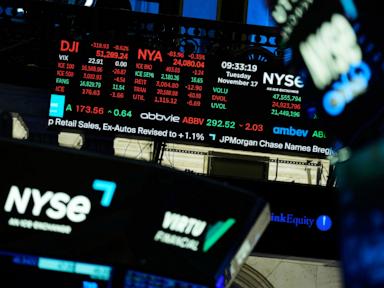
At 4:15 in the morning, before the sun has even thought about cresting the Hudson River, the blue light of a triple-monitor setup is already washing over Arthur’s face.
Arthur is not a Wall Street titan. He doesn't wear custom-tailored pinstripes or bark orders across a mahogany trading floor. He is a fifty-eight-year-old retired high school history teacher living in a modest colonial outside of Albany, New York, sipping lukewarm black coffee from a chipped ceramic mug. Yet, every morning before dawn, Arthur stares at a glowing green and red ticker tape of US stock futures with the intensity of a bomb disposal expert watching a countdown clock.
Yesterday, Arthur lost eleven thousand dollars on paper before he finished his toast. The culprit wasn't a sudden war, a banking collapse, or a spike in oil prices. It was a single silicon wafer designed in Santa Clara, California.
Today, the numbers on Arthur’s screen are flickering green again. US futures are pointing higher, dragged upward by the sheer gravitational pull of a rebound in Nvidia.
To the financial wire services, this is a routine headline. Four words of market shorthand. Nvidia rebounds; futures rise. A dry, mechanical update meant to be skimmed and forgotten before the opening bell rings at 9:30 AM.
They are missing the real story. Because when a single semiconductor company catches a cold, millions of people like Arthur reach for the medicine cabinet—and when that company catches its breath, the entire global economy exhales. We have quietly entered an era where the retirement accounts of teachers, firefighters, and nurses are tethered to the violent mood swings of artificial intelligence infrastructure. Understanding why US futures hinge on a rebound for Nvidia isn't just about reading a stock chart. It is about understanding the fragile, beating heart of modern wealth.
The Weight of a Single Giant
Walk down any suburban street in America and ask ten people what a graphics processing unit does, and nine of them will shrug. Yet, those ten people almost certainly own a piece of the company that makes them.
Through target-date retirement funds, S&P 500 index trackers, and pension allocations, the average working adult is more exposed to the fortunes of mega-cap tech than at any point in financial history. For decades, market wisdom preached diversification. Do not put all your eggs in one basket, the textbooks warned. Spread your risk across railroads, steel, consumer staples, healthcare, and banking. If Detroit stumbled, Wall Street leaned on Houston. If retail slumped, pharmaceuticals picked up the slack.
That safety net has quietly frayed.
Over the past few years, the sheer scale of the artificial intelligence buildout has warped the geometry of the American stock market. Because major indexes like the S&P 500 are weighted by market capitalization—meaning the biggest companies carry the heaviest votes—a handful of technology behemoths now dictate the direction of the entire market. And standing at the center of that small circle, holding up the roof like a silicon Atlas, is Nvidia.
Consider a hypothetical scenario to picture how this actually works. Imagine a tug-of-war match with five hundred people on one side, representing the five hundred companies in the benchmark index. On the other side stands the daily uncertainty of inflation, interest rates, and global trade. Normally, if one person on the five-hundred-person team slips in the mud, the rope barely twitches. The other four hundred and ninety-nine dig their heels in and hold the line.
Now, imagine that one of those five hundred participants suddenly grows to the size of a freight train, weighing as much as two hundred of their teammates combined. When that giant stumbles backward, the rope rips through the hands of everyone else. When that giant plants its feet and surges forward, the entire line lurches ahead, even if half the team is still sitting on the ground.
That freight train is Nvidia.
When pre-market futures—those overnight contracts where institutional investors bet on where the market will open—start climbing because Nvidia shares are bouncing back from a sell-off, it is not merely a tech story. It is a systemic relief valve opening. It tells every pension manager in Chicago, every algorithmic trading desk in London, and every nervous retiree in Albany that the engine of market growth has not stalled.
What Happens in the Dark
To understand why these pre-market rebounds feel so dramatic, you have to look at what happens when the New York Stock Exchange closes its doors at 4:00 PM.
The market does not sleep; it simply moves into a smaller, darker room. After-hours and overnight futures trading operate with far less liquidity than the regular session. Fewer buyers and sellers are at the table. In that quiet, thin air, a single rumor about supply chain bottlenecks in Taiwan, a delayed shipment of liquid-cooled server racks, or a cautious remark from a cloud-computing executive can send shockwaves through the order books.
I remember sitting at a trading desk in lower Manhattan during the autumn of 2008, watching futures plummet limit-down in the middle of the night while the rest of the city slept peacefully. Back then, the fear was existential—we wondered if ATMs would still dispense cash by Friday. The anxiety today is different, quieter, yet strangely disorienting. We are no longer worried that the banks will vanish; we are worried that the future we priced into our portfolios might arrive six months late.
Yesterday’s dip in Nvidia was a textbook example of this modern nerves-of-steel test. Investors, jittery over valuations that have stretched into the trillions, began asking uncomfortable questions. Are the massive tech giants spending too much on AI data centers without seeing immediate profits? Could export restrictions choke off overseas demand? When fear takes the wheel, algorithms do not pause to debate philosophy. They sell first and ask questions at lunch.
The sell-off cascaded across the semiconductor sector. Chipmakers from Amsterdam to Seoul felt the tremor. By the time the closing bell clanged, billions of dollars in paper value had evaporated.
Then came the overnight shift.
As Asian markets digested the drop and European traders stepped up to their terminals, bargain hunters began running the numbers. The underlying reality hadn't changed overnight. The world's largest cloud providers—Microsoft, Alphabet, Amazon, Meta—were still locked in an existential arms race to build massive clusters of computing power. None of them could afford to blink. If one paused their hardware orders, they risked falling irreversibly behind in the race to build next-generation artificial intelligence.
In the cold light of 3:00 AM, the math reasserted itself. Demand for Nvidia’s flagship architectures remained backlogged for quarters. The panic began to look less like a structural collapse and more like a routine bout of altitude sickness. Buyers stepped in. Nvidia’s shares ticked up in pre-market trading—first by half a percent, then by two, then by three.
Instantly, the S&P 500 futures contracts flipped from red to green. Nasdaq futures surged. The narrative shifted before most Americans had even hit the snooze button on their alarms.
The Invisible Stakes of the Silicon Cycle
It is easy to dismiss all of this as a high-stakes casino game played by people who stare at flickering numbers for a living. That cynicism is understandable, especially when financial news reads like sports commentary for billionaires.
Yet, the invisible stakes reach straight into the physical world we inhabit.
Think about what a sustained downturn in semiconductor confidence actually triggers. Capital expenditure—the billions of dollars companies spend on physical equipment, factories, and research—runs on confidence. When Nvidia’s stock rebounds and stabilizes broader market futures, it validates the massive capital cycle currently reshaping the industrial landscape.
Across the American Midwest and Southwest, billions of dollars are pouring into concrete, copper, and steel. New fabrication plants are rising out of desert scrubland in Arizona and farmland in Ohio. Electrical grids are being upgraded to handle the staggering power requirements of hyperscale data centers. Local electricians, pipefitters, civil engineers, and cooling-system technicians are working overtime because Wall Street continues to greenlight the financing for this infrastructure.
When the market loses faith in the flagship chipmaker, the cost of capital rises across that entire ecosystem. Startups building medical diagnostic tools, autonomous logistics software, or climate-modeling systems suddenly find venture capitalists tightening their purse strings. Corporate boards delay expansion plans.
Conversely, when futures rally on the back of a semiconductor rebound, it acts as a green light for risk-taking across the broader economy. It signals that institutional money still believes the productivity gains promised by artificial intelligence are real, durable, and worth funding.
The Trap of the Rearview Mirror
Still, if you ask Arthur—or any seasoned investor who has survived more than two market cycles—whether a green screen at 6:00 AM guarantees smooth sailing, you will get a wry, tired laugh.
Pre-market futures are notoriously fickle narrators. Because volume is light before the opening bell, early gains can evaporate within fifteen minutes of the 9:30 AM open once millions of retail orders and institutional rebalancing trades hit the floor. Relying on overnight futures to predict the health of the economy is a bit like judging the weather for an entire summer by looking out your window at dawn. You might see clear skies, only to get drenched by a thunderstorm before noon.
There is also a deeper psychological trap baked into our obsession with these daily swings.
When a single stock becomes the barometer for the entire market, investors develop tunnel vision. They stop paying attention to the quieter, less glamorous corners of the economy that actually employ the majority of Americans. While everyone watches Nvidia’s pre-market ticks, crucial signals in consumer credit delinquencies, small-business hiring, manufacturing output, and commercial real estate can slip right past unnoticed.
History offers plenty of warnings about markets that lean too heavily on a single pillar. In the late 1990s, networking hardware giant Cisco Systems occupied a remarkably similar throne. Cisco built the routers and switches that made the early internet possible. Every time internet traffic doubled, Cisco’s stock surged, dragging the Nasdaq higher with it. Investors convinced themselves that buying Cisco at any price was a one-way ticket to prosperity, because the internet was undeniably changing the world.
They were right about the internet. It did change the world. Yet, when corporate spending finally paused to digest all that newly installed hardware in 2000, Cisco’s stock lost more than eighty percent of its value, and it took the broader tech index fifteen years to reclaim its peak.
The lesson isn't that Nvidia is destined to repeat Cisco’s exact trajectory—today’s AI leaders generate vastly more cash flow and carry far stronger balance sheets than the dot-com darlings of 1999. The lesson is that even revolutionary technologies move in waves, never in straight lines. Markets, however, hate waves. Markets demand relentless, linear perfection. Any hint that growth might slow from blistering to merely extraordinary is treated like a betrayal.
Navigating the Noise Without Losing Your Nerve
So where does that leave someone sitting at a kitchen table, watching the morning news flash bright green arrows next to the Dow and the S&P 500?
First, it requires separating the signal from the theater. A rebound in Nvidia lifting US futures tells you one clear, factual thing: institutional buyers saw yesterday’s drop as an overreaction and decided the risk-reward ratio favored stepping back in before the opening bell. It reflects a temporary triumph of greed—or rather, fear of missing out—over fear of overvaluation.
Second, it serves as a quiet reminder to look under the hood of your own financial life. Most people believe they own a balanced cross-section of the American economy because they hold a standard index fund. In reality, they own a heavily concentrated bet on artificial intelligence infrastructure, software platforms, and digital advertising, with a thin veneer of banks, retailers, and manufacturers painted underneath.
Knowing that doesn't mean panicking and stuffing cash under a mattress. Missing out on the compounding power of technological breakthroughs is one of the surest ways to fall behind inflation over decades. Instead, it means understanding why your account balance jumps two percent on a Tuesday morning when you haven't bought or sold a single share. When you know the mechanics behind the movement, the volatility loses its power to terrify you.
Back in Albany, the sky outside Arthur’s window is finally turning from charcoal to a pale, wintry gray. The clock on his microwave ticks over to 9:28 AM.
On his center monitor, the pre-market gains have held steady. Nvidia is up nearly four percent before a single regular-session share has changed hands. The S&P 500 futures are glowing a reassuring emerald green, promising to erase at least half of yesterday’s bruised pride within seconds of the opening bell.
Arthur takes a slow sip of his now-cold coffee, reaches over to the corner of his desk, and clicks the power button on his main display, turning the flickering numbers off. He stands up, stretches his back, and walks toward the front door to grab his heavy coat. He has a nine-thirty tee time at the driving range with his brother, and the sun is finally out.
Down in Manhattan, the brass bell is about to ring, unleashing billions of dollars of automated fury across fiber-optic cables buried beneath the asphalt. Millions of screens will flash, fortunes will shift by decimals, and anchors will breathlessly narrate every twitch of the silicon giant. Out in the crisp morning air, the gravel crunches beneath Arthur’s boots as he walks to his car, leaving the machines to argue with themselves until dinner.