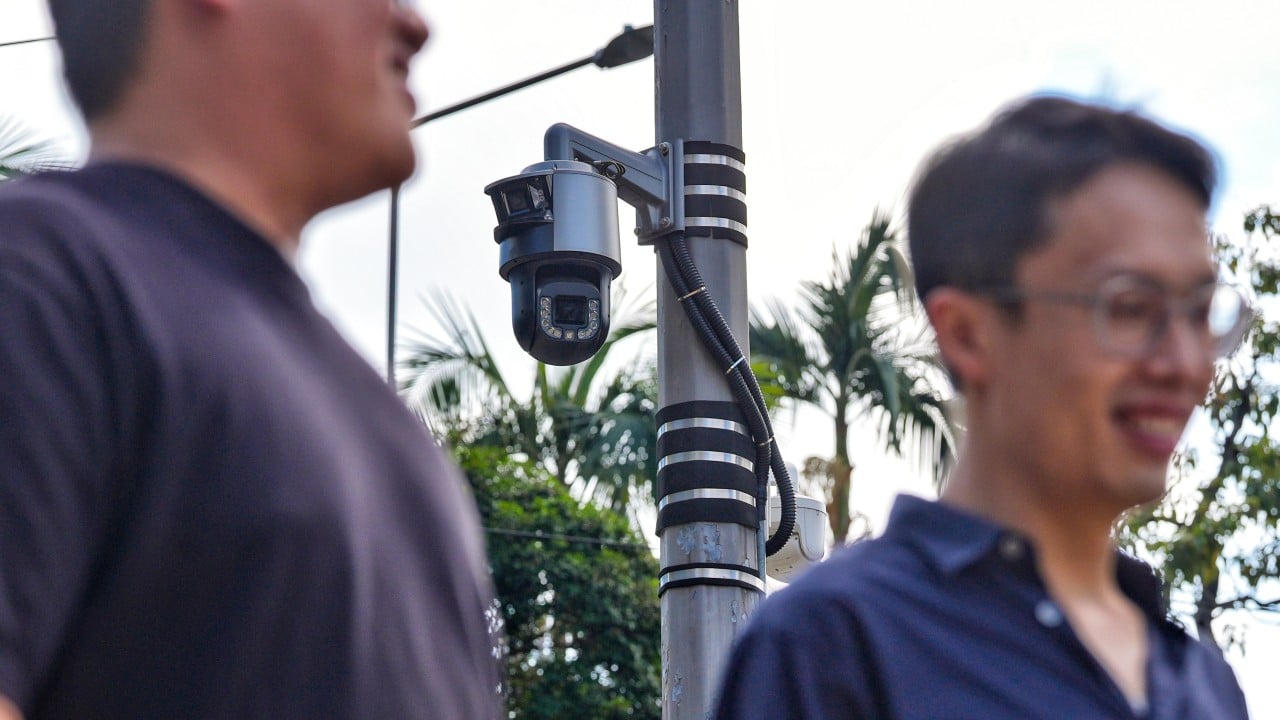
The rain in Mong Kok does not fall so much as it hangs, thick and warm, smelling of wet concrete, roasted chestnuts, and diesel exhaust.
Stand on the corner of Nathan Road at six in the evening. Look up. Beneath the tangle of neon and the towering concrete balconies of aging apartment blocks, small white domes sit tucked under metal eaves. They do not blink. They do not whir. For years, they were simply passive glass eyes recording blurry footage onto distant hard drives, reviewed only after a crime had already been committed. Discover more on a related topic: this related article.
Not anymore.
Hong Kong police are preparing to activate artificial intelligence facial recognition across the city’s sprawling surveillance network. On paper, it reads like a routine municipal software upgrade—a bureaucratic shift from analog recording to automated identification. In practice, it marks the quiet transformation of an entire metropolis into a searchable database of human faces. Additional analysis by Wired delves into related views on the subject.
The Weight of Being Seen
To understand what happens when a city learns to recognize every face in a crowd, consider a hypothetical morning commute.
Meet Mei, a twenty-eight-year-old graphic designer living in Kowloon. Mei has never broken a law. She pays her taxes, calls her mother on Sundays, and complains about the humidity. On Tuesday morning, she walks out of her building, steps onto the pavement, and heads toward the MTR station.
Before she even taps her Octopus card at the turnstile, a camera mounted three meters above a convenience store captures her likeness. Within milliseconds, algorithms map the geometry of her face—the distance between her eyes, the curve of her jawline, the depth of her eye sockets—converting her physical identity into a string of mathematical coordinates. That digital fingerprint is instantly cross-referenced against watchlists, police databases, and movement logs.
Mei feels nothing. There is no flash of light, no audible click, no friction in her step.
Yet the fundamental contract between a citizen and the street has just been rewritten. For centuries, walking through a dense city offered a peculiar kind of freedom—the liberty of the crowd. You could be surrounded by ten thousand strangers and remain entirely invisible. Automated surveillance dissolves that anonymity. The crowd ceases to be a refuge and becomes a sorting mechanism.
When I first stood beneath the early installations of smart lampposts in Kowloon Bay a few years back, the hardware looked almost underwhelming. Just grey poles and modest lenses bolted to steel brackets. Residents walked past them staring at their phones, entirely indifferent. That is the trick of modern infrastructure. It does not arrive with sirens or concrete walls. It arrives silently, disguised as convenience, safety, and civic modernization.
How a Camera Learns to Remember
To grasp the mechanics behind the Hong Kong police rollout, strip away the science-fiction glamour. AI facial recognition is not magic, nor is it infallible human intuition scaled up. Think of it instead like a tireless clerk sorting millions of passport photos at superhuman speed, armed with a ruler and a checklist.
Traditional closed-circuit television acted like a tape recorder. If a robbery occurred at 2:00 PM, detectives had to pull the footage, sit in a room, and scrub through hours of video with their own eyes, hoping to spot a suspect. The camera was dumb glass.
Artificial intelligence changes the sequence entirely. Instead of recording first and searching later, the system analyzes live video feeds in real time. Software detects a human face inside the frame, isolates it from the background noise of passing buses and umbrellas, normalizes the lighting, and extracts a biometric template.
Hong Kong authorities have spent recent years rapidly expanding the physical hardware needed to feed this software. Following the launch of an ambitious citywide CCTV installation program in 2024—which began by placing thousands of new cameras across high-crime and high-foot-traffic districts—officials signaled plans to scale the network toward tens of thousands of lenses by 2027. For months, officials maintained that the cameras lacked facial recognition capabilities, serving only as standard recording devices.
Now, the software layer is catching up to the hardware. By integrating AI analytics into existing and newly installed cameras, the police force shifts from reactive investigation to real-time tracking.
The Architecture of Assurances
Whenever a government introduces biometric tracking at this scale, the official justification follows a familiar, reassuring script. Authorities in Hong Kong emphasize public safety, crime prevention, and operational efficiency. They point to missing elderly residents suffering from dementia who can be located before they wander into danger. They highlight fugitives caught in crowded transit hubs, stolen vehicles traced across districts, and violent offenders apprehended before they can strike again.
These are not fabricated benefits. In a city of over seven million people packed into steep vertical neighborhoods, policing is genuinely complex. When an eighty-year-old grandfather disappears into the labyrinth of Sham Shui Po, speed saves lives. An algorithm that scans ten thousand faces a minute can do in seconds what would take a precinct of officers three days.
Officials also stress guardrails. They point to Hong Kong’s Personal Data (Privacy) Ordinance, insisting that footage is encrypted, access is strictly logged, and data is purged after set retention periods unless tied to an active criminal investigation.
I want to believe those guardrails hold. Truly. The promise of a safer city, stripped of street crime and swift in emergencies, carries an undeniable pull.
Yet history teaches us a stubborn lesson about surveillance architecture: capabilities almost always outlive the promises that justified their creation. Once the fiber-optic cables are laid, the servers cooled, and the neural networks trained, expanding the rules of who gets watched requires nothing more than a keystroke in an administrative office. No new cameras need to be bolted to walls. No public debate needs to be re-opened. The infrastructure is already humming in the dark.
The Ghost in the Algorithm
There is another problem, quieter and more technical, that rarely makes it into press releases. Algorithms make mistakes.
Facial recognition systems do not deal in absolute certainty; they deal in probability scores. When a camera flags a face on a rainy street in Causeway Bay, the software is not saying, This is the suspect. It is saying, There is an 87 percent mathematical similarity between this face and a reference photo.
Everything depends on where human operators set the threshold—and how blindly they trust the machine.
Consider what happens when a system trained primarily on well-lit, front-facing mugshots encounters real life. Real life is messy. People wear surgical masks, which remain common across Hong Kong long after the pandemic faded. They tilt their heads down against gusts of wind. Neon signs cast magenta and cyan shadows across cheekbones. Rain streaks the lens.
Under those conditions, false positives multiply. An innocent commuter shares a passing structural resemblance to someone on a watchlist. Suddenly, police officers intercept a bewildered citizen on a subway platform, demanding identification, searching bags, holding them in public view while commuters hurry past with averted eyes.
Even when the mistake is resolved ten minutes later, the damage lingers. You begin to carry yourself differently when you know a mathematical miscalculation could trigger a confrontation at any moment. You stop lingering near certain intersections. You lower your gaze. You edit your own behavior in public spaces—not because you have done anything wrong, but because you cannot verify how the machine is reading you.
Psychologists have a name for this phenomenon: the chilling effect. You do not need a policeman on every corner to enforce conformity. You only need the credible suspicion that every corner is watching.
The Invisible Shift in Daily Life
Look closely at how cities change under continuous observation. The transformation is rarely dramatic. Nobody wakes up one morning to find barbed wire across the harbor.
Instead, the texture of everyday life subtly stiffens.
Take another hypothetical scene, set six months after full activation. David, a retired schoolteacher in Tsuen Wan, meets two old university friends at a local cha chaan teng for milk tea and pineapple buns. They talk about rising grocery prices, the housing market, and local politics. Outside the glass storefront, across the narrow street, a camera mounted on a traffic pole pivots slightly, or simply maintains its wide-angle stare through the window.
David knows the camera probably cannot hear their conversation. He knows he is not a high-priority target. Still, he lowers his voice when the conversation turns toward civic affairs. He glances toward the doorway before finishing a sentence. His friends notice, exchange a brief look, and steer the talk back to their grandchildren.
Nothing happened. No arrest was made. No file was opened.
Yet a piece of the city’s soul just quietly evaporated. Public space—the cafés, the footbridges, the ferry piers, the wet markets—has always been the living room of Hong Kong. Because apartments here are famously tiny, people live their lives out in the open, spilling onto pavements and park benches to read, argue, laugh, and exist together. When those shared spaces become instrumented environments, monitored by automated pattern-recognition engines, the living room turns into a lobby. You pass through it politely, minding your posture, careful not to draw attention.
What We Trade Away
We are living through a global experiment in automated governance, and Hong Kong is far from the only laboratory. From London’s sprawling CCTV grid to facial recognition trials in Singapore, Tokyo, and major American airports, municipalities everywhere are wrestling with the same temptation. The technology is cheap, scalable, and seductively efficient.
The difference lies in density and friction. Hong Kong’s geography compresses millions of lives into vertical corridors linked by choke points—bridges, tunnels, escalators, and MTR gates. A single camera placed at the entrance of Central Station captures a staggering percentage of the city’s daily workforce. You cannot easily take a back road when the city is built into a mountainside and across a harbor.
That physical compression amplifies the power of algorithmic surveillance. There is no rural periphery to disappear into, no quiet country lane beyond the grid. To live in Hong Kong is to move through its arteries, and those arteries are now wired to recognize you by sight.
I find myself caught between two competing truths whenever I walk through the city at dusk. Part of me appreciates the order—the clean platforms, the absence of petty street crime, the comforting sense that emergencies meet swift, organized responses. Another part feels an unmistakable chill, a quiet grief for the unrecorded moment, the casual anonymity that used to belong to everyone simply by virtue of stepping outside their front door.
Once a society teaches its machines to recognize every face, it rarely unlearns the habit. Laws can be amended. Commissioners retire. Software updates roll out overnight while the city sleeps.
Walk down Nathan Road tonight after the rain clears. The neon still hums against the dark sky. The smell of street food still drifts through the humid air. Thousands of people still hurry past one another, shoulders brushing in the warm evening rush.
Look up at the white domes tucked beneath the eaves, and realize that for the first time in the city’s history, the street is looking back—and it knows your name.