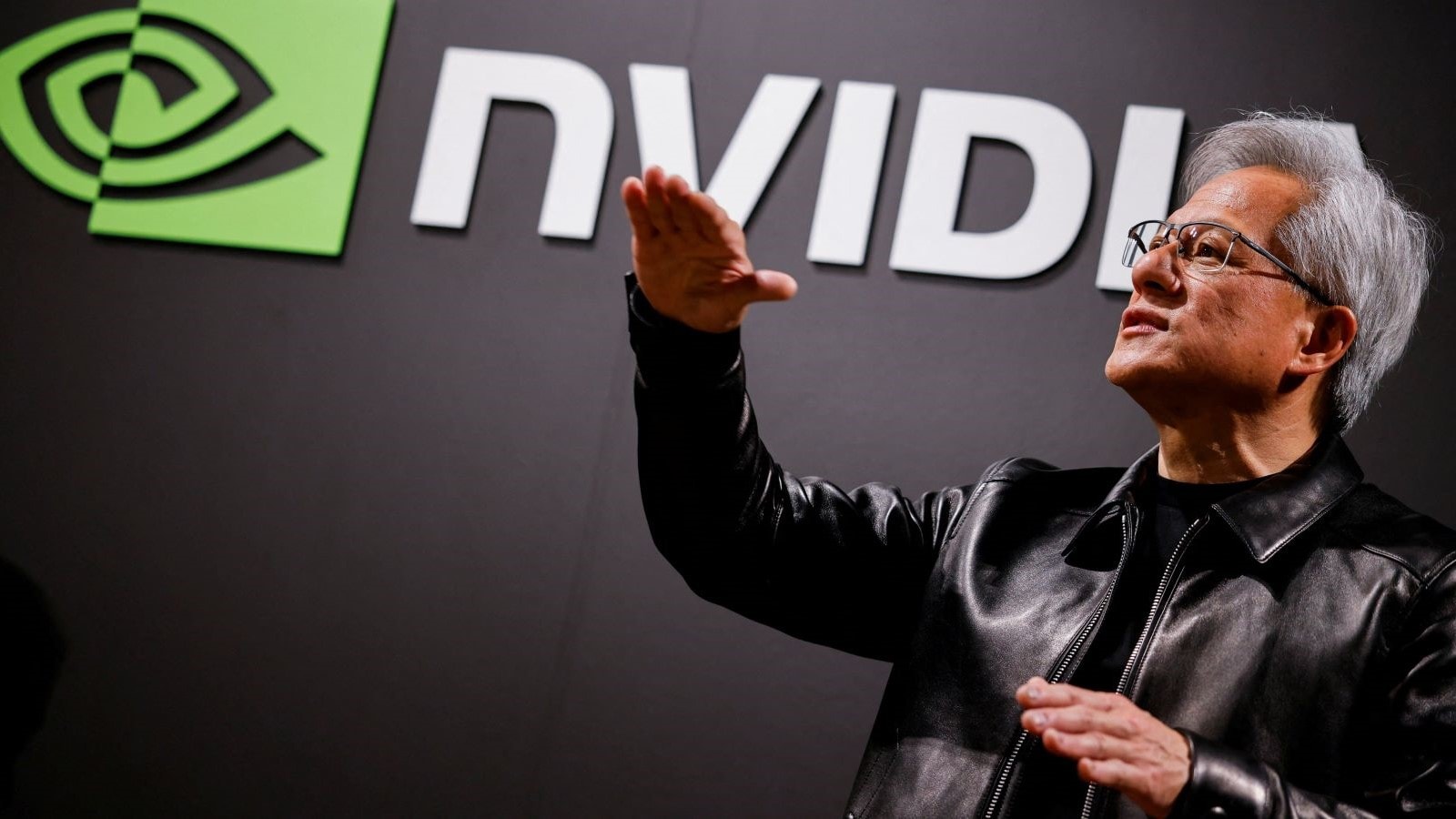
At 6:14 a.m. in a kitchen outside Chicago, a retired electrical engineer named Marcus stared at the glowing blue numbers on his tablet until his coffee went cold. For three years, those numbers had been a source of quiet, almost effortless comfort. Every time he checked his brokerage account, the green arrows next to Nvidia seemed to defy gravity, turning a modest retirement bet into the anchor of his family’s financial security. Then came the morning of November 11, 2026. The headline on his screen was brief, clinical, and devastating in its restraint: Morgan Stanley had dropped Nvidia from its list of top semiconductor picks.
Marcus did not panic immediately. Panic is loud; doubt is a slow leak. He read the subheadline twice, trying to square two ideas that felt completely at odds. The bank had removed the stock from its coveted top-pick pedestal, yet analyst Joseph Moore was keeping his "Overweight" rating and holding firm to a $300 price target. To a man who spent forty years designing circuit boards rather than trading derivatives, Wall Street’s language felt like a locked room. Was the house on fire, or were the architects simply rearranging the furniture?
If you have ever watched a stock you love stumble after years of feeling invincible, you know the exact physical sensation Marcus felt in his chest that morning. It is the sudden realization that you are no longer riding a sure thing—you are holding a question mark.
The Anatomy of a Mechanical Retreat
To understand what happened on November 11, you have to look past the drama of cable news tickers and examine the cold, unyielding machinery of institutional risk management. Only weeks earlier, on October 2, 2026, Morgan Stanley had actually reinstated Nvidia as its premier semiconductor pick. Following direct meetings with the company's leadership, the bank’s analysts laid out a thesis that sounded bulletproof. They pointed to a customer base stretching far beyond a handful of tech giants, an upcoming Feynman chip architecture projected to generate over $50 billion in revenue per gigawatt, and a valuation hovering around fifteen times estimated 2028 earnings that looked remarkably restrained for a company powering the global artificial intelligence buildout.
Then the floor gave way.
In the span of just forty-eight hours across November 9 and 10, Nvidia shares suffered a brutal two-day selloff, shedding roughly $430 billion in market value. The catalyst was not a missed earnings target or a sudden collapse in chip demand. It was human frailty colliding with geopolitical tension. Explosive reports surfaced regarding CEO Jensen Huang’s personal relationship with a Chinese businesswoman suspected of ties to Beijing’s intelligence network, prompting Nvidia’s board to launch an independent investigation and bring in outside legal counsel.
By the time the market closed on Tuesday, November 10, Nvidia’s stock had fallen more than 25% since its October 2 reinstatement. That threshold mattered. Inside Morgan Stanley, the "Top Picks" list is governed by strict internal discipline. Think of it like a circuit breaker in an old house—a metaphor Marcus would appreciate immediately. When current surges past a predetermined limit, the breaker trips automatically. It does not care whether the wiring behind the drywall is copper or gold, nor does it pass moral judgment on the appliances plugged into the outlets. Its sole job is to stop the circuit from overheating before the whole structure burns down.
Morgan Stanley’s stop-loss policy for top picks works on that exact principle. Once the 25% drawdown limit was breached, removal from the premier list became a mechanical necessity rather than an ideological surrender.
Why a Demotion Is Not a Divorce
Here is where retail investors frequently lose their footing, confusing a shift in tactical positioning with a collapse in fundamental belief. Wall Street speaks in graduated shades of conviction, and the gap between a "Top Pick" and an "Overweight" rating is subtle enough to trip up anyone reading headlines in a rush.
Imagine a hypothetical coaching staff preparing for a championship tournament. Every player on the starting roster is expected to outperform the competition—that is what an Overweight rating means. Morgan Stanley is still telling its clients that over the next twelve to eighteen months, Nvidia’s shares are expected to beat the broader semiconductor sector and the market at large. Retaining that $300 price target signals that, in the bank's financial models, the underlying cash-generating engine of the business remains intact.
A Top Pick, however, is the single player the coach hands the ball to with five seconds left on the clock. It is an exclusive, high-conviction designation reserved for the stock an analyst would choose above every other name in their coverage universe if forced to make just one bet.
When Morgan Stanley pulled Nvidia out of that top slot, the message to institutional fund managers was nuanced: We still believe this company will win over time, but right now, the air around it is too thick with headline risk to make it our number one immediate call.
For Marcus in his Chicago kitchen—and for millions of everyday savers whose index funds, target-date retirement accounts, and personal portfolios are heavily weighted toward the chipmaker—that distinction carries enormous practical weight. When an analyst downgrades a stock to "Underweight" or "Sell," they are telling you the business thesis is broken. When they keep an "Overweight" rating while stepping back from the "Top Pick" label, they are acknowledging a painful truth that financial spreadsheets rarely capture: sometimes a great business becomes a difficult stock to own in the short term.
The Invisible Weight of Key-Person Risk
I have spent enough years watching market cycles turn to recognize the specific kind of dread that settles over a trading floor when a founder-led titan hits a governance crisis. For decades, investors treated Jensen Huang’s leather-jacketed presence not merely as an asset, but as an immutable law of physics. He was the visionary who bet the company on accelerated computing years before Wall Street knew what a neural network was.
That devotion created an invisible vulnerability that financial textbooks call key-person risk. When one leader becomes synonymous with a trillion-dollar enterprise, their personal judgment becomes inseparable from the company’s valuation.
Consider what happens next when trust fractures at the very top of a company sitting squarely on the fault line between Washington and Beijing. Even though Nvidia stated it had no reason to believe national security or proprietary company secrets were compromised, markets do not wait for forensic audits to finish before pricing in fear. Suddenly, every institutional investor has to ask questions that have nothing to do with wafer yields or data center power consumption:
- Will U.S. regulators tighten export controls even further in response to perceived governance lapses?
- Can the board of directors maintain stability if leadership transitions accelerate?
- How much of Nvidia’s valuation premium belonged to the silicon, and how much belonged to the man holding it up on stage?
Analysts across Wall Street quickly began running those numbers out loud. Some warned that without Huang at the helm, the company’s perceived market value could suffer a steep structural discount. Others, including Morgan Stanley’s team, argued that Nvidia’s architectural lead and ecosystem were deep enough to survive turbulence at the top.
Yet uncertainty itself acts like a tax on stock prices. Institutional portfolio managers who answer to pension boards and university endowments hate explaining why they own a headline-generating controversy right before year-end reporting. Even if they believe Nvidia’s chips will dominate AI data centers for years to come, stepping to the sidelines—or rotating into memory chipmakers and alternative semiconductor plays—becomes the path of least resistance.
The Numbers Beneath the Noise
Step away from the governance drama for a moment, and you collide with the paradox that kept Morgan Stanley from abandoning the stock altogether. On paper, Nvidia’s operational scale in late 2026 remains staggering.
Before the scandal broke, Morgan Stanley’s research highlighted three structural pillars supporting its $300 valuation:
- A Wider Customer Net: Critics had long warned that Nvidia was dangerously dependent on four or five massive cloud hyperscalers. Morgan Stanley pushed back against that narrative, noting that roughly half of Nvidia’s customer base now extends beyond those giant buyers. The bank tracked around eighty distinct cloud partners deploying Nvidia hardware, with fifty-five of them operating outside the United States—a geographic spread that cushions the company against localized power bottlenecks and capital spending pauses.
- The Feynman Leap: In the semiconductor world, resting on last year’s silicon is a death sentence. Morgan Stanley estimated that Nvidia’s next-generation Feynman architecture could push revenue generation past $50 billion per gigawatt of data center capacity, a substantial jump from the roughly $40 billion generated by the preceding Rubin generation.
- Valuation Discipline: Unlike the dot-com bubble of 2000, when tech stocks traded at triple-digit multiples of nonexistent profits, Nvidia was trading around fifteen times its projected fiscal 2028 earnings—a multiple Morgan Stanley explicitly described as undemanding given its growth trajectory.
Meanwhile, other major banks echoed that fundamental resilience even as volatility spiked. Wells Fargo projected fourth-quarter fiscal 2027 revenue to reach $126.4 billion, outpacing broader Wall Street consensus estimates. Bank of America maintained its Buy rating and $350 price target. Even Citi, which trimmed its price target from $315 to $285 on November 10, stopped well short of calling an end to the AI infrastructure cycle.
This is why the situation feels so disorienting to ordinary investors. Both stories are true at the exact same time. The factories are still shipping chips at a historic pace, and the boardroom is fighting a crisis of confidence.
Navigating the Space Between Conviction and Caution
I will be honest with you: moments like this expose the hardest part of investing. When a stock is soaring, everyone feels like a genius. When a stock collapses on fraud or obsolescence, the exit door is obvious. The hardest terrain in finance is the gray middle ground—when a world-changing company gets caught in a storm that is real enough to hurt your net worth, yet ambiguous enough that selling everything might mean locking in losses right before the clouds break.
If you are sitting where Marcus sat on November 11, staring at a red number that used to be your favorite success story, there are three grounded truths worth holding onto before you touch a single button in your brokerage account.
First, separate a firm’s tactical checklist from your personal timeline. Morgan Stanley manages institutional reputation and short-term relative performance. Their stop-loss rule is designed to protect professional money managers from looking flat-footed during a sharp drawdown. Your timeline is measured in years of retirement, college tuition, or financial independence. Never let a Wall Street desk’s housekeeping rule dictate an emotional trade at your kitchen table.
Second, check your concentration before the market checks it for you. Many investors who bought Nvidia years ago never intended to make it 20% or 30% of their life savings; the stock simply grew until it swallowed the rest of their portfolio. A 25% pullback feels survivable when a stock represents 5% of your nest egg. It feels existential when that single ticker determines whether you sleep through the night.
Third, watch operational execution, not daily rumor mills. Scandals consume oxygen, but quarterly earnings, customer capital expenditures, and product transitions ultimately decide where a stock trades three years from now. Whether Nvidia can sustain its gross margins and keep its cloud partners building through leadership turbulence matters infinitely more than intraday swings driven by breaking alerts.
Late that afternoon in Illinois, Marcus finally closed his tablet. He did not sell his entire stake in a fit of nerves, nor did he blindly double down pretending nothing had changed. Instead, he trimmed a fraction of the position that had grown too large for his comfort, moved that cash into boring, dividend-paying Treasury bills, and left the rest untouched to see how the company’s next chapter would unfold.
Outside his window, the November wind stripped the last dry leaves from the oak trees along his street, leaving bare branches silhouetted against a cold gray sky—sturdy enough to weather winter, even without their summer crown.
You can learn more about the bank's decision in this 24KZ report on Morgan Stanley removing Nvidia from its top semiconductor picks, which outlines the market backdrop surrounding the shift.