The fluorescent lights in a downtown Vancouver community center hum with a steady, indifferent buzz at seven o'clock on a Tuesday evening. Plastic chairs scrape against linoleum. A half-dozen volunteers pass around paper cups of lukewarm tea, preparing for a local riding association meeting that will draw maybe forty people on a good night.
In the back row sits a woman we will call Mei—a hypothetical composite drawn from dozens of real testimonies given to Canadian public inquiries over the past three years. Mei arrived in British Columbia twenty years ago, built a small accounting practice, and volunteers on local school boards. She believes deeply in the quiet machinery of Canadian democracy. Yet, as she unfolds a printed agenda, her thumb hovers over the corner of the page, her eyes darting toward the double doors every time someone walks in. Two days ago, a distant cousin in Guangdong received a polite, unscheduled visit from local municipal officials asking whether Mei had been "attending too many political gatherings" in Canada.
Nobody broke a window. Nobody sent a threatening letter with cut-out magazine text. Nothing happened that would trigger a siren or a headline on the six o'clock news.
Silence.
That silence is the exact weight sitting in the briefcase of Prime Minister Mark Carney as he prepares to sit across from Chinese President Xi Jinping. When diplomatic communiqués announce that a Canadian leader will "raise foreign interference concerns" during a bilateral summit, the phrasing sounds sterile, almost procedural—like an agenda item tucked between agricultural tariffs and clean-energy supply chains. We read those words over morning coffee, nod at the familiar diplomatic choreography, and move on to the weather forecast.
We treat foreign interference like an abstract chess match played by intelligence agencies in windowless rooms. We get it completely backward.
The Invisible Architecture of Intimidation
To understand what is actually at stake when Carney looks Xi in the eye, you have to strip away the jargon of national security briefings and look at how modern transnational repression actually functions. It rarely looks like a spy thriller. There are no trench coats on foggy bridges, no microfilms hidden inside hollowed-out coins.
Instead, it looks like a WeChat message forwarded into a neighborhood group chat three days before a nomination vote. It looks like a sudden, unexplained audit of a family-owned import business back in Fujian. It looks like an unofficial "police service station" operating quietly above a convenience store in Markham or Richmond, staffed by individuals who know exactly which apartment building your elderly mother lives in six thousand miles away.
Think of traditional espionage as a burglar picking the lock on your front door to steal blueprints from your safe. Foreign interference is entirely different. It is someone quietly rewiring the thermostat in your house while you sleep, turning the heat up half a degree every night until you begin sweating, arguing with your spouse, and doubting your own sanity—never realizing the temperature was deliberately manipulated from outside.
Over the last several years, Canadians have watched this slow, unsettling realization unfold in public view. First came the leaked intelligence assessments suggesting covert funding networks and coordinated disinformation campaigns during the 2019 and 2021 federal elections. Then came the revelations surrounding Conservative MP Michael Chong, whose family in Hong Kong was targeted for intelligence gathering after he sponsored a parliamentary motion condemning the treatment of Uyghurs in Xinjiang. By the time Justice Marie-Josée Hogue convened the Public Inquiry into Foreign Interference in Federal Electoral Processes and Democratic Institutions, the dry headlines had hardened into an undeniable reality: foreign state actors, with Beijing identified by Canadian intelligence agencies as the most persistent and sophisticated among them, had been actively testing the seams of Canada's democratic fabric.
I remember sitting in the public gallery during early parliamentary committee hearings on this issue, watching diaspora witnesses testify behind translucent screens or under pseudonyms, their voices trembling not from dramatic rage, but from sheer exhaustion. One witness described checking the rearview mirror of his Honda Civic three times before turning onto his own residential street—not because he feared an assassin, but because he knew a photograph of his license plate could end up on a desk in another hemisphere, costing his sister her teaching job. Once you see the physical toll that invisible pressure leaves on an ordinary citizen's shoulders, you never read a diplomatic readout the same way again.
Why This Meeting Carries a Different Weight
Mark Carney enters this room carrying a specific, double-edged reputation. Before stepping into the prime minister's office, Carney spent decades navigating the highest corridors of global finance—first as Governor of the Bank of Canada, then at the helm of the Bank of England, and later leading global transition-finance initiatives. He speaks the language of sovereign debt, capital flows, and systemic risk fluently. Beijing knows this. In fact, Chinese state media and economic officials have historically viewed technocratic Western leaders with measured pragmatism, hoping that balance sheets and trade volumes might smooth over political friction.
After all, the numbers on the ledger are staggering. China remains Canada's second-largest single-nation trading partner, with bilateral merchandise trade routinely exceeding one hundred billion Canadian dollars annually. Prairie canola farmers, British Columbia lumber mills, and critical-mineral developers all feel the immediate tremor whenever diplomatic relations freeze. When Ottawa imposed 100 percent tariffs on Chinese-made electric vehicles and 25 percent tariffs on steel and aluminum in 2024—aligning with Washington—Beijing retaliated swiftly with anti-dumping probes into Canadian canola and chemical products.
Here lies the trap that has ensnared Western leaders for twenty years: the false choice between economic pragmatism and democratic sovereignty.
For decades, the prevailing wisdom in Ottawa, London, and Canberra operated on a comforting assumption. Trade would soften authoritarian edges. Deeper commercial integration would naturally nudge Beijing toward international norms, and any political friction could be managed quietly behind closed doors without disrupting container ships crossing the Pacific.
That assumption is dead.
Beijing does not separate economics from politics; it fuses them into a single instrument of statecraft. Access to Chinese markets, visas for executives, and regulatory approvals for joint ventures are routinely leveraged alongside covert diaspora monitoring and digital influence operations. If a Canadian prime minister treats foreign interference as a mere talking point—a box to be checked off in the first five minutes of a meeting before moving on to canola exports—Xi Jinping receives an unmistakable signal: Ottawa is willing to price its democratic integrity below its trade deficit.
What Actually Happens Behind Closed Doors
So what does it look like when a leader actually confronts Xi on foreign interference, rather than merely mentioning it?
Diplomacy at this level is an exercise in extreme precision. Xi Jinping is not a leader who responds to public lecturing; in fact, Western moralizing often strengthens his domestic narrative that foreign powers are trying to contain China's rise. In Beijing's official lexicon, any accusation of interference is immediately inverted—dismissed as Western "smears" or counter-accused as Canadian meddling in China's internal affairs whenever Ottawa speaks out on Hong Kong, Tibet, or Taiwan.
Carney's task is not to win an argument in front of cameras. His task is to establish unambiguous deterrence.
Consider what happens next when a prime minister shifts from general complaints to specific red lines. Instead of vague expressions of concern about "democratic norms," effective deterrence requires laying out concrete, verifiable realities:
First, it means making clear that Canada's newly enacted counter-interference architecture—including the foreign influence transparency registry, expanded powers for the Canadian Security Intelligence Service (CSIS) to brief threatened citizens directly, and criminalized acts of deceptive foreign interference—is permanent and non-negotiable. It is not a temporary political storm that will blow over after an election cycle.
Second, it means linking diplomatic presence directly to conduct. When Ottawa expelled Chinese diplomat Zhao Wei in 2023 over his involvement in targeting Michael Chong's family, Beijing retaliated by expelling a Canadian diplomat in Shanghai. That tit-for-tat was painful, yet necessary. Carney must communicate that any accredited official operating out of the embassy in Ottawa or consulates in Toronto, Vancouver, Calgary, or Montreal who steps outside the Vienna Convention to monitor Canadian residents will face immediate expulsion—regardless of the commercial fallout.
Third, and perhaps most crucially, it requires addressing the digital ecosystem where modern interference thrives. During recent Canadian election cycles, researchers at Rapid Response Mechanism Canada documented coordinated campaigns on platforms like WeChat and Douyin that amplified false narratives targeting specific Canadian candidates who had criticized Beijing's human rights record. These campaigns rarely use crude, obvious bots. Instead, they rely on seemingly organic community accounts, subtly amplifying anxieties about crime, taxes, or foreign policy to depress voter turnout in key suburban ridings.
The Vulnerability We Rarely Admit
Let's be honest about something that policy papers rarely acknowledge: confronting this problem is deeply uncomfortable, messy, and fraught with the risk of getting it wrong.
There is a genuine fear among many Chinese Canadians—and rightly so—that heightened suspicion around Beijing's covert operations can curdle into broad-brush prejudice against an entire community. History offers painful warnings. During the early twentieth century, discriminatory head taxes and the Chinese Exclusion Act treated people of Chinese descent as perpetual foreigners in the country they helped build. Even today, when politicians carelessly toss around accusations of disloyalty without ironclad evidence, ordinary citizens pay the price in sideways glances on the subway or sudden skepticism about their civic participation.
If Canada responds to authoritarian interference by growing paranoid toward its own diverse population, Beijing wins without spending a single yuan.
This is why the human dimension cannot be separated from the geopolitical strategy. Protecting democracy does not mean building higher walls around Canadian institutions and locking diaspora communities outside them. It means doing the exact opposite: empowering those communities so that a phone call from an overseas official loses its power to terrify.
Think back to Mei in that Vancouver community center. Why does an indirect inquiry to her cousin in Guangdong carry so much weight? Because Mei feels isolated. She wonders whether local police would understand the nuance of a polite warning delivered in Mandarin half a world away. She worries that speaking up might draw unwanted scrutiny to her own family, or that politicians in Ottawa care far more about trade delegations than about a single volunteer in a suburban riding.
When the Canadian government creates clear, accessible channels for diaspora citizens to report transnational intimidation—backed by multilingual support, genuine witness protection where needed, and visible accountability—the leverage evaporates. An intimidation tactic only works in the dark. Once exposed, documented, and met with institutional solidarity, the threat loses its sharpest edge.
History's Quiet Warning
We have seen variations of this story before, though never quite at this digital speed or global scale. Throughout the Cold War, democratic nations grappled with Soviet "active measures"—front organizations, planted newspaper stories, and covert funding designed to widen existing social fractures inside Western societies. Back then, the KGB exploited genuine racial tensions and anti-war movements in North America, pouring gasoline on fires that already existed.
Today's playbook is far more agile. Modern state-backed interference does not need to invent grievances from scratch; it simply locates existing fault lines in a pluralistic democracy—housing affordability, immigration debates, geopolitical anxieties—and uses algorithmic amplification and community-level pressure to turn healthy political disagreement into paralyzing distrust.
Australia learned this lesson the hard way nearly a decade ago. After uncovering extensive covert political donations and influence networks tied to Beijing—including a sitting senator forced to resign after echoing Beijing's talking points on the South China Sea—Canberra passed sweeping foreign interference laws in 2018. Beijing responded with a brutal freeze on ministerial contact and punitive tariffs on Australian wine, barley, beef, and coal. For three years, Australian exporters absorbed billions in losses.
Yet Australia did not repeal its laws. Canberra diversified its trade routes, stood firm on its domestic transparency rules, and waited. Eventually, facing its own domestic economic headwinds, Beijing quietly lifted almost every tariff and resumed high-level dialogue—on terms where Australia's sovereign guardrails remained intact.
The lesson for Mark Carney is written plainly in Canberra's ledger: resilience commands respect; accommodation invites further testing.
The Weight of a Single Sentence
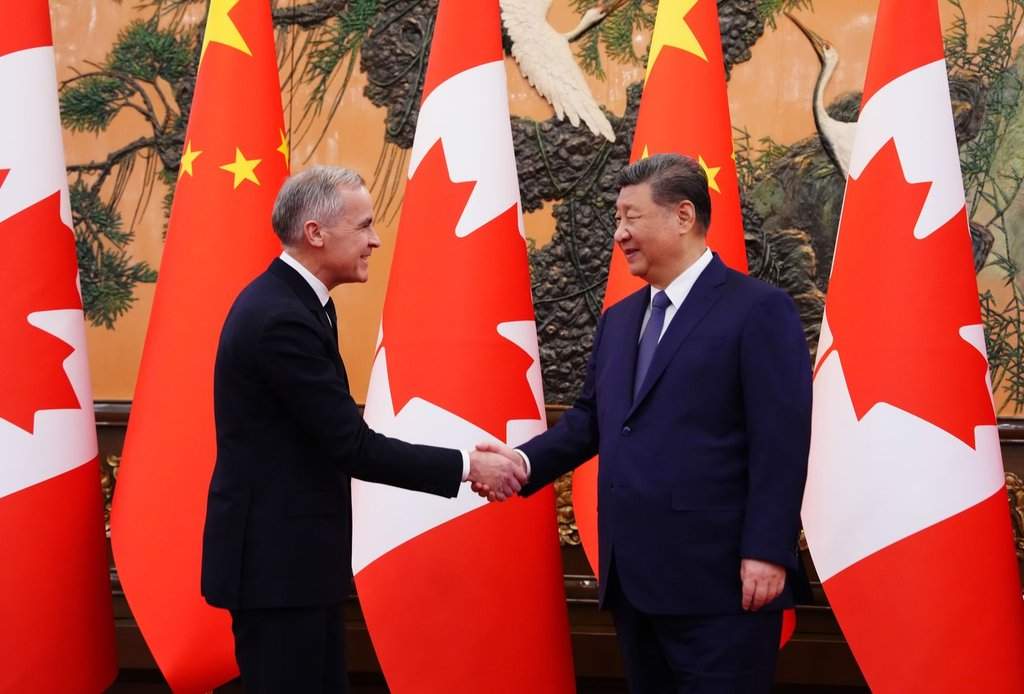
Diplomatic summits are famous for their theatrical choreography. Cameras will click as Carney and Xi shake hands against a backdrop of national flags. Translators will lean forward, murmuring carefully calibrated phrases into earpieces. Afterward, the official readouts will appear on government websites, scrubbed of emotion, dense with words like constructive, candid, and mutual respect.
Ignore the adjectives. Look instead at what happens in the months that follow.
Will accredited diplomats stay strictly within the bounds of legitimate statecraft, or will community leaders continue receiving midnight warnings about their relatives abroad? Will digital platforms operating in Canada face real accountability when foreign state networks weaponize them to suppress voter turnout? Will Ottawa fund the long, unglamorous work of civic protection—legal aid, counter-disinformation literacy, community liaisons—with the same urgency it brings to trade missions?
A handshake across a polished conference table lasts three seconds. The consequences of what is said—and what is left unsaid—echo for years in places cameras never reach.
Somewhere in a brightly lit room in Richmond or Markham, next Tuesday evening, another volunteer will unfold a paper agenda, take a sip of lukewarm tea, and decide whether to raise their hand and speak.