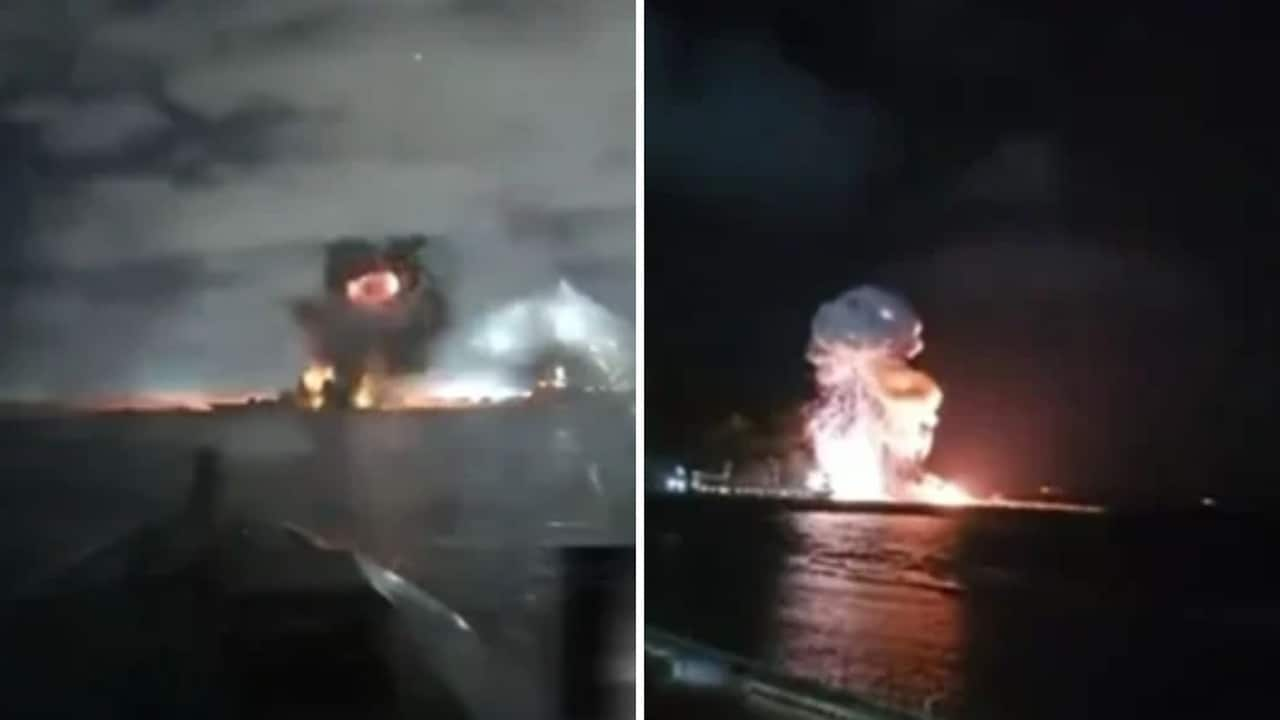
Saltwater smells different when it is burning.
Anyone who has ever stood on a coastal pier at dawn knows the sharp, metallic tang of low tide, diesel exhaust, and wet rope. Add burning high-grade marine fuel, melted aluminum, and cordite to that breeze, and you get the specific, suffocating perfume that has hung over the Black Sea since Ukrainian naval drones began turning Russian warships into artificial reefs.
In Kyiv, people celebrate. They have every right to. When a country without a traditional navy uses remote-controlled speedboats packed with explosives to sink billion-dollar cruisers, it feels like a biblical miracle. It is David slinging a fiberglass kayak straight into Goliath’s hull.
I remember watching the grainy night-vision footage from Sevastopol and Novorossiysk on a cracked phone screen in a crowded café, feeling that sudden, electric jolt of vindication. A nation backed into a corner had rewritten the rules of naval warfare with commercial Starlink terminals, jet-ski engines, and sheer desperation.
But celebration has a blinding glare. While the world applauds the tactical brilliance of Ukraine’s maritime strikes, a much colder reality is drifting across the water. The war is no longer contained inside the jagged lines of a map in Eastern Europe. By taking the fight to the open sea—and striking vessels far beyond the immediate coastline of Crimea—Ukraine has inadvertently pulled the trigger on a global tripwire.
The water does not respect borders. Neither do the consequences.
The Ghost Fleet and the Grocer
To understand why a hole in a Russian hull three thousand miles away matters to your kitchen table, consider a hypothetical character named Mateo.
Mateo runs a mid-sized grain import operation out of a port in southern Spain. He does not follow troop movements in the Donbas. He cannot name the commander of Russia’s Black Sea Fleet. What Mateo knows are insurance premiums, hull classifications, and the exact cost of moving forty thousand tons of wheat from Odesa to Valencia.
For months, Mateo watched the shipping lanes with a quiet, creeping dread. Every time a Ukrainian Magura V5 sea drone punched through the dark waves and crippled a Russian landing ship or a patrol corvette, the celebrations in Kyiv grew louder. Simultaneously, the underwriters in London grew quieter.
War risk insurance is the invisible oxygen of global trade. Without it, a cargo ship is just a floating pile of steel that nobody dares to move. When Ukraine proved it could strike targets across the entire width of the Black Sea—even hitting vessels near Russian ports like Tuapse and Novorossiysk—the maritime map changed overnight.
Think of the Black Sea not as a battlefield, but as a narrow hallway connecting a massive farm to a hungry neighborhood. For years, Russia tried to lock the door at the end of that hallway. Ukraine responded by blowing the hinges off the frame. The problem is that splinters are now flying into the street.
When Mateo calls his maritime broker today, the price to insure a bulk carrier entering that hallway has spiked to astronomical levels. Those costs do not evaporate. They travel from the broker to Mateo, from Mateo to the flour mill, from the mill to the bakery, and finally onto the receipt in your pocket.
The Illusion of the Contained War
We love neat boxes. We want conflicts to stay inside the borders where they started, like a fire contained within a brick hearth.
Since February 2022, Western policymakers have spent billions of dollars and endless sleepless nights trying to build a firewall around Ukraine. The unspoken rule was simple: arm Kyiv enough to survive, but keep the violence strictly inside Ukrainian territory. Do not let it spill into NATO airspace. Do not let it choke global energy markets. Do not let it become our war.
Kyiv’s maritime campaign shattered that illusion.
Let us look at the verified reality on the water. Between 2022 and 2024, Ukrainian forces destroyed or severely damaged roughly a third of Russia’s Black Sea Fleet. Flagships like the Moskva, modern corvettes like the Ivanovets, and large landing ships like the Caesar Kunikov went to the bottom. The remaining Russian vessels fled eastern Crimea, hiding behind floating barriers in Novorossiysk—a port city sitting squarely on internationally recognized Russian soil, far from the contested beaches of Sevastopol.
Then Ukraine hit them there, too.
It was a masterstroke of asymmetric warfare. Yet, in striking targets deep inside Russia’s maritime backyard, Ukraine erased the geographic boundary of the conflict. Moscow’s response was predictable and terrifying: if Russian ships are not safe in Russian waters, then commercial vessels carrying Ukrainian grain—or oil tankers serving Western markets—are fair game anywhere on the high seas.
You do not need a degree in military strategy to see the trap. Once commercial shipping lanes become contested hunting grounds, neutrality dies. A cargo ship flying a Panamanian flag, owned by a Greek shipping magnate, crewed by Filipino sailors, and carrying corn bound for Egypt suddenly becomes a frontline target.
One stray mine. One misidentified radar signature in a heavy fog. That is all it takes to drag half a dozen nations into a maritime crisis they swore they would avoid.
The Anatomy of an Unstoppable Machine
Walk through a boatyard in Odesa today, and you will not see grand naval architecture. You will see men in grease-stained hoodies wiring consumer electronics into sleek, gray fiberglass hulls that look like oversized surfboards.
This is the true terror of what is happening in the Black Sea, and it has nothing to do with Vladimir Putin.
For centuries, controlling the world’s oceans required unimaginable wealth. You needed dry docks, decades of engineering pedigree, and billions of dollars to build an aircraft carrier or a guided-missile destroyer. That financial barrier kept maritime warfare exclusive to superpowers. It created a cold, predictable stability.
Ukraine just democratized naval annihilation.
For roughly $250,000—less than the price of a suburban home in the American Midwest—engineers can build a sea drone capable of outrunning a warship, evading radar by skimming just inches above the swell, and delivering a warhead powerful enough to snap a steel keel in half.
Stop and think about what that means for the rest of the planet.
The blueprints are out. The tactics are streaming in high definition on social media. Every rebel group, cartel, rogue state, and terrorist organization from the Red Sea to the South China Sea is taking notes. We are already watching Houthi militants in Yemen use remarkably similar unmanned surface vessels to terrorize global shipping through the Bab el-Mandeb Strait, forcing massive container ships to divert around the southern tip of Africa at a cost of millions of dollars per voyage.
The Black Sea was the laboratory. The rest of the world’s oceans are the proving ground.
I confess that when I first started tracking these maritime strikes, I viewed them purely through the lens of traditional military history—a clever David-and-Goliath story that would eventually force Moscow to the negotiating table. I was wrong. I was looking at the tactical brilliance and missing the strategic contagion. It is deeply unsettling to realize that the very weapon saving a democracy today is simultaneously handing a cheap, unstoppable master key to every bad actor on earth.
The Silent Chokepoints
To feel the true weight of this shift, look at a globe and trace the thin blue lines where global commerce squeezes through narrow straits.
- The Bosporus and Dardanelles, where Russian oil and Ukrainian grain pass through the heart of Istanbul.
- The Strait of Hormuz, through which a fifth of the world’s petroleum flows every single day.
- The Taiwan Strait, the fragile artery carrying the microchips that power your phone, your car, and your hospital’s MRI machine.
All of these waterways rely on a fragile gentleman’s agreement: that the seas remain open, and that the cost of attacking a ship is higher than the reward.
By proving that cheap, unmanned boats can paralyze a nuclear-armed superpower’s navy, the war in the Black Sea has inverted that math. Attacking is now cheap. Defending is impossibly expensive. A multimillion-dollar air-defense missile cannot profitably be fired at a $250,000 fiberglass drone—and even if a warship shoots down nine of them, the tenth one sends the ship to the bottom.
Russia has already begun adapting, deploying helicopters, electronic jamming, and fortified harbor booms, while simultaneously expanding its own shadow fleet of aging, uninsured oil tankers to bypass Western sanctions. These rusty, poorly maintained vessels are currently crisscrossing European waters, carrying millions of barrels of crude oil with expired safety certificates and no liability coverage.
If a Ukrainian drone—or a mechanical failure—splits one of those shadow tankers open in the Baltic or the Black Sea, the resulting ecological disaster will coat coastlines in thick, toxic sludge for a generation. No diplomatic treaty will clean that up. No victory parade in Kyiv or Moscow will scrub oil from the feathers of dying seabirds or restore the livelihoods of fishermen from Romania to Turkey.
The Echo Across the Water
History rarely announces when a local conflict mutates into a global crisis. There is no siren. There is no breaking news banner that captures the exact second a regional war slips its leash.
Instead, it happens quietly.
It happens when a naval officer in Sevastopol realizes his harbor is no longer a sanctuary. It happens when a maritime insurer in London doubles the rate on a grain freighter. It happens when a militant in a desert workshop downloads the wiring diagram for a remote-controlled boat and looks out at the nearest shipping lane.
Ukraine is fighting for its survival, and on the dark waters of the Black Sea, its engineers have achieved something miraculous. They took an invincible fleet and broke its spine. They gave a battered nation a reason to cheer in the dark.
Yet standing on the shore, watching the distant orange glow of another burning hull on the horizon, it is impossible to ignore the cold wind blowing inward from the sea. The fire is no longer just on their side of the water.
The smoke is already in our lungs.