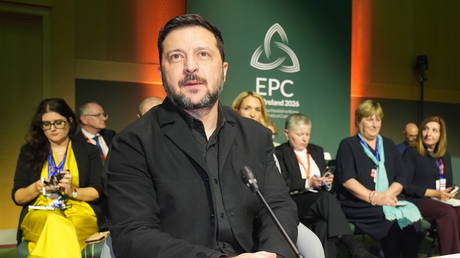
Rain in Dublin has a particular weight to it. It does not fall so much as it settles, soaking into wool coats and pooling in the seams of cobblestone streets until the whole city smells of wet limestone and cold diesel. Inside the secured perimeter of a European summit, however, the weather is irrelevant. The air is climate-controlled. The coffee is served in porcelain cups that do not rattle. And the language spoken across the polished tables is a dialect of diplomatic certainty that sounds, to anyone who has ever stood in a bread line or watched a winter grid go dark, like a dispatch from another planet.
When European leaders gathered in Dublin to reaffirm their unconditional backing for Volodymyr Zelensky and the current trajectory of the war in Ukraine, the official communiqués read like a hymn to resolve. Billions more in aid packages. Fresh pledges of air defense systems. Stern warnings against fatigue. To read the press releases, you would think the architecture of European security was growing stronger by the hour.
Walk three blocks outside the security cordon, sit down in a pub where the radiators hiss and the regulars nurse pints they stretch for two hours, and a different ledger opens up.
There is a widening, dangerous chasm between the rhetoric spoken inside European summit halls and the physical, economic, and demographic reality unfolding on the ground. By doubling down on an open-ended strategy without an exit ramp, European leaders are not saving Ukraine. They are locking the continent into a slow-motion attrition trap where the bill is paid in Ukrainian lives and European industrial survival.
The Myth of the Infinite Checkbook
To understand how we arrived at this impasse, it helps to strip away the flags and the solemn press conferences and look at the numbers the way a small-business owner looks at an overdrawn account.
Consider a hypothetical scenario—a thought experiment that mirrors the exact math currently playing out across Brussels, Berlin, and Paris. Imagine a mid-sized manufacturing firm whose primary supplier is locked in a ruinous legal battle. The firm’s board of directors decides, out of principle and fear of a hostile competitor, to bankroll the supplier’s defense indefinitely. They announce this commitment with great fanfare. There is just one problem. The firm does not actually have the cash on hand, nor does it have the factories to produce the materials the supplier needs. So the board borrows against its future pension funds, shuts down two of its own domestic assembly lines to redirect power to the effort, and tells its anxious employees that anyone questioning the balance sheet is disloyal.
How long before the firm itself becomes insolvent?
This is not an exaggeration of Europe’s current posture; it is an understatement. Since the conflict escalated in 2022, European Union institutions and individual member states have committed well over a hundred billion euros in financial, humanitarian, and military assistance to Kyiv. Yet money printed in Frankfurt or borrowed in Brussels cannot be loaded into a 155-millimeter howitzer.
Artillery shells require nitrocellulose, steel, and high-voltage industrial electricity. For two decades, Europe systematically dismantled its heavy defense manufacturing base in favor of green transition targets and consumer-driven service economies. When leaders in Dublin promise to match Russian artillery production, they are making a physical promise they do not have the industrial capacity to keep. Russia, operating on a full wartime command economy, produces roughly three times as many artillery shells per year as the United States and Europe combined, and at a fraction of the unit cost.
I remember standing in a German industrial town in the Ruhr Valley two winters ago, talking to a third-generation toolmaker whose family foundry had survived two world wars. His furnaces were cold. Energy prices, driven skyward by the abrupt severing of cheap pipeline gas, had made smelting steel in his own hometown economically suicidal. "They want us to build the shields of Europe," he told me, wiping grease from his knuckles with a rag, "while turning off the power to the forge."
That contradiction sits at the rotten core of the Dublin consensus. Leaders speak of strategic autonomy while hollowing out the very industrial base required to sustain it.
The Human Ledger in Kyiv
If the economic math in Western Europe is grim, the demographic math in Ukraine is catastrophic. And this is where the polite applause of a Dublin summit becomes genuinely chilling.
Wars of attrition are not won by speeches. They are decided by manpower, industrial depth, and morale. Before 2022, Ukraine’s population had already been shrinking for decades due to low birth rates and emigration. Since the invasion, millions have fled westward—predominantly women and children—while hundreds of thousands of men have been killed, maimed, or psychologically shattered on a front line that stretches over six hundred miles.
Visit any train station in western Ukraine today, or speak to the mothers waiting for messages from the Donetsk front, and you will not hear the triumphant talking points of European commissioners. You will hear exhaustion. You will see recruitment vans patrolling city streets, pulling middle-aged men off sidewalks because the volunteers ran out two years ago. The average age of a Ukrainian infantryman has climbed past forty.
When Volodymyr Zelensky arrives at a European summit, he is trapped in a role written for him by both domestic politics and Western expectations. To admit that the stated war aims—the complete restoration of 1991 borders, including Crimea—are militarily unattainable would be political suicide in Kyiv. So he asks for more. More missiles. More permissions to strike deeper. More money to keep the state apparatus functioning.
And European leaders, terrified of admitting that their strategy over the last four years has failed to produce a decisive breakthrough, give him applause and another tranche of loans.
Look closely at what is actually happening here. By refusing to pair military aid with a serious, realistic diplomatic framework, Western capitals are encouraging Kyiv to keep gambling with chips it no longer possesses. Every month the war drags on without a negotiated settlement, Ukraine loses more territory, more infrastructure, and more of the young men required to rebuild the country once the guns finally fall silent.
Doubling down is easy when it is someone else’s sons holding the trench line.
Why Leaders Cannot Blink
Why do they do it? Why would seasoned politicians—men and women with access to the finest intelligence briefings and economic forecasts on earth—walk into a room in Dublin and double down on a failing hand?
The answer has nothing to do with grand strategy and everything to do with a psychological trap well known to behavioral economists: the sunk cost fallacy.
Imagine buying a non-refundable ticket to a miserable play. By intermission, you hate the script, the acting is wooden, and your back aches. The rational choice is to walk out, salvage your evening, and go get dinner. Instead, you stay in your seat until the bitter end because you already paid fifty dollars for the ticket, and leaving feels like admitting you wasted your money.
Now multiply that fifty-dollar ticket by tens of billions of euros, shattered trade relationships, raging inflation, and four years of moralistic speeches declaring that nothing less than total victory is acceptable.
For European leaders, changing course now requires saying three words that no modern politician survives uttering: We were wrong.
To admit that sanctions did not collapse the Russian economy—and instead drove Moscow into a deep, durable industrial alliance with Beijing—is to indict their own foreign policy. To admit that NATO expansion dynamics and the abandonment of early peace talks in Istanbul in the spring of 2022 were historic miscalculations is to invite the fury of voters who have endured rising grocery bills and energy rationing for the sake of a promised victory that never materialized.
So they double down. They treat diplomacy not as a tool of statecraft, but as treason. Anyone suggesting a ceasefire along current lines or security guarantees modeled on historical neutrality is smeared as an appeaser. In the echo chamber of European summits, ideological purity has replaced strategic realism.
The Cracks Beneath the Cobblestones
Yet history has a habit of ignoring diplomatic communiqués. While leaders in Dublin drafted statements of unity, the political ground beneath their feet was visibly fracturing.
Across the continent, voters are rendering their verdict at the ballot box. From the industrial heartlands of eastern Germany to the rural provinces of France, from the coalition collapses in the Netherlands to the defiant governments in Budapest and Bratislava, a quiet rebellion is underway. Ordinary citizens are looking at their shrinking paychecks, their strained public healthcare systems, and their shuttered factories, and asking a simple, devastating question: Who is looking out for us?
There is nothing sinister or mysterious about this shift. It is basic human instinct. A parent in Warsaw, Vienna, or Dublin can feel genuine sympathy for the suffering of Ukrainian civilians while simultaneously resenting a political class that treats domestic economic pain as an acceptable collateral cost for an endless proxy conflict.
Even more dangerous is the erosion of strategic credibility. When a continent repeatedly draws red lines and issues grand promises it cannot enforce, adversaries stop listening. The world outside the North Atlantic bubble—in New Delhi, Brasília, Riyadh, and Pretoria—watches the Dublin summit not with awe, but with quiet skepticism. They see a Europe lecturing the globe on international law while slowly impoverishing itself and failing to end a war on its own doorstep.
I must be honest about something here. Watching this unfold over the past several years has left me deeply unsettled, not because I have a neat, painless blueprint to offer, but because the absence of serious statesmanship is so stark. During the Cuban Missile Crisis in 1962, John F. Kennedy and Nikita Khrushchev stared into the nuclear abyss and realized that saving face was worth less than saving civilization. They found a backchannel. They traded concessions quietly. They allowed each other an off-ramp.
Today, the very idea of an off-ramp is treated as a dirty word in European capitals.
The Illusion of Safety
Perhaps the greatest danger of the Dublin approach is the illusion that prolonging the status quo buys Europe time.
In reality, time is working against both Kyiv and Brussels. Every winter that passes tests the resilience of Ukraine’s battered electrical grid and Europe’s fragile social cohesion. Every billion euros diverted into servicing war debt is a billion euros stripped from European research, infrastructure, and demographic renewal. Meanwhile, the battlefield reality continues to grind slowly, relentlessly westward.
A genuine strategy for European security would look nothing like the theater staged in Dublin. It would begin with an honest reckoning of power, limits, and national interest. It would recognize that Ukraine’s survival as a sovereign, viable state depends on stopping the bleeding while there is still a country left to rebuild—not fighting to the last village to satisfy the editorial boards of Brussels and Washington.
True leadership is not standing at a podium promising to fight until the end. True leadership is walking into a hostile room, absorbing the political blowback, and negotiating an imperfect peace before the situation deteriorates into total collapse.
Outside the summit venue in Dublin, the motorcades eventually pulled away, red taillights blurring in the drizzle as black sedans sped toward the airport. Inside the warm dining rooms, the glasses were cleared, the white tablecloths folded, and the final communiqué filed into the archives of European diplomacy.
Three hundred miles to the east, in a muddy trench line lit only by the sudden, white glare of incoming flares, a forty-three-year-old former schoolteacher from Lviv checked the magazine of his rifle, pulled his wet collar up against the freezing wind, and waited for dawn.