Menstrual equity initiatives routinely fail not from a lack of altruism, but from a fundamental miscalculation of supply chain velocity and recurring demand predictability. When grassroots organizations scale from informal donation boxes to serving thousands of individuals monthly, they transition from a marketing exercise to a high-frequency logistical operation. The structural challenge of period poverty requires examining the exact mechanics of inventory turnover, distribution friction, and capital allocation that govern community-based distribution networks.
The Unit Economics of Recurring Biological Demand
Consumer packaged goods companies operate on predictable replenishment cycles dictated by consumption rates. Menstrual hygiene products share this exact biological constraint. A typical menstruating individual requires an average of twenty to twenty-five units of protection per cycle, repeating every twenty-eight to thirty days without exception. Unlike food insecurity, which can sometimes be mitigated by irregular canned food drives or bulk agricultural surpluses, menstrual product demand is temporally fixed and non-negotiable.
When an organization scales to support nearly two thousand individuals monthly, the monthly inventory requirement stabilizes at approximately forty thousand individual items. This volume transforms the operational profile entirely. Ad-hoc collection drives relying on office drop-off boxes and sporadic community donations introduce high variance into the inbound supply chain. Inbound variance paired with inelastic outbound demand creates structural deficits.
To model this accurately, define the baseline consumption function:
$D = N \times U$
Where $D$ represents total monthly demand units, $N$ is the active user count, and $U$ is the average unit consumption per cycle. For 1,900 active recipients, $D$ sits between 38,000 and 47,500 units monthly. When inbound donations drop below this threshold during off-peak donation months, the organization faces an immediate fulfillment gap. Relying entirely on volunteer-driven donations means the supply curve fluctuates seasonally, whereas the demand curve remains entirely flat.
The Bottleneck of Decentralized Collection Networks
Grassroots initiatives typically begin with decentralized collection models. Supermarkets, community centers, and corporate lobbies host collection bins. While this approach maximizes community engagement and lowers initial acquisition costs to zero, it introduces severe operational inefficiencies.
Sorting and Quality Control Overhead
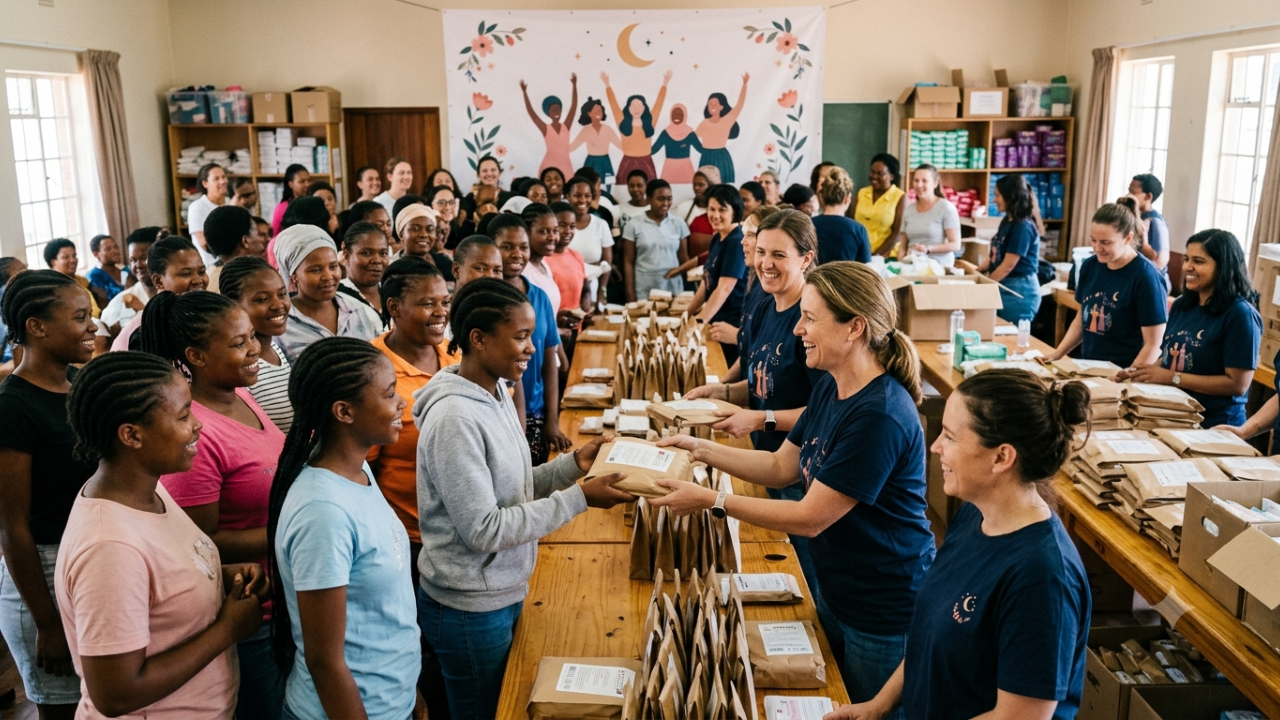
Donated goods arrive in heterogeneous assortments. Unlike wholesale procurement where pallets contain standardized boxes of identical absorbency and brand specifications, community bins yield mixed open packages, varied pad sizes, and unsealed tampons. Each unit must pass quality control inspection, sorting, and repackaging before distribution. This manual labor introduces a significant human capital bottleneck. Every hour spent sorting opened boxes is an hour unavailable for core distribution logistics or institutional partnership development.
Geographic Misalignment
Decentralized collection rarely mirrors geographic need. Affluent neighborhoods with high foot traffic in corporate or retail spaces generate the highest volume of donations, while the target populations experiencing acute period poverty often reside in geographically disparate urban pockets or under-resourced rural sectors. The secondary transportation cost—moving goods from collection hubs to distribution endpoints—eats into financial reserves and increases carbon overhead.
Brand and Quality Variance
Unstandardized donations create equity issues among recipients. Receiving inconsistent product types affects user comfort and reliability. Institutional programs addressing period poverty must establish baseline quality thresholds, ensuring that every kit distributed meets safety and reliability standards.
Scaling Friction and the Operational Plateau
Organizations scaling past the initial thousand-user threshold frequently encounter an operational plateau. The transition from a kitchen-table volunteer project to an entity supporting 1,900 individuals requires formalizing three distinct functional layers: inbound acquisition, inventory management, and outbound delivery channels.
[Inbound: Drives/Wholesale] ---> [Processing: Sorting/Kitting] ---> [Outbound: Distribution Partners]
Organizations that fail to modernize their processing stage experience compounding administrative drag. Volunteer burnout accelerates because the manual labor required to kit tens of thousands of items scales linearly with user growth. Without automation or bulk wholesale purchasing contracts, doubling the recipient base doubles the sorting hours required.
Furthermore, storage capacity becomes a binding constraint. Pallet storage requires dry, secure warehouse space. Garage-based operations hit a hard physical limit once inventory turnover exceeds several thousand units per month. Renting commercial storage introduces fixed overhead expenses that clash with the zero-cost ethos of traditional donation-dependent models.
Inventory Buffer Ratios and Supply Volatility
Managing inventory for non-perishable hygiene goods differs from managing perishable foodstuffs, but the capital lockup principle remains identical. To insulate against seasonal donation dips—such as the drop in community giving during summer months or post-holiday periods—an organization must maintain a safety stock ratio.
The optimal safety stock $S$ can be modeled against the coefficient of variation in inbound donations:
$S = Z \times \sigma_d \times \sqrt{L}$
Where $Z$ represents the service level factor, $\sigma_d$ is the standard deviation of daily inbound supply, and $L$ is the lead time required to secure emergency wholesale procurement. When inbound supply relies entirely on unpredictable community drives, $\sigma_d$ is exceptionally high, necessitating large safety buffers.
To reduce $\sigma_d$, mature initiatives pivot toward hybrid procurement models. Rather than waiting for community members to buy and drop off boxes of tampons, organizations establish direct corporate partnerships with manufacturers to secure wholesale overstock, or allocate financial donations directly to bulk purchasing. Wholesale purchasing compresses lead times and normalizes unit costs, transforming a volatile collection model into a predictable supply chain.
Distribution Channels and Institutional Integration
Direct-to-consumer distribution of hygiene supplies is highly inefficient. Hand-delivering individual kits to 1,900 separate residential addresses incurs prohibitive labor and transit costs. Consequently, successful scale relies on institutional embedding.
Partnering with existing infrastructure nodes—such as public school systems, community health clinics, domestic violence shelters, and local food pantries—pivots the distribution model from push-based delivery to pull-based integration. These institutions already possess regular touchpoints with the target demographic.
Schools as Distribution Hubs
Educational facilities represent the highest-yield distribution channel for adolescent girls and young women. Absenteeism driven by period poverty is a well-documented driver of academic drop-out rates. Providing products through school nurses' offices or discreet dispensers eliminates the stigma of asking for help while guaranteeing high-frequency access points.
Healthcare Clinics and Community Centers
Integrating distribution into routine health and social service visits removes the friction of dedicated product-pickup trips. Recipients acquire necessary supplies while attending pre-scheduled appointments, lowering the psychological barrier to entry and utilizing trusted community spaces.
Capital Allocation and Strategic Execution
Organizations operating at the scale of 1,900 monthly recipients must transition their strategic focus from collection volume to capital efficiency and institutional partnerships. Relying on passive community goodwill creates a perpetual vulnerability to economic downturns and donor fatigue.
The strategic imperative moving forward involves shifting from reliance on sporadic consumer-level product donations to corporate philanthropic matching grants, direct B2B manufacturer surplus acquisition, and multi-year institutional funding streams. By securing predictable cash reserves rather than volatile physical product donations, leadership can execute wholesale bulk purchasing agreements, eliminate manual sorting overhead through pre-packaged commercial units, and redirect volunteer capital toward expanding institutional distribution partnerships into under-served adjacent districts.