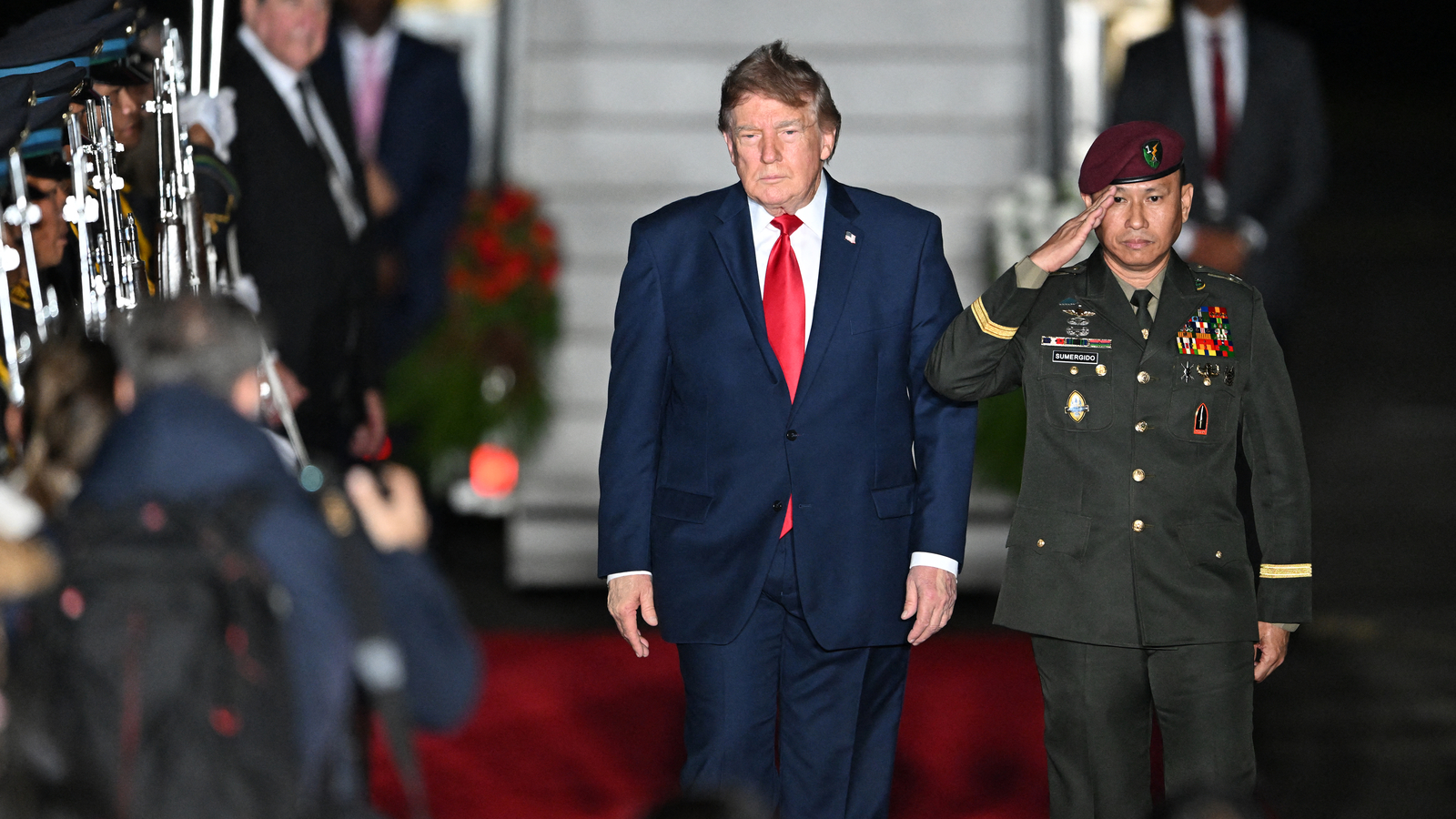
Leaders from the United States, Japan, Australia, and India are convening in Manila today to move the Quadrilateral Security Dialogue from diplomatic rhetoric to operational maritime enforcement. By holding this summit in the Philippine capital rather than a member nation, the bloc is drawing an unmistakable geographic line in the South China Sea. The primary agenda centers on integrating real-time maritime surveillance, hardening undersea telecommunications infrastructure, and establishing a permanent logistics framework to counter gray-zone coercion in Indo-Pacific waters.
Most coverage of this summit treats it as another routine diplomatic photo opportunity. That misses the structural shift happening beneath the surface. For years, the Quad operated as an informal talking shop, carefully avoiding the label of an Asian NATO to keep regional neighbors comfortable and avoid provoking Beijing prematurely. Moving the meeting to Manila strips away that diplomatic insulation. The Philippines sits on the frontline of daily maritime friction, where water cannons, laser blinding, and ship-ramming incidents at Second Thomas Shoal and Scarborough Shoal have become standard operating procedure. Bringing the heads of state directly to Manila signals that the Quad is no longer just discussing regional stability from afar; it is positioning itself as an active backstop for Southeast Asian sovereignty. Don't forget to check out our earlier post on this related article.
The Geography of Deterrence
Location dictates strategy in geopolitics. When the Quad met in Tokyo, Hiroshima, or Wilmington, the messaging remained broad, touching on vaccine distribution, climate resilience, and emerging technologies. Manila changes the gravity of the room entirely.
The Philippine archipelago forms the central link in the First Island Chain, the string of territories running from Japan down through Taiwan and the Philippines to Borneo. Whoever controls the maritime chokepoints around Luzon and Palawan controls access between the South China Sea and the open Pacific Ocean. If an adversary establishes uncontested dominance over these waters, naval forces from the United States and Japan face severe operational constraints, while Australia's northern approaches become dangerously exposed. If you want more about the context of this, NPR provides an informative summary.
By gathering in Manila, the Quad is validating the strategic pivot undertaken by the Philippine government over the past few years. Manila has expanded defense access for American forces under the Enhanced Defense Cooperation Agreement, signed reciprocal access pacts with Tokyo, and conducted joint patrols with Canberra. India, traditionally cautious about entangling itself in East Asian territorial disputes, has stepped up by delivering BrahMos supersonic cruise missiles to the Philippine Marine Corps. Today's summit locks these bilateral threads into a coordinated regional web.
Inside the Maritime Domain Awareness Architecture
Diplomacy requires hardware to be credible. The centerpiece of today's closed-door sessions is the expansion of the Indo-Pacific Partnership for Maritime Domain Awareness, commonly referred to as IPMDA.
To understand why this matters, you have to understand how modern maritime coercion works. It rarely involves gray-hulled warships firing missiles. Instead, it relies on hundreds of maritime militia vessels, coast guard cutters, and survey ships operating with their Automatic Identification System transponders switched off. Without persistent tracking, smaller coastal nations cannot prove what is happening inside their Exclusive Economic Zones until an artificial island is already built or a reef is completely blockaded.
IPMDA solves this blind spot by fusing commercial satellite imagery, radio-frequency detection, and synthetic aperture radar data from all four Quad nations and feeding it directly to regional fusion centers, including the Philippine Coast Guard. Synthetic aperture radar is critical here because cloud cover blankets the South China Sea for much of the year, rendering standard optical satellites useless. Radar penetrates the clouds day and night, spotting dark vessels by their metallic hulls and wake signatures.
The summit in Manila is expected to formalize the next phase of this system. That means moving from passive tracking to automated predictive analytics, allowing Manila and its neighbors to anticipate swarming tactics before a blockade forms. Sharing intelligence is easy on paper. Integrating four distinct military and intelligence bureaucracies so that a satellite pass over the Spratly Islands triggers an actionable alert on a Philippine patrol boat within minutes is an immense technical hurdle. The working groups meeting alongside the leaders today are tasked with ironing out the classification protocols that usually choke multinational data sharing.
The Hidden Front Under the Waves
While cameras focus on naval vessels and territorial reefs, the most urgent security briefing on the table in Manila involves the ocean floor. Over ninety-five percent of intercontinental internet traffic, financial transactions, and military communications travels through subsea fiber-optic cables.
The Luzon Strait, separating the northern Philippines from Taiwan, is one of the densest bottlenecks for undersea cables on earth. A single coordinated severing of cables in that corridor would cripple banking systems, cloud infrastructure, and communications across East Asia and North America. Over the past few years, unexplained cable cuts near Taiwan's outlying islands and suspicious loitering by foreign research vessels over cable routes have alarmed defense planners in Washington, Tokyo, and Canberra.
The Quad is using the Manila summit to accelerate its Cable Connectivity and Resilience initiative. Historically, telecom companies laid cables based purely on commercial cost, often routing them through shallow, vulnerable waters and relying on state-subsidized foreign repair ships to fix breaks. Repairing a severed subsea cable requires specialized vessels equipped with grappling hooks and splicing rooms, and there are fewer than sixty such ships operating globally.
Quad leaders are moving to subsidize trusted commercial operators, fund alternative routing paths that bypass high-risk chokepoints, and establish a dedicated fleet of allied cable-laying and repair vessels stationed in the Indo-Pacific. By bringing the Philippines into this framework, the bloc gains access to vital landing stations and coastal waters needed to diversify trans-Pacific data routes.
India and the Reluctant Alliance
Any honest assessment of the Quad has to confront the elephant in the room: New Delhi does not share the exact same threat perception or strategic playbook as Washington, Tokyo, and Canberra.
The United States, Japan, and Australia are formal treaty allies. Their militaries train together constantly, use interoperable weapons systems, and share high-level cryptographic communications. India operates on a doctrine of strategic autonomy. It buys Russian defense hardware, maintains independent diplomatic channels with Moscow and Tehran, and avoids mutual defense treaties that could drag it into a conflict over Taiwan.
This divergence creates real friction inside the Quad. Whenever the summit agenda leans too heavily toward explicit military containment, Indian diplomats pump the brakes. New Delhi prefers to frame the Quad around public goods—infrastructure financing, clean energy supply chains, digital public infrastructure, and maritime safety—rather than hard military deterrence.
Yet India's presence in Manila proves that its calculus is shifting. New Delhi faces its own unresolved, bloody border standoff with China high in the Himalayas. Indian strategists recognize that keeping Beijing occupied and constrained in the maritime domain relieves pressure along the Line of Actual Control. Furthermore, India views itself as the natural voice of the Global South. By standing alongside the Philippines—a developing nation facing coercion from a massive neighbor—India reinforces its own credentials as a defender of international law without needing to sign a formal military alliance. The Manila communique will reflect this careful balancing act, using precise legal language about the United Nations Convention on the Law of the Sea rather than overt military threats.
The ASEAN Dilemma
Stepping into Manila also forces the Quad to navigate the complex politics of Southeast Asia. The Association of Southeast Asian Nations, or ASEAN, prizes consensus and centrality. Many member states, particularly Malaysia, Indonesia, and Cambodia, rely heavily on Chinese trade and infrastructure investment. They view the Quad with deep suspicion, fearing that great-power competition will force them to choose sides or turn their region into a battleground.
For years, Quad leaders went out of their way to affirm ASEAN centrality in every joint statement, promising that the Quad was merely supporting existing regional frameworks. That polite fiction is wearing thin. ASEAN has spent more than two decades negotiating a Code of Conduct for the South China Sea with Beijing, producing endless rounds of talks while maritime coercion escalated unchecked.
The Philippines grew tired of waiting for a consensus that never arrives. By hosting the Quad leaders directly, Manila is effectively bypassing ASEAN's paralysis and seeking security guarantees from external powers. This creates a fracture within Southeast Asia. While Singapore and Vietnam quietly welcome a stronger counterbalance in the region, other capitals worry that the Manila summit undermines regional neutrality. Quad diplomats know that if they appear to be steamrolling ASEAN, they risk pushing hesitant neighbors closer to Beijing. Expect the leaders today to announce new funding for regional coast guard training, clean energy grids, and disaster response across Southeast Asia to show that the bloc brings economic dividends alongside security hardware.
Supply Chains and Critical Minerals
Security in the Indo-Pacific is no longer just about ships and missiles; it is about who controls the raw materials required to build them. The Philippines sits atop massive reserves of nickel, cobalt, and copper—the exact minerals needed for electric vehicle batteries, grid storage, and defense electronics.
Right now, the global processing supply chain for these critical minerals is overwhelmingly dominated by a single country. If a crisis erupts in the Western Pacific, access to refined nickel and rare earth elements could be cut off overnight. Australia brings immense mining expertise and raw material reserves to the Quad, Japan brings advanced refining and battery manufacturing technology, and the United States brings capital and market demand.
Integrating the Philippines into the Quad's critical minerals network is a major economic pillar of the Manila meeting. Currently, much of the raw nickel ore mined in the Philippines is shipped abroad for processing, leaving little value-added manufacturing inside the country and concentrating supply chain risk. Quad development finance agencies are putting forward joint financing packages to build local processing facilities in the Philippines that meet strict environmental and labor standards. For Manila, this translates into high-paying industrial jobs and economic diversification. For the Quad, it creates an allied supply chain outside the reach of export controls.
What the Communique Will Not Say
When the joint statement drops at the close of the Manila summit, read the omissions as closely as the announcements. You will not see a mutual defense clause. You will not see a pledge to deploy Quad warships to escort Philippine resupply missions into disputed shoals.
The operational reality is that the Quad remains a political and logistical coalition, not a unified military command. If a kinetic clash breaks out in the South China Sea tomorrow, the response will come through bilateral mechanisms—specifically the 1951 Mutual Defense Treaty between the United States and the Philippines, supported by logistics from Japan and Australia—rather than under a Quad banner.
The real test of today's summit will not be measured by the strength of the adjectives in the final press release. It will be measured six months from now on the water: whether Philippine vessels have uninterrupted satellite coverage during bad weather, whether subsea cable repair ships are stationed within rapid-response distance of Luzon, and whether the economic cost of maritime coercion begins to outweigh its strategic gains.