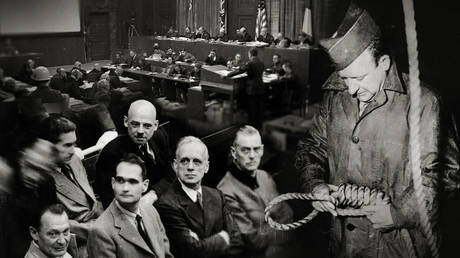
Putting an industrial genocide machine on trial required turning its own filing cabinets into the prosecution's sharpest weapon. Eighty years after the Nuremberg trials opened in a shattered German city, the central problem of international justice remains unchanged: ordinary legal rules were built to judge individual bandits and murderers, not state bureaucracies engineered to exterminate millions under the cover of law.
Conventional courts look for a smoking gun held by one pair of hands. A totalitarian regime works differently. Clerks draft timetables for deportation trains; engineers calibrate gas chambers; ministries rebrand mass murder in polite administrative euphemisms; generals sign orders that cascade through millions of soldiers. When prosecutors at Nuremberg faced twenty-one major Nazi defendants in the dock—and nearly two hundred more in subsequent proceedings—they were not merely charging men with street crimes. They were attempting to dissect a state apparatus without letting individual culprits hide behind the system they built. For another look, check out: this related article.
The photograph above captures the stark visual geometry of that experiment. Uniformed military guards stand behind rows of once-untouchable officials, generals, and party barons stripped of their pomp and placed under legal scrutiny. Looking at those faces, it is easy to see why observers at the time wondered whether a courtroom could contain crimes of that scale without collapsing into either theater or vengeance. Similar analysis on the subject has been shared by BBC News.
Why Traditional Law Struggled With State Atrocity
Classic criminal law assumes a neat divide between the state and the individual. If a citizen commits murder, the state prosecutes. When the state itself organizes deportation, starvation, slave labor, and mass execution, that neat divide breaks down.
Under the legal orthodoxy dominant before 1945, sovereign states were treated as supreme actors within their own borders, and subordinates who carried out orders from superiors often claimed immunity. Worse still, the Nazi regime had wrapped its persecution in domestic decrees and statutes. Acts that horrified the rest of the world were frequently "legal" inside Germany under rules written by the regime itself.
"That four great nations, flushed with victory and stung with injury stay the hand of vengeance and voluntarily submit their captive enemies to the judgment of the law is one of the most significant tributes that Power has ever paid to Reason."
That line from U.S. Supreme Court Justice Robert H. Jackson, who took leave to serve as Chief U.S. Prosecutor, states the ideal with clarity. Reality was messier. Convincing four Allied powers—the United States, the United Kingdom, the Soviet Union, and France—to agree on a single courtroom procedure meant reconciling rival legal traditions, from Anglo-American common law to civil-law systems shaped by Roman jurisprudence. It also meant accepting uncomfortable compromises so the tribunal could function at all.
Consider the structural tension built into the London Charter of August 1945. The Charter defined three core categories of offenses: crimes against peace (planning or waging aggressive war), war crimes (violations of the laws and customs of war), and crimes against humanity (murder, extermination, enslavement, deportation, and persecution of civilian populations). Just as importantly, it barred defendants from hiding behind head-of-state immunity or claiming a blanket defense of "superior orders," though following orders could still be weighed in mitigation of punishment.
Paper Trails Over Dramatic Witnesses
A common misconception is that the Nuremberg trials succeeded because dramatic survivor testimony overwhelmed the accused. Witness accounts mattered deeply in establishing human reality, yet prosecutors knew that defense lawyers could attack memory, bias, or translation errors under cross-examination.
Paper was harder to impeach. The Allied advance across Germany captured mountains of ministerial files, military orders, financial ledgers, and correspondence written by the perpetrators themselves. Instead of relying solely on memory, prosecutors built a forensic paper trail showing how policy moved from drafting tables in Berlin to killing sites across occupied Europe.
Bureaucratic language did much of the incriminating work. Officials wrote about "special treatment," "resettlement," and "evacuation" while moving human beings toward death. Placed side by side with operational reports and camp records, those clinical phrases exposed the cold mechanics of state policy.
| Legal Concept | What It Targeted at Nuremberg | Practical Limitation or Friction |
|---|---|---|
| Crimes against peace | Planning, preparing, initiating, or waging wars of aggression | Raised questions about retroactive criminal definitions and victor blind spots |
| War crimes | Violations of established rules of warfare, including mistreatment of prisoners and civilians | Easier to anchor in existing treaties, yet unevenly applied across theaters |
| Crimes against humanity | Widespread or systematic atrocities against civilians, including persecution on racial, religious, or political grounds | Required linking pre-war domestic persecution to wartime aggression in the main judgment |
| Rejection of superior orders | Prevented subordinates from escaping accountability solely by citing orders from above | Left moral and legal gray areas for low-ranking conscripts versus senior planners |
That insistence on documentary proof also had a quiet credibility payoff. When the evidence for a specific charge against an individual defendant fell short, the tribunal acquitted rather than manufacturing guilt to satisfy public anger. Three defendants in the main trial were acquitted. That result infuriated some critics who saw the entire enterprise as rigged, yet it gave the verdicts a legal weight that a show trial could never possess.
The Uncomfortable Flaws Nobody Can Ignore
Celebrating Nuremberg without examining its flaws turns history into mythology. The tribunal was convened by victorious powers sitting in judgment over the defeated. That asymmetry is not a minor footnote; it is the central fault line of international criminal justice.
Soviet participation exposed the contradiction starkly. The Soviet delegation sat as prosecutor and judge while the Soviet state had itself committed mass atrocities—including the 1940 Katyn Forest massacre of Polish officers, which Soviet officials brazenly tried to blame on the Germans during the proceedings. Meanwhile, Western Allied bombing campaigns against German cities and ongoing colonial conflicts sat outside the tribunal's mandate.
Critics also raised sharp questions about retroactive justice. Had aggressive war or crimes against humanity been clearly codified as individual crimes with fixed penalties before 1939? Legal scholars debated that point fiercely in 1945 and 1946. Prosecutors argued that certain acts shock the conscience of humanity so fundamentally that offenders cannot claim ignorance or hide behind domestic statutes. Skeptics countered that stretching legal definitions after the fact weakens the rule of law even when the moral outcome feels right.
To understand how a modern legal team faces a similar structural puzzle without copying Nuremberg word for word, consider a hypothetical example. Suppose an intelligence and security agency uses automated surveillance software to flag dissidents for arbitrary detention across three provinces. If investigators only charge the local police officer who pulled the lever on a single arrest, the software architects, data brokers, and cabinet ministers who authorized the targeting criteria walk free. Holding the entire chain accountable requires tracing authorization, design, and execution together—while proving each person's specific role rather than lumping everyone into vague collective guilt.
How Nuremberg Echoes Eighty Years Later
Eighty years on, the Nuremberg trials still frame how jurists, journalists, and citizens argue about mass atrocity. The Nuremberg Principles articulated by the United Nations International Law Commission in 1950—individual criminal responsibility, the supremacy of international law over conflicting domestic law, and the refusal to treat official status or superior orders as automatic shields—helped shape later tribunals for the former Yugoslavia and Rwanda as well as the International Criminal Court.
Yet modern conflicts have exposed new friction points that the 1945 prosecutors could scarcely have imagined in full detail. Asymmetric proxy networks obscure chains of command. Commercial satellite imagery, leaked databases, and digital communications generate vast oceans of evidence that must be authenticated against synthetic media and state disinformation. Archival digitization initiatives—such as major efforts making Nuremberg transcripts and documents searchable online—have expanded public access to the historical record at a moment when truth itself is routinely contested.
Equally urgent is the enforcement gap. A court charter is only as strong as the states willing to arrest suspects, surrender records, and submit their own conduct to scrutiny. When major powers treat international law as a tool for rivals while exempting themselves and their allies, the old charge of victor's justice returns with renewed force.
Anyone tracking contemporary war crimes investigations or debates over global accountability should start by reading primary trial records and judgments directly rather than relying on secondhand slogans. Look closely at how each charge is proven, where documentary evidence holds up under scrutiny, and where political power still dictates who stands in the dock and who never appears at all.



