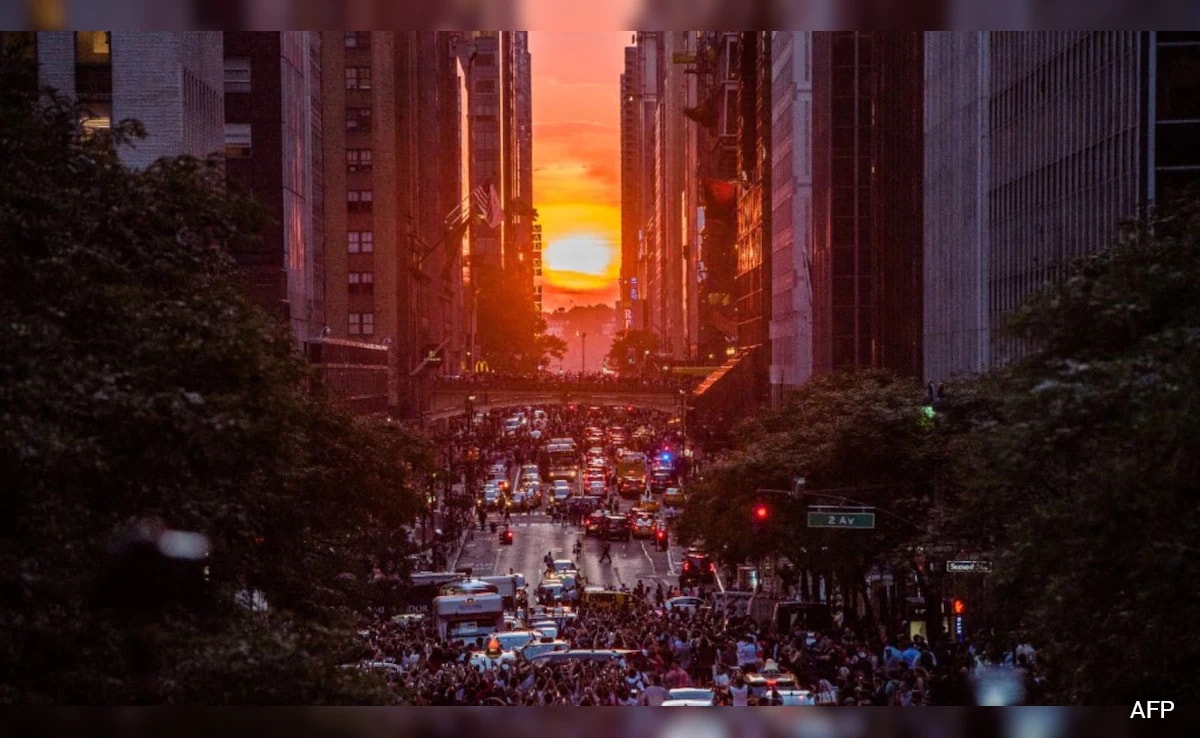
Every summer, thousands of people crowd onto the hot asphalt of 42nd Street, holding up smartphones, desperately trying to catch a glimpse of Manhattanhenge. It's a massive urban ritual. The sun aligns perfectly with New York City's grid, casting a blinding, cinematic glow down the steel canyons.
But honesty forces me to tell you that most people do it completely wrong. They show up at the wrong time, stand on the wrong blocks, and get their views blocked by a city bus or an aggressive tourist elbow.
If you want to actually experience this phenomenon instead of just looking at the back of someone else's head, you need a strategy. This isn't just about showing up for a pretty sunset. It's an intersection of nineteenth-century urban planning and cosmic geometry that turns Manhattan into a modern-day Stonehenge.
The 1811 Accident That Created a Spectacle
New York wasn't built to honor the sun god. It was built for real estate. In 1811, city planners established the Commissioners' Plan, laying out the regular, rectangular street grid we know today. They didn't align the grid with true geographic north and south. Instead, they tilted it roughly 30 degrees clockwise to match the natural shape of Manhattan island.
That slight tilt is exactly why Manhattanhenge happens.
If the grid ran perfectly east to west, the sun would align with the streets on the equinoxes in March and September. Because of the 30-degree rotation, the alignment shifts. Renowned astrophysicist Neil deGrasse Tyson noticed this relationship and coined the phrase "Manhattanhenge" back in the late 1990s. He drew the comparison to Stonehenge, where the ancient stones line up precisely with the solstices. In New York, our standing stones are skyscrapers.
When the sun hits the exact azimuth of 299.1 degrees, it lines up perfectly with the cross streets. For a few minutes, the setting sun illuminates both the north and south sides of every single brick and steel building along the grid. It's a striking visual that only happens four times a year.
The Crucial Difference Between Full Sun and Half Sun
People often talk about Manhattanhenge as a single night, but the American Museum of Natural History tracks four distinct dates every summer. You have to choose between the full-sun grid and the half-sun grid. They offer completely different visual experiences.
The full-sun alignment means the entire burning orb sits right on the horizon, perfectly framed by the buildings. It looks like a giant glowing ball floating at the end of the street. The half-sun alignment happens when the top half of the sun rests on the horizon while the bottom half has already dipped below it.
Summer Dates and Exact Times
- May 28: Half-Sun alignment at 8:14 p.m. EDT
- May 29: Full-Sun alignment at 8:13 p.m. EDT
- July 11: Full-Sun alignment at 8:20 p.m. EDT
- July 12: Half-Sun alignment at 8:21 p.m. EDT
The May dates happen right before the summer solstice, and the July dates occur just after. If you want the absolute brightest, most intense light, aim for the full-sun nights. If you prefer a moodier, more defined silhouette of the city streets, the half-sun nights are superior.
There's also a winter version. Around December and January, a reverse Manhattanhenge happens during sunrise. But let's be real: standing on a freezing street corner at 7:00 a.m. in January doesn't quite have the same appeal as a warm July evening.
Where to Stand to Beat the Crowds
The default advice is always to head to 42nd Street near the Tudor City Overpass. Don't do that to yourself unless you enjoy being packed like a sardine. The overpass fills up hours in advance with professional photographers who will aggressively defend their tripod territory.
You need to think like an insider. The key to getting a great view is finding wide cross streets with iconic architecture to frame the shot. You also want to position yourself as far east as possible. The further east you go, the longer the street canyon looks, and the more dramatic the sun appears as it sinks toward New Jersey.
The Best Cross Streets
- 34th Street: This is a phenomenal alternative to 42nd Street because you get the Empire State Building framing your view. Stand near Park Avenue or Lexington Avenue and look west.
- 23rd Street: The Flatiron district provides great architectural angles. The streets here are wide enough to let a massive amount of golden light pour through.
- 14th Street: Often overlooked, 14th Street is wide and busy, giving you a very gritty, classic New York energy as the sun goes down.
- 72nd and 86th Streets: If you want to escape Midtown entirely, head to the Upper West Side. The cross streets here offer excellent views, and the crowds are vastly more manageable.
The Secret Outer-Borough View
If you want to skip Manhattan entirely, cross the river. Go to Hunter's Point South Park in Long Island City, Queens.
From the waterfront, you can look straight across the East River down the canyons of Manhattan's grid. You get to see the light hitting multiple streets simultaneously from a distance, reflecting off the water. It's a much more relaxed vibe, and you won't have to dodge traffic.
Survival Tips for Shutterbugs and Spectators
Let's talk logistics. If you show up at 8:10 p.m. for an 8:13 p.m. sunset, you're going to miss it. The actual alignment lasts for only three to five minutes.
You need to arrive at least 45 minutes early. This gives you time to scout a safe spot on the sidewalk. Be smart about traffic. New York drivers don't care about your Instagram feed; they want to get through the intersection. When the light turns green, the crowd inevitably spills into the crosswalks to snap photos. Keep your head on a swivel.
Check the weather report. If it's completely overcast, Manhattanhenge is effectively canceled. A few light clouds can actually make the sunset more dramatic, but a heavy gray sky means you're just standing on a crowded street corner for nothing.
If you're shooting with a smartphone, turn off your flash. It sounds obvious, but you'll see hundreds of flashes firing uselessly into the sky. Instead, tap on the brightest part of the sun on your screen to lower the exposure. This prevents the image from blowing out into a blurry white mess and preserves the deep orange and purple tones of the sky.
After the sun drops below the horizon, don't run away immediately. The sky stays illuminated with a brilliant twilight glow for another fifteen minutes. The crowds usually scatter the second the sun disappears, leaving the sidewalks wide open for some of the best blue-hour photos you can get all year. Walk a few blocks away from the main viewing hubs to find an open outdoor table at a local spot, grab a cold drink, and let the grid traffic clear out.