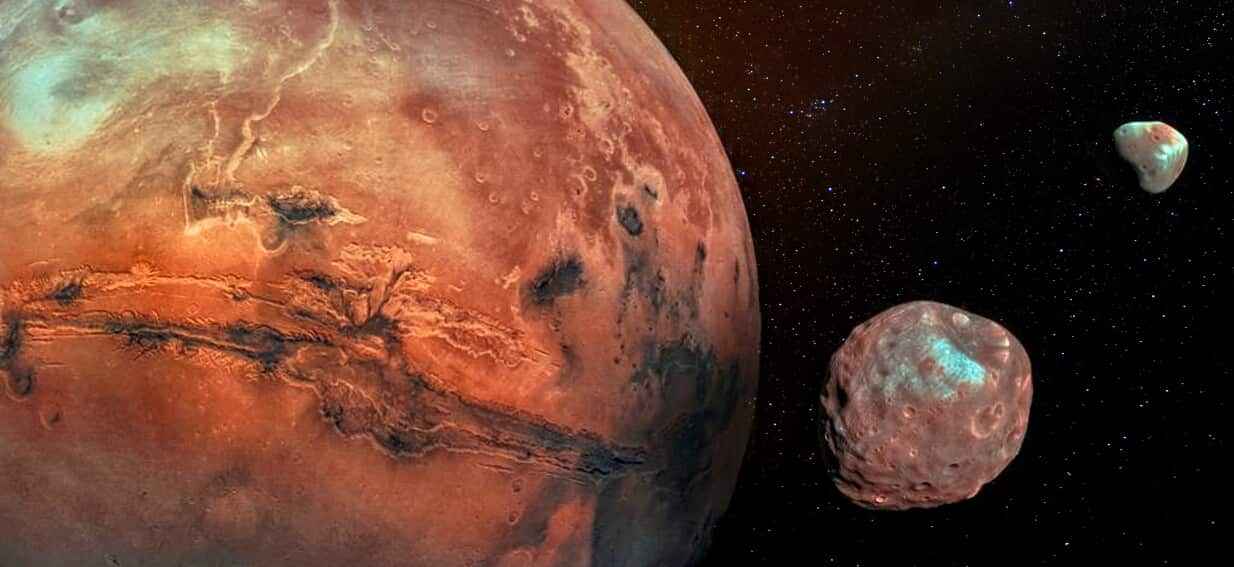
Everyone loves a headline that promises Mars will change overnight. The truth is quieter, dirtier, and way more interesting. Japan is exploring Phobos, a potato-shaped little moon orbiting Mars, with the Martian Moons eXploration mission led by JAXA. What they bring back won't rewrite human biology in a single afternoon, yet it could settle a decades-old argument about how rocky planets form, whether life's ingredients hitchhike across space, and how future crews refuel on their way to the red planet.
Phobos is tiny. Its mean radius is only about 11 kilometers (roughly 6.8 miles), which makes it small enough that you could drive around its equator in a few hours if you didn't get stuck in a crater. Gravity there is less than one-thousandth of Earth's. Drop a wrench on Phobos and it doesn't thud; it floats down lazily like a feather in slow motion.
Still, size doesn't equal irrelevance. Phobos hugs Mars tightly, orbiting roughly 6,000 kilometers above the Martian surface, closer than any other known moon in the solar system is to its planet. Because that orbit is slowly decaying due to tidal forces, Phobos is doomed over tens of millions of years either to break apart into a ring or crash onto Mars. That makes this little moon a ticking clock and a time capsule rolled into one.
Why Phobos Matters More Than Another Mars Rover
Rovers on Mars are great, don't get me wrong. Curiosity and Perseverance have given us jaw-dropping geology from Gale and Jezero craters. Yet Mars itself is a messy place. Wind storms, dust, volcanic ash, radiation, and surface chemistry have battered and altered rocks over billions of years.
Phobos sits above much of that surface churn. If Phobos is a captured asteroid from the outer solar system or the main asteroid belt, its dark, carbon-rich surface may hold primitive material from the early solar system that barely changed since planets first clumped together. If instead Phobos formed from debris knocked off Mars during a massive collision, its rocks will tell us what the young Martian crust and mantle looked like before everything got scrambled.
Honestly, that distinction is the whole ballgame. Planetary scientists have argued for years over the captured-asteroid versus giant-impact origin stories. Looking at pixels from orbit only gets you so far when surface dust and dark regolith look ambiguous under a spectrometer. Bringing actual material back to Earth lets laboratories use instruments that will never fit on a spacecraft.
Think about what Hayabusa and Hayabusa2 already proved for JAXA. Returning samples from small bodies isn't a stunt anymore; it's a specialty. Applying that hard-won sample-return playbook to a moon orbiting another planet is a huge leap in engineering ambition, even if some folks treat it like a side quest compared to landing humans on Mars.
The Origin Debate Nobody Can Settle From Orbit
Walk into a planetary science conference and ask ten researchers where Phobos came from. You won't get ten identical answers, though you will get strong opinions.
One camp favors capture. Phobos looks dark, lumpy, and vaguely asteroid-like, much like primitive C-type or D-type asteroids. Capturing a body into a neat, nearly circular equatorial orbit around Mars isn't easy—you need a way to bleed off orbital energy, such as atmospheric drag or a three-body interaction—yet modelers keep trying to make the math work.
The other camp leans toward a giant impact. A massive object slamming into early Mars could have blasted a disk of debris into orbit, which then coalesced into moons—maybe a bigger moon or moons once existed alongside Phobos and Deimos. That model explains the low orbital inclination nicely, though explaining why Phobos looks so dark and porous requires extra tweaks.
What if Phobos is a hybrid? What if impact debris mixed with captured material, or what if Phobos is a rubble pile held together weakly by tiny gravity and surface forces? You can't guess your way out of that uncertainty forever. Lab analysis of returned grains—checking isotopic ratios of oxygen, titanium, or noble gases—gives scientists hard numbers instead of educated guesses.
What Samples Could Reveal About Water and Life's Building Blocks
When headlines say a mission's findings "could change everything," readers usually picture microbes waving hello from a rock. Let's keep our feet on the ground. Nobody has announced finding life on Phobos, and planetary protection rules exist for good reason.
What is realistic and super exciting is finding hydrated minerals, organic compounds, or volatiles trapped inside grains shielded from harsher conditions. Organic molecules in space are carbon-based compounds, not automatic proof of biology; meteorites and asteroids carry plenty of non-biological organics. Still, understanding how carbon, nitrogen, hydrogen, and oxygen get distributed across the inner solar system helps explain where planets get their water and prebiotic chemistry.
There's also a practical angle that gets overlooked. If Phobos holds accessible water—bound in hydrated minerals or ice—future mission planners could view the Martian moons as waystations rather than dead ends. Lifting propellant out of Earth's gravity well is expensive and brutal. Climbing out of Mars's gravity well is tough too. A moon with low escape velocity is a different kind of stepping stone, provided any resources there are actually usable rather than locked in trace amounts.
Let's be real, though. Turning a scientific discovery into an off-world fueling depot takes decades of infrastructure that doesn't exist yet. Treating Phobos as an immediate gas station is wishful thinking. Treating it as a testbed to measure what's really there? Smart, cautious planning.
Engineering Hurdles That Make Low Gravity Tricky
People assume low gravity makes landing easy. In practice, low gravity can make surface operations downright nerve-wracking.
On Earth, friction and weight help keep a lander planted. On Phobos, a gentle push or uneven touchdown can send hardware bouncing or drifting across terrain covered in fine regolith and sharp boulders. Touching down, grabbing a sample, and lifting back off without tipping over or choking mechanisms with dust demands tight control and careful timing.
International collaboration adds another layer of real-world complexity. JAXA leads the overall mission, while partners—including agencies and teams from France's CNES, Germany's DLR, and NASA—have contributed instruments or rover concepts. Coordinating flight software, navigation data, and science priorities across time zones and institutions isn't glamorous, yet it's how big space science actually gets done.
And remember: space missions operate on long timelines. Delays, orbital windows, and technical checks are normal parts of deep-space exploration, not signs of failure. Anyone expecting instant answers every few weeks is watching the wrong kind of drama.
Common Myths About Exploring the Martian Moons
A few misconceptions keep popping up whenever Phobos hits the news:
- Phobos is just a mini-Mars. Not really. It lacks Mars's atmosphere, magnetosphere history, and scale, and its low gravity shapes everything from cratering to dust behavior.
- Deimos is basically identical. Phobos and Deimos orbit the same planet, yet Deimos is smaller, orbits farther out, and has a smoother-looking surface in many regions. Comparing the two helps separate local Martian effects from broader moon history.
- Finding one clue proves alien life. Prebiotic chemistry or water traces inform origin stories; they don't equal biological life. Good science resists jumping straight to that conclusion.
- Sample return is easy once you arrive. Getting to orbit is half the trip. Collecting material cleanly and sending a return capsule back toward Earth with precision entry and recovery is notoriously unforgiving.
How to Follow the Science Without Getting Hyped
If you want to track this story like someone who actually cares about planetary science rather than clickbait, start with primary mission pages from JAXA and NASA Solar System Exploration. Read mission status updates and science objectives directly instead of relying solely on second-hand summaries that inflate every routine milestone.
Next, brush up on the basics of sample-return missions like Hayabusa2 and OSIRIS-REx. Seeing how scientists study tiny grains under microscopes and mass spectrometers makes it much clearer why a handful of soil from a tiny moon can answer questions that years of telescope observations couldn't touch.
Finally, keep an eye on the origin debate itself. Watch for discussions of spectral data, crater counts, and isotopic clues—those are the bread-and-butter signals that tell you whether the needle is moving toward captured asteroid, giant impact, or something weirder we haven't named yet.