Two rusty, dull pieces of metal sat inside a gold-filled Spanish museum display for sixty years without anyone realizing they fell from space.
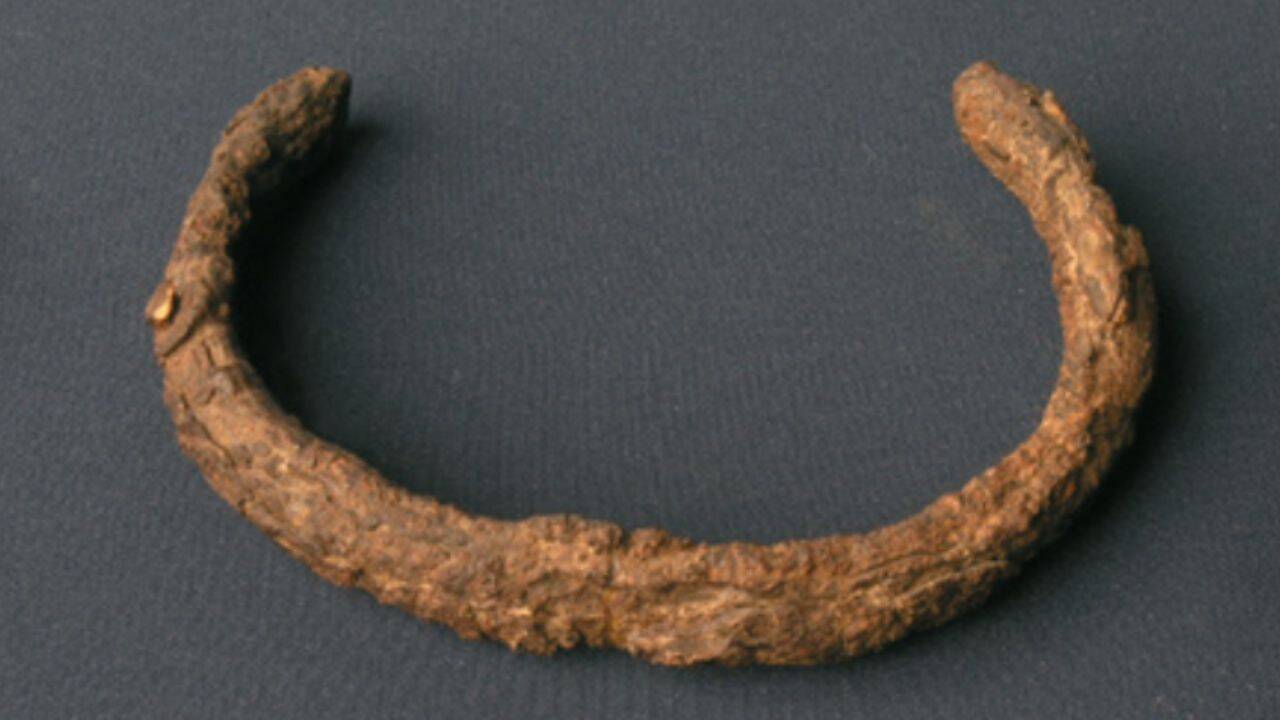
When archaeologists dug up the Treasure of Villena in 1963 near Alicante, Spain, they found 66 dazzling objects. Most were pure gold. Bowls, bracelets, bottles, and decorative caps glittered in the dirt, dating back to the Late Bronze Age between 1400 and 1200 BCE. Right alongside that blinding gold sat a small, hollow hemisphere coated in gold leaf and an open, corroded bracelet. Researchers assumed they were made of dark lead or standard terrestrial iron. They weren't. Chemical testing published in the journal Trabajos de Prehistoria proved both artifacts contain meteoritic iron—metal forged inside dying stars and delivered to Earth via space rocks long before Iberian metalworkers learned how to smelt iron ore from the ground.
Honestly, this changes how we look at Bronze Age Europe. Most people assume ancient civilizations stumbled into the Iron Age cleanly, trading bronze swords for iron ones overnight. That's completely backwards. Long before humans figured out how to heat iron ore to extreme temperatures, elite rulers prized "sky metal" as something rarer and far more valuable than gold.
Why the Villena Treasure Broke the Archaeological Timeline
To understand why these two corroded objects caused such a stir among metallurgists, you have to look at the calendar.
Terrestrial iron smelting didn't take off on the Iberian Peninsula until around 850 BCE. Yet the Treasure of Villena dates to roughly 1400–1200 BCE. Finding iron in a Bronze Age hoard creates an immediate chronological headache. Either the entire collection was buried centuries later than archaeologists believed, or the artisans got their hands on iron without knowing how to mine and smelt it.
Salvador Rovira-Llorens, the former head of conservation at Spain's National Archaeological Museum, led a team to solve that exact problem. You can't just slice into a priceless 3,000-year-old museum artifact with a saw. Instead, the researchers used mass spectrometry on microscopic samples scraped from the corrosion layers of both pieces.
They were hunting for one specific chemical signature—nickel.
Terrestrial iron ore dug out of the Earth's crust contains very little nickel. Meteorites, on the other hand, are packed with iron-nickel alloys. When the mass spectrometry results came back, the nickel levels in both the hollow hemisphere and the bracelet were dramatically higher than anything found in terrestrial iron. Even with heavy surface corrosion messing with the exact percentages, the data matched known meteoritic compositions.
How Bronze Age Smiths Worked Space Metal
Working with meteoritic iron wasn't like smelting bog iron or mining hematite. Bronze Age smiths had zero experience with blast furnaces capable of melting iron, which requires temperatures above 1,500 degrees Celsius.
Instead, they treated meteorites like weird, stubborn stones.
Because meteoritic iron naturally contains high levels of nickel, it's already an alloy. Smiths didn't need to smelt it from rock. They found raw chunks of iron meteorites on the ground, heated them in charcoal fires until they softened slightly, and hammered them cold or warm into shape. It was brutal, exhausting work. You couldn't pour it into a mold like bronze. You had to beat it into submission, annealing it repeatedly so it wouldn't crack under the hammer.
Look at the two Villena pieces again with that process in mind.
- The hollow hemisphere likely capped the pommel of a ceremonial sword or scepter, wrapped partially in thin gold foil to contrast the dark, matte iron against bright yellow metal.
- The C-shaped bracelet weighed around 140 grams and was hammered into a thick, open ring meant to be worn openly as a badge of extreme status.
At the time, gold was already abundant in certain parts of Iberia. Meteoritic iron wasn't. Wearing a bracelet hammered from a fallen star told everyone in the room that you commanded resources nobody else could touch.
It Wasn't Just Spain Using Sky Metal
People often treat the Villena discovery like an isolated fluke, which misses the bigger picture of ancient metallurgy. Across the Mediterranean and Near East, Bronze Age elites were obsessed with celestial iron centuries before the true Iron Age began.
The most famous example sits in Cairo. King Tutankhamun was buried in Egypt around 1323 BCE—right around the same window as the Villena treasure—with an ornate dagger tucked into his linen wrappings. For decades, historians wondered how an Egyptian pharaoh owned a rust-free iron blade centuries before Egypt developed iron smelting. In 2016, X-ray fluorescence spectrometry confirmed the dagger's blade contained nearly 11 percent nickel and trace amounts of cobalt. It came straight from a meteorite, likely the Kharga meteorite found west of Alexandria.
We see the exact same pattern elsewhere in the ancient world.
In ancient Mesopotamia and Anatolia, cuneiform tablets explicitly distinguish between standard metals and "iron from heaven." Hittite texts from the second millennium BCE list meteoritic iron among royal gifts exchanged between kings, treating it as a sacred material tied directly to the sky gods. In Greenland, centuries later, Inuit communities cold-hammered fragments from the massive Cape York meteorite into harpoon blades and knives using stone hammers, proving that meteoritic ironworking didn't even require Bronze Age furnace technology.
The Villena artifacts stand out because they represent the first confirmed meteoritic iron objects ever identified on the Iberian Peninsula. Before this study, Western Europe had almost no hard chemical proof that Bronze Age Iberian smiths were harvesting space rocks alongside their gold and copper.
What Makes Testing Ancient Iron So Tricky
If mass spectrometry solves this so easily, why did it take sixty years to test the Villena hoard?
Because rust destroys evidence.
When iron sits underground for three millennia, oxygen and moisture eat away at the metal, turning crisp metallic alloys into flaky iron oxides. Corrosion leaches nickel out of the surface layers over time, dropping the nickel concentration until it looks dangerously close to terrestrial iron. If a lab tests only the outer crust of a heavily corroded artifact, they'll get a false negative every single time.
Rovira-Llorens and his colleagues had to account for that exact degradation. They compared the degraded nickel ratios in the Villena bracelet and hemisphere against known corrosion curves for meteoritic iron. While the numbers were lower than pristine, unweathered meteorite samples—which usually run between 5 and 20 percent nickel—they were still far too high to come from Iberian iron mines.
The researchers also acknowledged a realistic limitation in their paper. Because the artifacts are too fragile and culturally priceless to drill deeply into their cores, future non-invasive testing—like neutron tomography or high-energy X-ray imaging—will eventually give an even sharper picture of the uncorroded metal trapped inside.
How to Spot Real Meteoritic Iron vs Terrestrial Iron
If you're ever wandering through an archaeological museum—or examining historical metalwork—you can't identify meteoritic iron with the naked eye, especially once it's covered in brown rust. Still, context and metallurgy leave clear clues that separate Bronze Age space metal from later Iron Age tools.
- Check the archaeological date. Any iron artifact firmly dated before 1000 BCE in Europe or the Mediterranean is an immediate suspect for meteoritic origin, because true smelting hadn't spread there yet.
- Look at the pairing with gold. Bronze Age smiths didn't use meteoritic iron for plows, nails, or basic cookware. They paired it with gold, silver, and ivory in ceremonial weapons and royal jewelry.
- Watch for Widmanstätten patterns on polished cuts. On modern or uncorroded meteoritic iron etched with mild acid, intersecting bands of kamacite and taenite form a geometric crystalline grid that never occurs in Earth-made steel.
- Verify nickel and cobalt ratios. True meteoritic iron almost always carries 5% to 20% nickel alongside measurable cobalt, whereas early bloomery iron smelted from Earth ore contains virtually zero nickel.
Next time you visit a history museum and walk past a display of shimmering gold jewelry, slow down and look at the dull, corroded gray pieces sitting in the corner of the case. In the Bronze Age, those rough dark metals weren't cheap filler—they were pieces of the sky, hammered by hand and prized above all the gold in the room.


