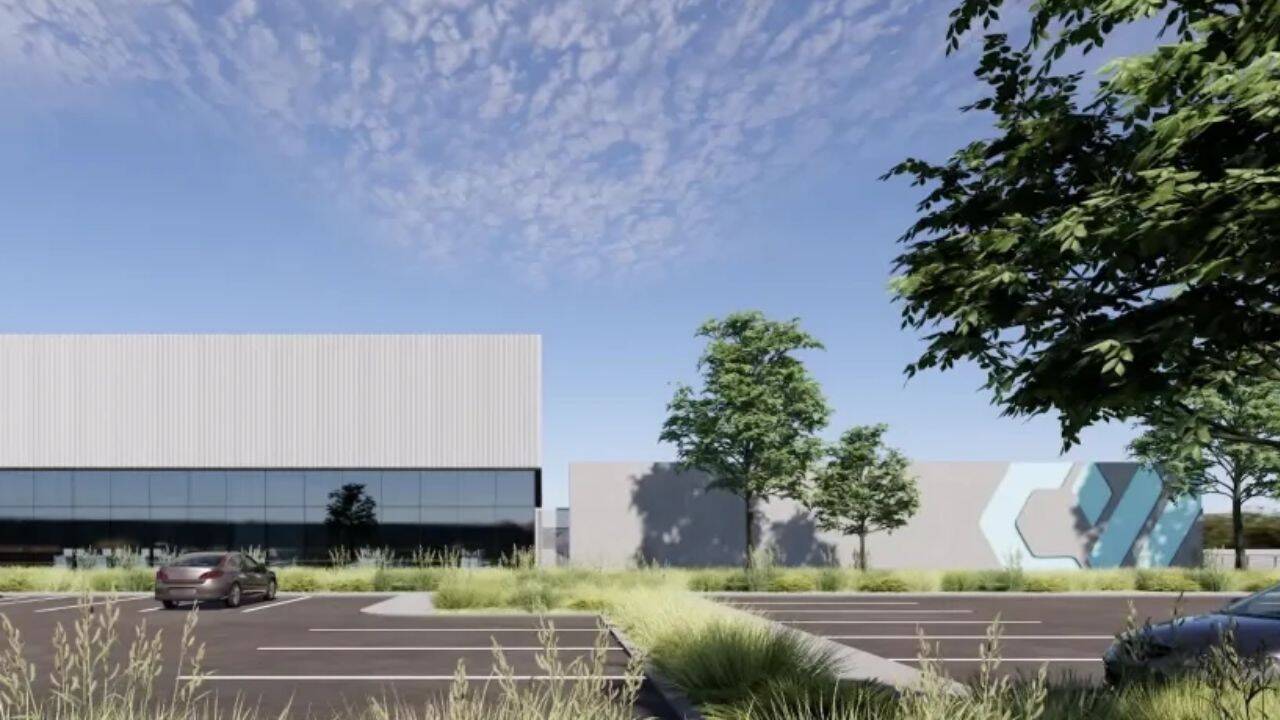
They are celebrating a $1.4 billion miracle in rural Pennsylvania. 194 families. 4,466 acres. A rubber-stamped zoning approval that local officials are parading around like they just landed the Apollo program in their backyard.
Stop clapping. Look at the math.
When a county government rezones nearly seven square miles of agricultural or open land for a single hyperscale data center campus, they aren’t buying a ticket to the digital gold rush. They are signing a permanent lease on a high-voltage ghost town. The mainstream press loves the big, shiny capital expenditure number—$1.4 billion sounds like generational wealth for a quiet township. It sounds like bustling main streets, overflowing diners, and endless property tax revenue.
Except servers don't buy cheeseburgers. Graphics processing units don't send kids to local Little League. And concrete tilt-up warehouses packed with liquid-cooled racks do not create the economic multiplier that local zoning boards hallucinate when they see ten-figure press releases.
I have sat across the table from municipal planners, utility executives, and site-selection consultants for fifteen years. I have watched towns bend over backward to give away their zoning authority, their water rights, and their grid capacity to hyperscalers, only to realize five years later that they traded irreplaceable land for thirty-five permanent security and maintenance jobs. The competitor coverage of this Pennsylvania deal repeats the same lazy consensus we hear from Northern Virginia to Central Ohio: Data centers equal economic salvation.
That consensus is a lie. Here is what actually happens when 4,466 acres get swallowed by the cloud.
The $1.4 Billion Mirage and the CapEx Trap
The biggest trick in modern industrial development is convincing local politicians to confuse Capital Expenditure (CapEx) with Operational Expenditure (OpEx) in the local economy.
When a developer announces a $1.4 billion data center project, 80% to 85% of that money never touches the county line. It goes straight to Silicon Valley, Taiwan, and Austin. It buys NVIDIA H200s or Blackwell racks, custom switchgear, uninterruptible power supplies, and industrial chillers manufactured thousands of miles away. The local township gets the dirt work, the concrete pour, and the steel erection.
Yes, construction brings a temporary sugar high. You get 1,500 pipefitters, electricians, and ironworkers staying in local hotels and buying gas for eighteen to twenty-four months. Then the ribbon gets cut, the trailers pull out, and the parking lot empties.
Compare a 4,466-acre data center campus to a traditional manufacturing plant or a regional logistics hub on a fraction of that footprint. A legacy automotive or heavy manufacturing facility on 500 acres easily employs 1,200 to 2,500 permanent workers across multiple shifts. A hyperscale campus of the exact same physical scale requires roughly 0.05 to 0.1 employees per megawatt once operational. Even if this Pennsylvania site scales to 300 or 400 megawatts over a decade, you are looking at a permanent headcount that could fit inside a single high school gymnasium.
If you are a county commissioner, you just burned 4,466 acres of developable inventory—an area roughly the size of ten Magic Kingdoms—for a payroll smaller than a mid-sized regional hospital.
194 Families and the Assemblage Illusion
Let’s talk about the 194 families involved in this land assemblage.
In real estate circles, pulling together 194 separate parcels to create a 4,466-acre mega-site is treated like a masterclass in dealmaking. Land assemblers descend on rural communities with non-disclosure agreements, option contracts, and offers priced at two or three times agricultural value. For the individual farmer or homeowner, taking the payout is completely rational. Farming margins are brutal, property taxes are rising, and a seven-figure check solves a lot of immediate problems.
Nobody blames the 194 families for cashing out. The failure belongs to the zoning board that treated a private land assemblage as a public zoning mandate.
Once you rezone 4,466 contiguous acres from agricultural or low-density residential to heavy industrial/data center use, you trigger an irreversible ratchet effect:
- You destroy land optionality forever. You will never turn a concrete pad reinforced for 3,000-pound server racks back into Class I or Class II prime farmland.
- You create an infrastructure moat. The surrounding properties—the families who didn't sell—are now boxed in by high-voltage transmission corridors, substation yards, and 24/7/365 mechanical hum from rooftop chillers and backup diesel generator testing.
- You lock in a single-tenant dependency. If the hyperscaler delays Phase 2 because AI training architectures shift toward smaller, more efficient edge clusters, the township is stuck with half-graded dirt and unbuilt tax promises.
The Grid Reality Check Nobody Wants to Print
To understand why Pennsylvania is suddenly ground zero for these mega-deals, you have to look past the real estate and stare directly at the PJM Interconnection queue.
Northern Virginia—the undisputed capital of the global internet—hit a brick wall. Dominion Energy ran out of transmission capacity, substations backed up for years, and Loudoun County residents finally revolted against living inside a giant humming refrigerator. So the hyperscalers did what they always do when they exhaust a resource: they marched north along the high-voltage transmission lines into Pennsylvania.
Pennsylvania has legacy coal and nuclear generation footprints, natural gas reserves in the Marcellus Shale, and existing bulk transmission lines. On paper, it looks like an energy paradise.
In reality, the PJM grid is already flashing red. Capacity auction prices in PJM recently exploded by more than 800% in a single cycle, jumping from $28.92 per megawatt-day to $269.92 per megawatt-day. Why? Because massive, flat-load data centers are sucking gigawatts of baseload power off the grid faster than utilities can build new generation or clear interconnection bottlenecks.
When a $1.4 billion data center plugs into rural Pennsylvania, it doesn't just consume power. It shifts the cost of grid upgrades onto every residential ratepayer and small business in the region. Utility rate structures socialize transmission investments across the customer base. While the tech giant negotiates a bespoke economic development tariff behind closed doors, the retired couple living three miles down the road watches their monthly electric bill climb to subsidize the substations required to keep AI chatbots running.
Water, Diesel, and the Environmental Shell Game
Mainstream articles love to mention that modern data centers use "closed-loop cooling" so they don't waste water.
Ask any mechanical engineer who actually commissions these facilities what happens when the ambient wet-bulb temperature crosses 85 degrees in July. Closed-loop systems still rely on evaporative cooling towers or adiabatic assist systems during peak summer heat to keep Power Usage Effectiveness (PUE) below 1.2. A single 100-megawatt facility can easily evaporate 300,000 to 500,000 gallons of water per day during peak load. Multiply that across a multi-thousand-acre campus, and you are pulling millions of gallons out of local watersheds during the exact months when agricultural irrigation needs it most.
Then there is the backup power problem.
Because data centers demand 99.999% uptime ("five nines"), every single megawatt of IT load must be backed up by on-site generation—almost exclusively Tier 4 diesel generators. A 300-megawatt campus requires roughly 100 to 150 massive industrial diesel engines sitting in rows behind chain-link fences, each holding thousands of gallons of fuel. They don't just sit silent; they must be load-tested monthly, pumping nitrogen oxides and particulate matter into rural airsheds that previously had pristine air quality.
Dismantling the "People Also Ask" Fantasy
Whenever a mega-project like this clears zoning, local search engines light up with the exact same questions. Almost all of them are built on flawed premises planted by developer PR firms.
"Will a $1.4 billion data center lower my local property taxes?"
No. At best, it will temporarily slow the rate at which your taxes increase—and only if the county didn't give away the store in tax abatements.
Pennsylvania, like over 30 other states, aggressively competes on tax incentives for data center equipment. When states exempt sales and use taxes on servers, chillers, and electrical gear, they wipe out the single largest revenue stream the facility generates. Local townships are left collecting tax strictly on the real estate value of the shell building and the raw land. Furthermore, because the assessment value of a specialized data center shell depreciates rapidly as power densities evolve, developers routinely sue local tax assessors five years post-construction to slash their property valuations by 40% to 60%.
"How many jobs does a 4,466-acre data center actually create?"
Far fewer than you think, and almost none of them will go to displaced local workers.
Industry benchmarks from the Uptime Institute and CBRE confirm that hyperscale facilities operate on hyper-lean staffing models. You need a handful of critical facility engineers (usually poached from nuclear plants, Navy nuclear programs, or rival data centers), a rotating crew of third-party security guards, and a few fiber technicians. If a township approves 4,466 acres expecting a manufacturing-style employment boom, they have fundamentally misunderstood the business model of cloud computing. The entire point of a hyperscale data center is automation at scale.
"Why do data centers need 4,466 acres if the buildings are only a million square feet?"
They don't need it for servers. They need it for buffers, substations, and real estate banking.
A modern two-story hyperscale building takes up maybe 25 to 40 acres including parking and generator yards. Developers assemble 4,466 acres for three reasons:
- Acoustic and visual setbacks: Putting half a mile of trees and dirt between the chillers and the neighbors prevents noise lawsuits.
- On-site power generation: Companies are increasingly building "behind-the-meter" natural gas turbines or solar arrays directly on-site because the public grid can't connect them fast enough.
- Land banking: Locking up 4,466 acres prevents competitors from building nearby and stealing local fiber routes or substation capacity.
What Smart Communities Do Instead (And Why Most Fail)
Look, I am not anti-technology, and I am certainly not suggesting we turn off the internet. Compute infrastructure has to live somewhere. If a township has brownfield industrial land—an old steel mill, a retired coal-fired power plant with existing high-voltage switchyards, or a contaminated quarry—putting a data center there is a slam dunk. You reuse dead dirt, tap into existing transmission lines, and collect tax revenue from a parcel that was producing zero dollars.
Taking 4,466 acres of intact rural land and 194 family parcels to build greenfield server farms is the exact opposite of smart land-use planning.
If a municipality insists on approving these mega-campuses, they need to stop acting like desperate suitors and start negotiating like ruthless private equity partners. Any zoning board approving a project over 500 acres should demand four non-negotiable clawbacks before a single shovel hits the dirt:
- Mandatory Waste-Heat Recovery: A 300-megawatt data center produces enough low-grade thermal energy to heat thousands of homes, commercial greenhouses, or local industrial processes. Forcing the developer to build a district heating loop or co-locate agricultural greenhouses turns a thermal liability into a permanent local industry.
- Zero-Abatement Equipment Clauses: Never waive local property or business privilege taxes on the mechanical and electrical infrastructure. The building shell is worth pennies compared to the transformers, switchgear, and cooling plants inside it.
- Behind-the-Meter Generation Mandates: Require the developer to fund and build dedicated generation capacity so they do not cannibalize existing PJM grid headroom or trigger rate hikes for residential ratepayers.
- Phased Rezoning Triggers: Do not rezone 4,466 acres on Day One. Rezone 500 acres for Phase 1. Hold the remaining 3,966 acres in agricultural zoning until the developer proves they have energized the first phase, hit their employment minimums, and paid their first three years of full property tax assessments.
The Uncomfortable Truth About Leverage
Why don't rural Pennsylvania townships demand those terms?
Because the developers play counties against each other like chess pieces. The moment a township supervisor asks tough questions about water consumption, PJM capacity charges, or phased zoning, the site-selection consultant threatens to pack their bags and take their "$1.4 billion investment" across the county line or down to Ohio.
Faced with the fear of missing out on a headline-grabbing number, local officials fold. They trade away 4,466 acres of permanent geography for a press release that lasts forty-eight hours.
Let’s be brutally honest about the trade-off. If your community is bankrupt, your tax base is collapsing, and you have no other economic prospects for the next fifty years, taking the data center cash and letting the servers hum might be your least-bad option. Sometimes survival requires selling the family silver.
Just don't call it a renaissance. And don't pretend that burying 4,466 acres of Pennsylvania under concrete, diesel tanks, and high-voltage fence lines is building a future for the people who actually live there.
The servers will run cool, the cloud will get faster, and the county will get its ribbon-cutting photo. Ten years from now, when the construction trailers are long gone and the electric bills are twice as high, those 4,466 acres will still be locked behind razor wire—quiet, empty, and working for someone else.