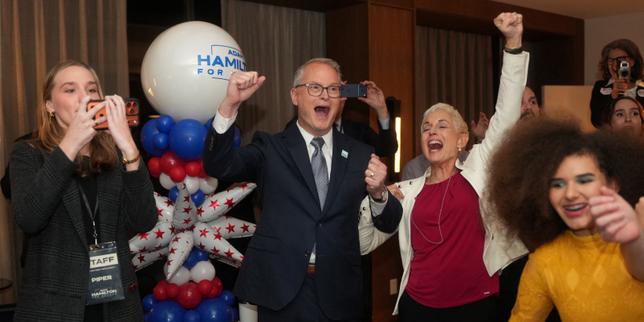
In the 2026 midterm elections, United Methodist pastor Adam Hamilton broke through decades of entrenched Republican dominance in Kansas by turning suburban moderate anxiety and faith-based community organizing into a decisive Democratic victory. Operating out of Leawood in Johnson County, Hamilton bypassed traditional partisan talking points and mobilized a coalition of disaffected conservatives, independents, and mainline Protestants who felt abandoned by hardline state politics.
Politics in Kansas usually follows a predictable script. You look at the map, you count the rural counties painted deep red, and you call the race before the polls even close in Topeka. For decades, national Democratic strategists treated the Sunflower State as a lost cause, a place where progressive money went to die and ambitious candidates went to pad their resumes before moving to the coasts. That conventional wisdom shattered during the 2026 midterm cycle. Expanding on this theme, you can find more in: Why Striking Russian Warehouses Changes the Ukraine War Forever.
The catalyst was not a seasoned Washington operative or a billionaire self-funder. It was Adam Hamilton, the longtime senior pastor of the United Methodist Church of the Resurrection. By translating the organizational muscle of America's largest United Methodist congregation into a disciplined civic engine, Hamilton engineered an electoral shockwave that caught both parties completely off guard.
The Architecture of a Suburban Rebellion
To understand how a pastor altered the political math in Kansas, you have to look at Johnson County. Located just across the state line from Kansas City, Missouri, this affluent, sprawling suburban hub is the economic engine of the state. For generations, it was also the reliable bedrock of the Kansas Republican Party. Analysts at The Guardian have also weighed in on this trend.
Times change. Over the past decade, the county has grown more diverse, more educated, and increasingly uneasy with the rightward lurch of the state legislature in Topeka. Yet, Democratic candidates consistently struggled to close the deal with these voters. Why? Because moderate suburbanites in the Midwest carry a deep, reflexive skepticism toward national Democratic branding. They dislike cultural lecturing from coastal elites almost as much as they dislike rigid ideological extremism from their own party.
Hamilton did not have that baggage. Having spent more than three decades building the Church of the Resurrection from a tiny startup in a funeral home into a multi-campus megachurch with tens of thousands of attendees, he possessed something no political consultant could manufacture. He had earned trust.
His approach to the 2026 campaign cycle relied on a simple, devastatingly effective premise. Instead of framing political choices as a battle between left and right, he framed them around civic neighborliness and basic competence. When a pastor who has baptized your children, counseled your marriage, and organized food drives during local emergencies tells you that public education funding and healthcare access are moral imperatives, you listen. You do not immediately reach for the partisan shield.
Why Traditional Partisan Playbooks Failed in the Heartland
Political operatives love data models. They love micro-targeting voters based on credit card purchases, cable subscriptions, and social media habits. In 2026, national committees poured millions into Kansas using these exact methods, saturating airwaves with attack ads that blurred together into white noise.
It barely moved the needle. Voters had developed an immunity to outrage.
Hamilton recognized early on that the traditional get-out-the-vote (GOTV) machinery was broken in suburban Kansas because it relied on transactional relationships. A paid canvasser knocking on a door in Overland Park with a clipboard and a script feels like an intrusion. A neighbor from your Sunday small group asking if you have a plan to vote feels like community.
Consider a hypothetical example of how this plays out on a Tuesday evening in October. A traditional campaign sends three glossy mailers warning a homeowner about extreme legislation in the statehouse; two go straight into the recycling bin, and the third gets used as a coaster. Now contrast that with a neighborhood captain from a local church network hosting a living-room discussion focused purely on local school boards, Medicaid expansion, and civil discourse. The second approach converts skeptics. The first just burns cash.
By leaning into relational organizing, the effort bypassed the media filter entirely. There were no viral soundbites designed for cable news panels. There was just relentless, face-to-face persuasion happening in coffee shops, church lobbies, and high school bleachers across the Third Congressional District and surrounding state legislative seats.
Deconstructing the Faith Voter Monolith
For nearly forty years, American political journalism has treated "the religious vote" as synonymous with white evangelical conservatism. That shorthand was always lazy, and by 2026, it had become actively misleading.
Kansas sits right at the fault line of American Protestantism. While evangelical churches hold significant sway in rural areas and parts of Wichita, mainline denominations—Methodists, Presbyterians, Lutherans, and Episcopalians—maintain a massive footprint in the metropolitan centers. These congregations have spent the last several years wrestling with internal schisms over theology, human sexuality, and the proper role of the church in public life.
Hamilton stood squarely at the center of those storms within the United Methodist Church, advocating for a "big tent" centrism that rejected rigid fundamentalism while maintaining traditional liturgical roots. That exact theological posture turned out to be the ultimate political asset.
- Rejection of Christian Nationalism: Many devout Kansans grew deeply uncomfortable watching faith reduced to a partisan weapon. Hamilton offered a counter-narrative grounded in the Social Gospel—caring for the poor, protecting the vulnerable, and upholding democratic norms.
- The Language of Grace: Rather than demonizing conservative neighbors, the messaging acknowledged their good intentions while questioning the real-world consequences of hardline policies.
- Institutional Credibility: Unlike pop-up political action committees that vanish the day after Election Day, the church infrastructure was permanent, visible, and deeply woven into the daily lives of voters.
When conservative commentators tried to paint the movement as radical or anti-religious, the attacks bounced off. You cannot credibly accuse a man who preaches traditional Christian scripture every Sunday of trying to destroy American values. The cognitive dissonance simply broke the standard attack playbook.
The Invisible Mechanics of the 2026 Turnout Surge
Winning a midterm election requires more than changing minds; it requires dragging reluctant voters to the ballot box when there is no presidential race at the top of the ticket. Midterm turnouts traditionally crater, especially among younger voters and political independents.
In 2026, Kansas defied the historical curve. Precinct-level data from Johnson, Douglas, and Wyandotte counties revealed an unusual spike in participation among ticket-splitters—voters who might have backed Republican candidates for local sheriff or county treasurer while casting ballots for Democrats in statehouse and federal contests.
This did not happen by accident. The campaign infrastructure treated civic participation as a spiritual discipline. Weeks before early voting began, volunteers mapped out precinct captains across dozens of suburban neighborhoods. They tracked not just party registration, but church attendance patterns, PTA involvement, and local civic club memberships.
They also ruthlessly exploited a critical blind spot in the state GOP's strategy. Confident in their structural advantage, Republican leaders focused heavily on primary challenges, pushing their candidates further to the right to satisfy base voters. By the time the general election arrived, those nominees were carrying positions on reproductive rights, public school vouchers, and tax policy that alienated the moderate center of Johnson County.
Hamilton's network stepped directly into that vacuum. They did not ask lifelong Republicans to abandon their identity. They simply asked them to hit the pause button on party loyalty for one election cycle to restore balance to Topeka.
The Counter-Argument and the Limits of the Model
Before national Democrats start printing blueprints to replicate the Kansas miracle across every red state from Alabama to Wyoming, a dose of reality is necessary. What worked in Leawood is not a universal skeleton key.
First, Adam Hamilton is an anomaly. Very few pastors possess his combination of communication skill, institutional scale, and personal charisma. Most clergy who wade into partisan politics end up fracturing their congregations, losing tax-exempt status anxiety, and alienating half their pews. Walking the razor's edge between moral advocacy and outright electioneering requires a level of discipline that most local leaders simply cannot sustain.
Second, the demographic specifics of the Kansas City suburbs are unique. Johnson County boasts one of the highest median household incomes and educational attainment rates in the Midwest. The voters who swung the 2026 midterms were largely college-educated professionals who already harbored doubts about the direction of the modern GOP. Trying to run this exact play in rural western Kansas—where economic anxieties revolve around agriculture, energy regulation, and cultural preservation—would likely hit a brick wall.
There is also the lingering question of sustainability. Coalitions built on frustration with the opposition party are notoriously fragile. Once the immediate threat recedes, the natural ideological fissures between progressive activists and moderate suburban churchgoers quickly resurface. Keeping a centrist Democrat and a lifelong Republican aligned on tax policy or regulatory reform is vastly harder than uniting them against a common rival.
What Topeka and Washington Missed
The real story of the 2026 Kansas midterms is not just about one pastor or one election cycle. It is an indictment of how disconnected modern political elites have become from the actual texture of American community life.
For years, strategists in Washington have viewed voters through a purely secular, transactional lens. They assume people vote based on macro-economic indicators, cable news narratives, or targeted digital ads. They consistently underestimate the power of analog social capital—the quiet, unglamorous networks of churches, schools, rotary clubs, and neighborhood associations where people actually form their worldviews.
In Kansas, Republicans took those networks for granted, assuming that cultural conservatism would permanently lock suburban churchgoers into their column. Democrats ignored those networks entirely, assuming that anyone walking into a megachurch on Sunday morning was beyond reach.
Both sides were wrong. Voters were exhausted by the constant, performative warfare of modern politics. They were looking for an off-ramp that did not require them to betray their core values or their neighbors. By stepping into the breach, Adam Hamilton proved that in an era of extreme polarization, the most disruptive political force in America isn't another angry populist—it's a trusted local leader willing to build a bridge across the aisle and dare people to walk over it.