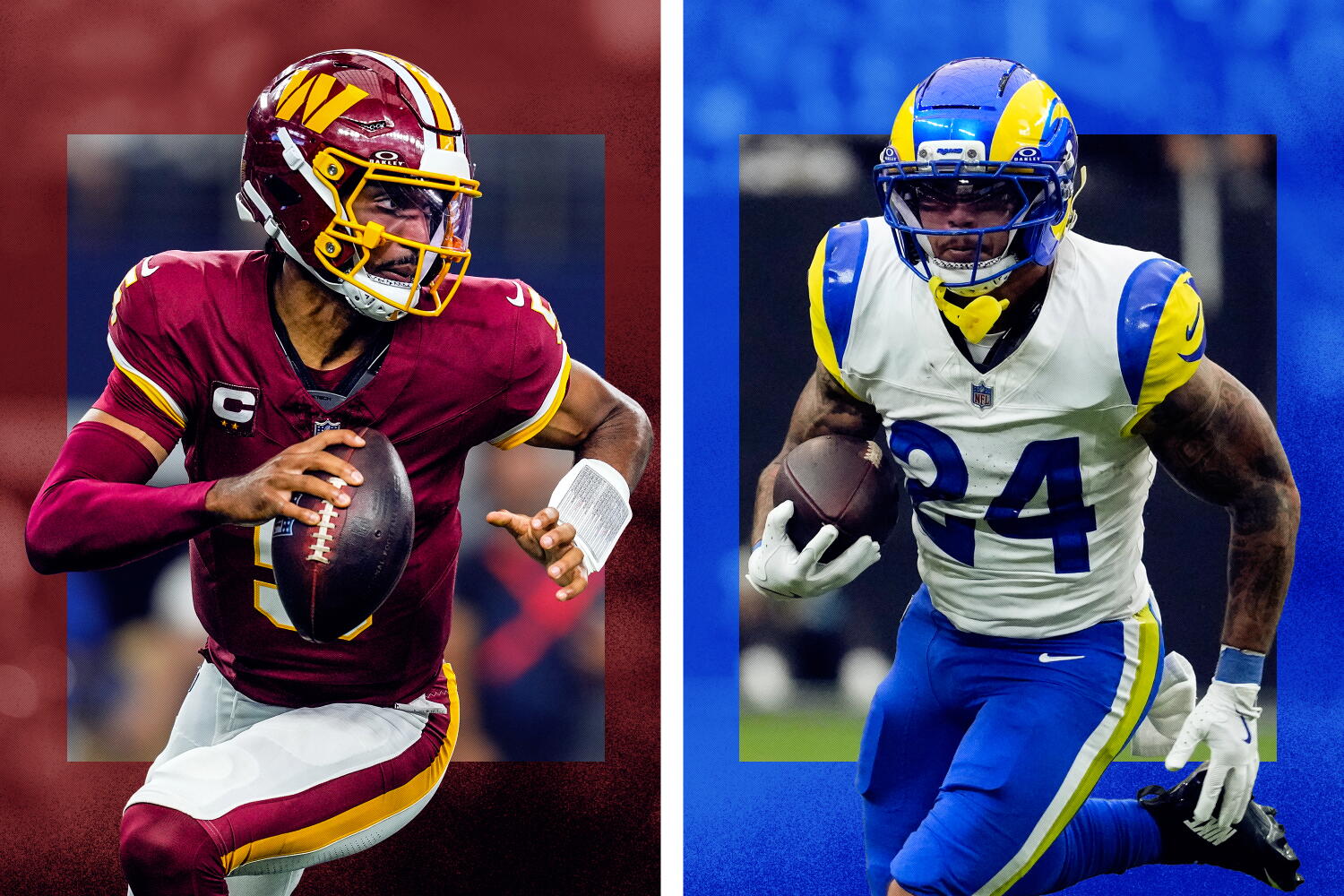
Offensive line protection schemes operate on a strict mathematical deficit: five eligible blockers must account for four primary rushers, leaving exactly one floating variable to neutralize the defense’s highest-value threat. When a defensive front deploys two generational pass rushers simultaneously—specifically Aaron Donald and Myles Garrett, who enter their 2026 Los Angeles Rams partnership with a combined 236.5 career sacks—that single floating blocker ceases to function as a structural solution and becomes an acute resource-allocation liability.
Most commentary reduces the pairing of Donald (111 career sacks prior to his two-year retirement) and Garrett (125.5 career sacks, including an NFL single-season record 23 sacks in 2025) to a simplistic narrative of accumulated box-score dominance. That framing misses the operational reality of modern offensive line mechanics. Through the first half of the 2026 season, Los Angeles struggled to generate consistent backfield disruption, recording just 12 team sacks (tied for 26th in the league) while Garrett recovered from knee surgery and Donald worked through post-retirement conditioning without registering a sack in his first five appearances. Integrating Garrett alongside Donald does not merely add individual sack totals; it breaks the foundational geometry of NFL pass protection by forcing offensive coordinators into a zero-sum trap across distinct spatial vectors.
The Structural Breakdown of Five-Man Protection
To understand why a Donald-Garrett alignment destabilizes opposing game plans, you must examine the mechanics of standard six-man and five-man pass protections. In a five-man protection call (empty or free-release concepts), the offensive line slides toward the designated danger side while leaving the opposite side isolated in one-on-one matchups.
When facing a defense with a single elite rusher, the protection calculus is straightforward:
- Interior Slide: If the primary threat aligns at 3-technique (outside shoulder of the guard), the center slides toward that gap, creating a two-on-one vice with the guard.
- Edge Chip: If the primary threat aligns at 7- or 9-technique (wide edge), the tackle takes an aggressive vertical set while a running back or tight end chips the outside hip before releasing into a route.
- Weak-Side Isolation: The remaining three offensive linemen block their assigned gaps one-on-one, betting that average interior or edge defenders cannot win quickly enough to disrupt the quarterback’s timing.
Deploying Donald on the interior and Garrett on the edge invalidates this entire hierarchy. Offensive lines cannot simultaneously slide the center toward Donald’s interior gap and commit help to Garrett’s wide alignment without keeping a sixth and seventh blocker in the backfield. Doing so removes two eligible receivers from the route concept, compressing the secondary’s coverage responsibilities and extending the quarterback’s time-to-throw—the exact variable that maximizes pass-rush efficiency.
The Three Vectors of Asymmetric Pressure
The operational value of pairing Donald and Garrett lies in the orthogonal nature of their attack angles. Rather than duplicating skill sets, their physical profiles and alignment preferences target entirely different structural weak points in a pocket.
1. Vertical Edge Compression
At 6-foot-4 and 272 pounds, Garrett generates elite get-off speed combined with upper-body torque capable of collapsing the arc from a wide-nine alignment. When Garrett threatens the outside shoulder of an offensive tackle, the tackle must open his hips early to protect the corner. This creates an immediate spatial void in the B-gap (between the tackle and guard). If the tackle oversets to stop Garrett’s speed rush, he exposes his inside chest to a counter-spin or bull-rush; if he sits down to anchor against power, Garrett bends the edge at a sub-4.6-second pace.
2. Interior Pocket Collapse
Donald operates on the shortest geometric path to the quarterback: the straight line through the A- and B-gaps. Even at age 35 following a two-year hiatus, Donald’s leverage and hand violence force guards to anchor immediately upon the snap. Unlike edge rushers, who must cover 7 to 9 yards on an arc, interior penetration disrupts the quarterback’s throwing platform within 2.2 seconds. When Donald drives a guard backward into the quarterback’s lap, the quarterback cannot step up into the pocket to avoid Garrett’s edge pursuit.
3. Secondary Exploitation and Stunt Multiplication
The third vector belongs to the auxiliary rushers—specifically edge defenders like Byron Young, who led Los Angeles with 4.5 sacks through the first half of the 2026 campaign while Donald drew disproportionate double-team attention. When an offense dedicates four hands to Donald on 90 percent of passing downs and assigns a chip-and-help scheme to Garrett, the remaining two defensive linemen face isolated single blocks against the offense’s weakest pass protectors. Furthermore, executing a T-E (tackle-end) stunt with Donald and Garrett forces the guard and tackle to pass off two defenders who each require double-team leverage, guaranteeing a free release or a holding penalty.
The Cost Function of Offensive Adjustments
Every adjustment an offensive coordinator makes to mitigate the Donald-Garrett alignment carries a measurable tax on offensive efficiency. These adjustments fall into three primary categories, each introducing a secondary vulnerability.
- Max-Protect Concepts (7-Man Protection): Keeping both a tight end and a running back in to block reduces the route tree to three receivers. Against standard Cover-3 or Cover-4 shells, seven defenders cover three routes, creating a 2.3-to-1 defender-to-receiver ratio. Passing efficiency plummets because receivers face bracket coverage at every intermediate depth, forcing the quarterback to hold the ball beyond the 3.0-second threshold where even max protection breaks down.
- Quick-Game Passing (Sub-2.2-Second Release): To neutralize pass-rush geometry entirely, offenses rely on RPOs (run-pass options), slants, and flat routes designed to get the ball out before the rush arrives. While effective at preventing sacks, this compresses the offense’s average depth of target (aDOT) below 5.5 yards. Defensive backs can then squat on short routes, jump passing lanes, and rally to tackle for minimal gains, eliminating explosive plays downfield.
- Moving the Pocket (Bootlegs and Sprint-Outs): Rolling the quarterback away from either Donald or Garrett buys temporary escape lanes. However, cutting the field in half eliminates backside progressions and exposes the quarterback to pursuit from the backside edge—a critical flaw given Garrett’s elite lateral pursuit speed across the formation.
Quantifying the Friction: Rust, Conditioning, and Snap Counts
Analytical rigor requires separating theoretical ceiling from operational constraints. Two major friction points govern whether this pairing yields immediate championship-level disruption or falls short of expectations.
First is the conditioning and timing deficit. Donald missed the entire 2024 and 2025 seasons before returning for 2026, and his zero-sack output across his first five games reflects the reality of reacclimating to 11-on-11 trench warfare. Pass rushing relies on micro-second hand-eye coordination and hip fluidity that cannot be replicated in individual workouts. Simultaneously, Garrett enters the lineup immediately following knee surgery, meaning his burst off the line and ability to plant and bend around the edge will face progressive stress tests across four quarters.
Second is usage optimization. Deploying both players on early run downs exposes them to unnecessary cumulative wear and invites offenses to run downhill gap schemes directly at Garrett’s aggressive upfield rush lanes. The Rams’ coaching staff cannot treat either player as an 85-percent-snap workhorse without risking late-season attrition.
Operational Deployment Protocol for the Rams
To maximize return on investment as Los Angeles pushes for a postseason berth and a potential Super Bowl LXI appearance at SoFi Stadium, defensive coordinator Chris Shula must manage Donald and Garrett as specialized high-leverage assets rather than conventional down-to-down linemen.
- Restrict Joint Deployment to High-Leverage Passing Downs: Cap simultaneous snaps for Donald and Garrett to third-and-medium/long (3rd-and-6 or greater) and verified two-minute drill situations during the initial three weeks of Garrett’s return. Limiting their shared workload to 20–25 high-impact snaps per game preserves explosive burst while protecting Garrett’s surgically repaired knee.
- Overload One Side of the Formation: Align Garrett at wide-9 and Donald at 3-technique on the same side of the offensive line on 40 percent of passing downs. This forces the offense to commit the guard, tackle, and a running back to just two defenders, leaving the opposite edge rusher (Byron Young) in an uncontested one-on-one matchup against a weak-side tackle or tight end.
- Weaponize Simulated Pressures: Pair the Donald-Garrett overload with a mugged linebacker in the opposite A-gap who drops into coverage at the snap. The offensive line must respect the interior blitz threat, preventing the center from sliding toward Donald and guaranteeing single blocks across the entire front four.