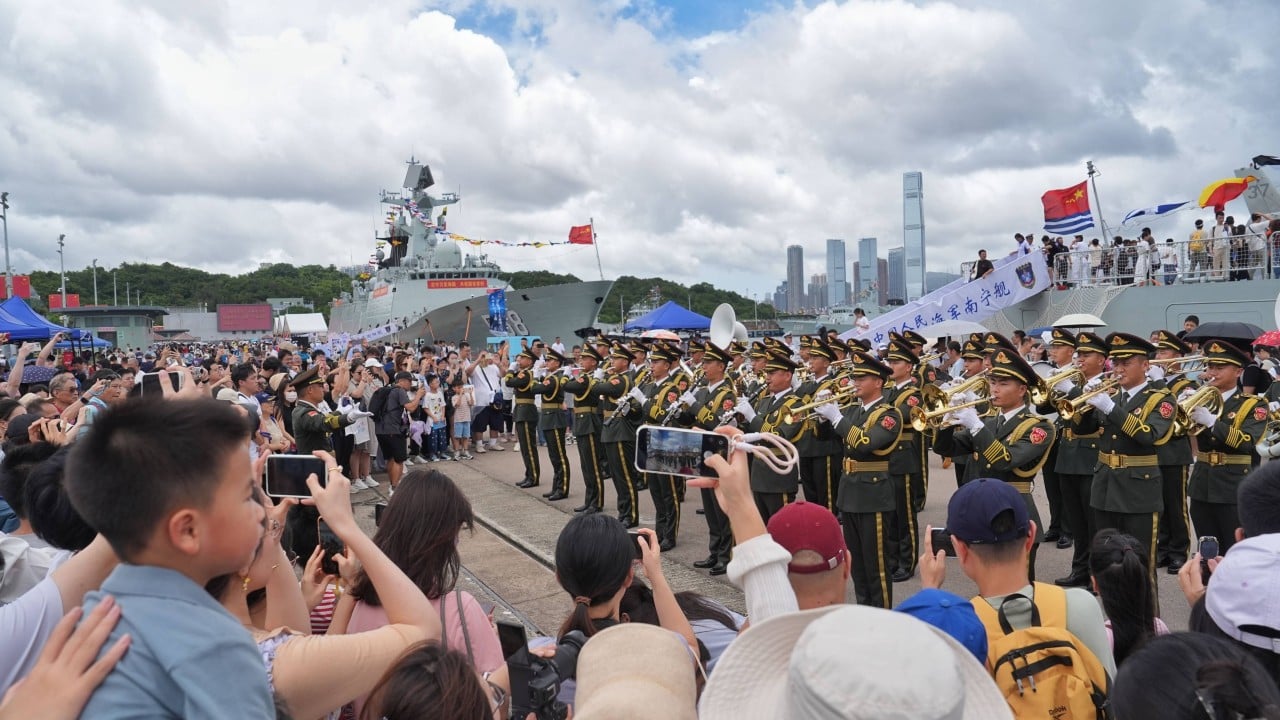
The execution of a Non-combatant Evacuation Operation (NEO) in an active conflict zone represents one of the most complex logistical and tactical challenges a modern military can face. When internal conflict erupted in Sudan, the People's Liberation Army Navy (PLAN) initiated a rapid-response evacuation that serves as a baseline case study for long-range power projection and civilian extraction. The operational details disclosed during the public opening of the PLA Hong Kong Garrison barracks provide a rare window into the structural mechanics, risk calculations, and command structures that govern China’s distant-water security paradigm.
Analyzing these operations requires moving past the emotional narrative of rescue to dissect the cold operational variables: time-to-target horizons, asset allocation trade-offs, security perimeters in degraded ports, and the psychological management of civilian payloads.
The Tripartite Framework of Emergency Maritime Projection
Distant-water civilian extraction operates under three distinct operational pillars. The failure of any single pillar collapses the entire mission vector, transforming an evacuation into a hostage or mass-casualty scenario.
[Conflict Zone Origin] ---> (Pillar 1: Overland Transit Corridor)
                                      |
                                      v
                           (Pillar 2: Port Security & Embarkation)
                                      |
                                      v
[Secured Destination] <--- (Pillar 3: Blue-Water Maritime Transit)
1. The Overland Transit Corridor
Before a hull ever touches a pier, civilians must traverse a highly volatile land domain. In the Sudan deployment, the primary friction point was the transit from Khartoum to Port Sudan—a distance of roughly 800 kilometers through territory punctuated by shifting checkpoints, fuel scarcities, and communication blackouts. The military’s role at this stage is primarily intelligence gathering, diplomatic coordination, and establishing a clear line of communication with civilian convoy leaders to time their arrival exactly with the berthing of naval assets.
2. The Port Security and Embarkation Interface
The port environment represents a profound vulnerability. Naval vessels are designed for open-ocean combat or structured port calls, not for absorbing thousands of unstructured civilian units. The configuration of Port Sudan required the establishment of an immediate, armed perimeter on the pier, rapid biometric and documentary verification, customs processing stripped to its absolute essentials, and physical screening for weapons or contraband that could compromise the vessel once at sea.
3. Blue-Water Maritime Transit
The final pillar involves the physical relocation of personnel across international waters—in this specific instance, crossing the Red Sea to Jeddah, Saudi Arabia. This stage forces a rapid reconfiguration of combat warships into high-density transport platforms. Fire suppression systems, life-support capacity, fresh water generation, and medical triaging must be recalibrated to support hundreds of individuals far exceeding the standard crew complement.
Asset Deployment and Tactical Reconfiguration
The dispatch of the 43rd Chinese naval escort task force—specifically the Type 052D guided-missile destroyer Nanning and the Type 903A replenishment ship Weishanhu—reveals the structural trade-offs dictated by immediate availability versus optimal utility.
Warship Architecture vs. Civilian Payload
A Type 052D destroyer is optimized for air defense, anti-surface, and anti-submarine warfare. Its interior architecture is highly compartmentalized, designed to contain damage during kinetic engagements. This architecture presents severe bottlenecks for civilian transport:
- Corridor Widths and Vertical Ladders: Warship transit paths are narrow and steep, optimized for trained sailors moving efficiently, not children, the elderly, or injured civilians.
- Environmental Control Systems (ECS): Air filtration and cooling systems are calibrated for a specific crew count (approximately 280 personnel). Introducing hundreds of additional occupants spikes ambient temperatures, carbon dioxide levels, and metabolic moisture, straining the vessel's life-support machinery.
- Aviation Deck Utilization: The flight deck, normally reserved for Harbin Z-9 or Changhe Z-20 helicopters, becomes the primary staging and open-air zones for evacuees to prevent claustrophobia and manage sanitation.
The Type 903A replenishment ship, by contrast, offers larger deck spaces and superior storage capacity, but lacks the organic point-defense systems necessary to deter asymmetric threats in a deteriorating port environment. The deployment of these two vessels in tandem created a tactical balance: the Nanning provided the protective umbrella and high-speed command node, while the Weishanhu absorbed the bulk of the logistical weight.
Logistical Calculations in High-Density Transits
The constraints of maritime physics dictate strict boundaries for any NEO. When hundreds of evacuees board a vessel, the logistical consumption rates shift predictably.
The Fresh Water Bottleneck
A standard human requires a minimum of three to five liters of potable water per day for basic survival in arid or high-temperature marine environments. A Type 052D destroyer utilizes reverse osmosis desalination plants capable of producing tens of tons of fresh water daily. Under standard operations, this easily satisfies crew requirements and machinery cooling loops.
However, when the onboard population doubles or triples unexpectedly, water rationing protocols must be implemented immediately. Showers are secured, galley operations are shifted to dry rations, and water distribution is strictly metered to prevent the depletion of the ship's internal storage tanks, which serve as a critical ballast buffer.
Caloric Logistics and Waste Management
The preparation of hot meals for thousands of unexpected passengers is structurally impossible in a standard warship galley. The PLAN managed this by deploying pre-packaged combat rations (MREs) and utilizing the replenishment ship’s expansive dry-stores capacity.
The more severe operational friction point is waste management. Warship blackwater treatment systems are designed for linear, predictable usage. The sudden influx of hundreds of civilians—many suffering from motion sickness or stress-induced gastrointestinal distress—can overwhelm vacuum-toilet systems within hours. The tactical response requires the deployment of portable chemical toilets on the open flight decks and strict enforcement of usage schedules.
Threat Matrix and Security Perimeters
A port city during a civil war is an environment characterized by extreme informational asymmetry. The PLAN task force had to operate under the assumption that the port could be targeted by artillery, drone strikes, or rogue militia factions at any moment.
[Warship Berth]
       |
 [Vessel Security: Heavy Machine Guns / Close-in Weapon Systems]
       |
 [Pier Security: Armed Entry Control Points & Biometric Screening]
       |
 [Buffer Zone: Local Port Authorities & Diplomatic Liaisons]
       |
 [Threat Horizon: Active Conflict Zone]
The Layered Defense Model
To mitigate these risks without executing a hostile amphibious landing, the detachment deployed a three-layered security ring:
- The Staging Ring: Established at the outer gates of the port facility, utilizing local authorities and Chinese diplomatic staff to filter individuals before they approached the water.
- The Embarkation Ring: A hard physical barrier on the concrete pier directly adjacent to the ship’s brow. Armed PLAN marine detachments established a secure corridor using temporary barriers, maintaining weapon readiness to counter sudden vehicle-borne or crowd-surge threats.
- The Onboard Ring: Heavy machine gun mounts on the ship's superstructure were manned continuously, and Close-in Weapon Systems (CIWS) were maintained in a state of high readiness to counter low-altitude aerial threats or fast-attack craft coming from the seaward approaches.
The primary operational constraint here is rules of engagement (ROE). The military forces must project sufficient lethal capability to deter attacks while maintaining a non-provocative posture that prevents escalation with local armed factions who might misinterpret defensive posturing as offensive intervention.
Strategic Implications for Global Power Projection
The Sudan evacuation demonstrates a critical milestone in the evolution of the PLAN from a green-water coastal defense force to a true blue-water navy capable of protecting its citizens and interests globally.
The Evolution of the "Far Seas" Doctrine
Historically, non-combatant evacuations conducted by China relied heavily on commercial aviation charters or chartered civilian cruise liners, as seen during the Libya crisis in 2011. While effective, commercial vessels lack the defense suites, command infrastructure, and sovereign legal status of commissioned warships. The transition to using front-line combatants like the Type 052D indicates a willingness to commit high-end military capital to non-war military operations (NWMO) thousands of miles from the Chinese mainland.
This shift underscores the practical application of China's "Far Seas Protection" doctrine. As economic investments and expatriate populations expand along global maritime trade routes, the requirement for organic, military-led protection mechanisms becomes absolute. The ability to divert a counter-piracy task force from the Gulf of Aden to execute an emergency extraction in the Red Sea demonstrates highly adaptable command-and-control structures within the People's Liberation Army Joint Command Center.
Institutional Memory and Force Multiplying
The public recount of the Sudan mission at the Hong Kong barracks open day is not merely a public relations exercise; it is an indication of institutionalizing operational lessons. By parsing the tactical friction points—such as civilian communication failures, pier-side processing delays, and shipboard crowding—the PLAN refines its doctrine for future contingencies. The insights gained from managing the human element under fire are integrated directly into the training syllabi of subsequent naval task forces.
Strategic Recommendation for Maritime Contingency Planning
Future遠洋 (far-seas) security operations must move away from ad-hoc task force diversions and toward specialized modular preparation. Naval commanders preparing for the next inevitable evacuation scenario must execute three concrete tactical shifts:
- Pre-Staging Modular NEO Kits: Replenishment ships and amphibious transport docks operating on long-range deployments must carry standardized containerized NEO kits. These modules should contain portable chemical toilets, rapid-deployable pier-side barrier systems, biometric processing terminals, and thousands of liters of vacuum-packed water rations separate from the ship's standard stores.
- Integrating Civil-Military Communication Redundancy: The primary point of failure in modern extraction is the data blackout between land-bound convoys and the approaching fleet. Future deployments must utilize dedicated satellite-linked communication beacons distributed to embassy personnel and corporate security leads on the ground long before kinetic conflict erupts.
- Amphibious Platform Prioritization: While guided-missile destroyers project necessary defensive power, they are fundamentally inefficient human transports. Future long-range deployments along volatile maritime corridors should prioritize the inclusion of Type 071 amphibious transport docks or Type 075 landing helicopter docks. These platforms possess the organic well decks, extensive medical bays, and sheer internal volume required to process and house thousands of civilians without degrading the operational readiness of the task force's primary surface combatants.