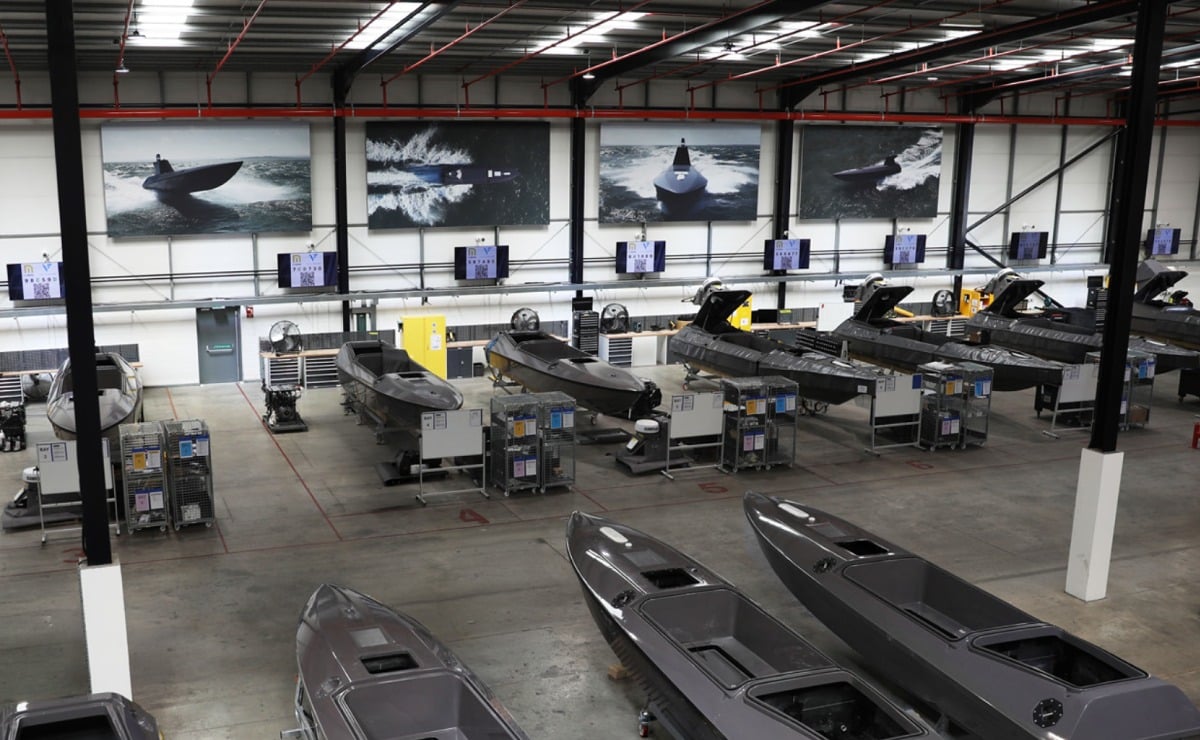
Silicon Valley and defense tech venture capitalists just found their latest shiny object: drone boats.
The breathless reporting surrounding a British maritime autonomy startup hitting a $1 billion unicorn valuation on the back of a $175 million funding round tells a familiar, exhausting story. The narrative is always the same. Software is eating the ocean. Uncrewed surface vessels (USVs) will replace traditional navies. Hardware is cheap, code is infinite, and the legacy defense primes are dinosaur institutions waiting to be disrupted.
It is a beautiful fantasy. It is also entirely wrong.
As someone who has spent over a decade analyzing naval procurement pipelines and watching VC funds flush capital down the drain of "dual-use" hardware startups, this latest funding mania is a case study in misallocating capital. The tech industry is treating maritime autonomy like self-driving cars on a two-dimensional grid. They are about to learn that the ocean is a chaotic, corrosive, electronic-warfare-heavy nightmare that does not care about your software margins.
The Lazy Consensus of the Drone Boat Revolution
The bull case for these $1 billion valuations rests on a deeply flawed premise: that building a successful drone boat company is primarily a software problem.
The thesis goes like this: if you build a sleek hull, pack it with off-the-shelf sensors, and write a proprietary AI piloting system, you can mass-produce autonomous fleets at a fraction of the cost of a traditional naval vessel. Proponents point to recent conflicts in the Black Sea, where cheap, explosive-laden Ukrainian jet skis managed to sink multi-million-dollar warships.
This is the ultimate asymmetric warfare data point. It is also an exception being treated as a universal rule.
What the hype cycle conveniently ignores is the staggering difference between a one-way kamikaze strike drone and an enduring, multi-mission autonomous platform.
- The Black Sea Fallacy: The Ukrainian USVs are essentially guided missiles with a human operator steering via satellite link up until the point of impact. They are not autonomous. They do not survive beyond a single mission. They do not have to maintain themselves at sea for six months.
- The False Equivalence: A warship is a floating, self-sustaining city designed to project power, absorb damage, and protect sea lanes. A drone boat is a sensor node. You cannot replace the former with the latter, no matter how much venture capital you inject into the system.
The Scaling Illusion: Hardware Wins, Software Adapts
Software scaling laws do not apply to the open ocean. In the digital world, marginal cost approaches zero. In the maritime world, the ocean wants to destroy everything you build, every single second it is in the water.
1. The Saltwater Tax
I have seen brilliant software engineers build exquisite autonomous navigation algorithms, only to watch their multi-million-dollar prototype get disabled three weeks into a deployment because biofouling clogged the cooling intake or saltwater corroded a critical sensor seal.
Hardware maintenance is the hidden killer of maritime startups. When a crewed ship suffers a generator failure or a hydraulic leak, sailors fix it with duct tape, spare parts, and mechanical intuition. When an uncrewed boat suffers a minor mechanical failure 300 miles away from the nearest port, it becomes an expensive piece of drifting ocean debris.
2. The Satcom Chokepoint
The tech industry loves to talk about edge computing, but the reality of naval operations is that these platforms require constant, high-bandwidth data links to be operationally useful. In a high-end conflict against a peer adversary, the first things to disappear are GPS signals and satellite communications.
An autonomous boat that cannot communicate and cannot verify its position becomes a liability, not an asset. If your business model relies on seamless Starlink connectivity to justify its $1 billion valuation, you haven't built a defense asset; you've built a peacetime luxury.
+------------------------------------+---------------------------------------+
| Tech Investor Expectation          | Operational Reality                   |
+------------------------------------+---------------------------------------+
| 90% Gross Margins via SaaS Model   | Brutal Capex on Hardware & Logistics  |
| "Set and Forget" Autonomous Fleets | Massive Maintenance & Recovery Crews   |
| Disruption of Legacy Shipbuilding  | Complete Dependence on Prime Shipyards|
+------------------------------------+---------------------------------------+
Dismantling the Defense Procurement Myths
When you look at the questions analysts and tech journalists ask about this sector, the fundamental misunderstanding becomes glaringly obvious. They are asking the wrong questions because they do not understand how militaries actually buy things.
"Will autonomous fleets replace traditional destroyers?"
This is a nonsense question. It assumes a zero-sum game where a navy chooses between one $2 billion destroyer and two thousand $1 million drone boats.
Militaries do not buy platforms; they buy capabilities. A drone boat cannot perform anti-submarine warfare effectively because it lacks the mass to carry heavy sonar arrays and torpedoes. It cannot provide area air defense. It cannot conduct humanitarian relief or enforce maritime law via physical presence.
The real utility of USVs is as a force multiplier—an extended sensor pack for the crewed ship. This means the market size for these drone boats is intrinsically capped by the size of the crewed fleet. You cannot sell 10,000 drone boats to a navy that only has 300 major warships to command and maintain them. The addressable market is a fraction of what these VC pitch decks claim.
"Can startups out-innovate traditional defense primes?"
The tech press loves the David vs. Goliath narrative. They claim nimble startups will outpace companies like General Dynamics, Huntington Ingalls, or BAE Systems.
Here is the brutal truth from inside the defense acquisition pipeline: the primes always win the scaling phase.
Startups are fantastic at rapid prototyping. They can build a slick, working prototype in twelve months. But when it comes to navigating the labyrinthine, multi-year process of military certification, explosive safety compliance, and government contracting vehicles, startups choke.
What actually happens? A startup spends $150 million of venture money developing a cool boat, realizes they can't cross the "Valley of Death" into a Program of Record, and ends up getting acquired or partnered with a legacy prime for a fraction of their peak valuation. The prime takes the IP, integrates it into their existing hull designs, and walks away with the multi-billion-dollar government contract. The venture capitalists lose their shirts, and the cycle repeats.
The Uncomfortable Truth About Dual-Use Claims
The biggest red flag in this $175 million raise is the inevitable claim that these drone boats have a massive "dual-use" commercial market. Founders love to claim that if the navy doesn't buy their boats, offshore wind farms, oil companies, and environmental research institutes will.
This is a defensive coping mechanism for a flawed business model.
The requirements for a military-grade USV and a commercial survey drone are fundamentally irreconcilable. A military drone boat needs low radar cross-sections, encrypted communications, hardened electronics, and the ability to operate in contested environments. These features add immense cost.
A commercial operator inspecting an offshore wind turbine does not care about electronic counter-countermeasures. They care about the lowest possible cost per hour of operation. A startup trying to build a single platform that pleases both the Pentagon and a commercial wind farm operator will end up building something that is too expensive for the commercial market and under-spec'd for the military.
Where the Real Value Lies
Am I saying maritime autonomy is useless? No. I am saying the current valuation models are completely detached from reality.
If you want to find the companies that will actually survive the inevitable drone boat crash, stop looking at the companies building the sleek hulls. Look at the boring companies building the underlying components.
- The Component Winners: The real value is in the specialized payloads, the ruggedized sensors, the low-power underwater acoustic modems, and the specialized power management systems that allow a boat to sit silently at sea for months without burning through its fuel.
- The Software Reality: The software that matters isn't the AI that steers the boat around a buoy. It is the data fusion software that takes messy, degraded sensor inputs from fifty different drones and turns it into a clean, actionable targeting picture for a human commander on a carrier strike group.
The British firm that just raised $175 million at a $1 billion valuation is now under immense pressure to deliver hyper-growth. But the defense market does not move at the speed of software. It moves at the speed of congressional budget cycles, bureaucratic testing protocols, and industrial manufacturing constraints.
Injecting massive amounts of capital into a company cannot force a navy to change its procurement cycle any faster. It merely inflates expectations to a level that the physical reality of ocean engineering cannot support.
The maritime tech revolution will be a slow, grinding war of attrition won by companies that understand rust, logistics, and bureaucratic patience. The investors treating it like a SaaS play are about to get a very expensive lesson in oceanography.