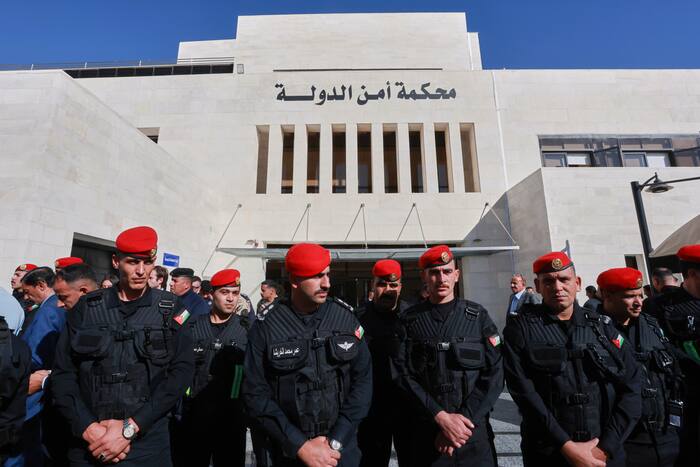
Wire-service news roundups treat Middle Eastern geopolitics like a sports ticker. One commander is eliminated in Gaza; three suspects are sentenced in Amman; a diplomatic convoy crosses a border. Standard news summaries bundle these events together under the banner of "other Mideast news," implicitly framing them as isolated episodes of perpetual, disconnected chaos.
Analysts who treat these developments as separate items miss the structural reality of the region. When security forces in Israel target senior militant leadership while Jordanian courts hand down sentences for domestic terror plots, observers are not witnessing random friction. They are watching two distinct faces of the same regional stress test: the struggle between established state apparatuses and decentralized, cross-border militant networks.
The Illusion of the "Decapitation" Metric
Mainstream reporting frequently treats the elimination of a high-ranking militant commander as a decisive turning point—or, conversely, dismisses it entirely as a futile exercise in "whack-a-mole." Both takes rely on flawed assumptions about how modern asymmetric organizations operate.
Military historians and counterterrorism researchers, including scholars at the Combating Terrorism Center at West Point and analysts like Robert Pape and Jenna Jordan, have spent decades studying leadership decapitation. Their findings are nuanced and often uncomfortable for partisans on either side:
- Tactical Disruption vs. Strategic Collapse: Removing a senior operational commander rarely causes an entrenched, bureaucratized group like Hamas to surrender immediately. Middle-tier operatives step up, and ideological recruitment continues.
- Institutional Memory Loss: What wire reports overlook is the degradation of technical and coordinating capacity. Top commanders who survive for decades possess irreplaceable institutional memory—specifically, the ability to bridge gaps between external financiers, smuggling networks, and local cell leaders. Replacing a figurehead takes days; replacing a logistics architect takes years.
- The Deterrence Paradox: While targeted killings signal intelligence penetration that forces surviving leaders underground—severely limiting their ability to communicate and command—they also narrow the diplomatic off-ramps available to state actors.
Focusing exclusively on the body count misses the operational reality. The real metric isn't whether a successor is named by Tuesday; it is how much bandwidth the surviving leadership must spend simply staying alive rather than planning complex operations.
Why Amman’s Courtrooms Matter as Much as Gaza’s Tunnels
Burying Jordan’s sentencing of church attack plotters in the second half of a headline roundup reflects a profound blind spot in Western media coverage. Events in Jordan are routinely treated as secondary footnotes to the Israeli-Palestinian conflict, rather than as bellwethers for regional stability.
Jordan sits at the geographical and demographic crossroads of the Levant. For decades, the Hashemite Kingdom has maintained internal stability through a delicate balancing act: robust intelligence capabilities via the General Intelligence Directorate (GID), careful management of tribal and Islamist political factions, and strict adherence to its 1994 peace treaty with Israel—even amid intense domestic public opposition during regional escalations.
When Jordanian courts prosecute and sentence individuals for plotting attacks against religious minorities or state institutions, three critical dynamics are on display:
- Preemptive Containment: Unlike theaters where state authority has collapsed, Jordan’s security apparatus relies heavily on preemptive disruption. Publicized judicial sentences serve as a domestic deterrent signal to radicalized cells that internal red lines remain enforced.
- The Spillover Threat: Instability in neighboring territories—whether in the West Bank, Gaza, Syria, or Iraq—inevitably tests Jordan’s borders. Smuggling routes for weapons and narcotics along the Syrian border have increasingly overlapped with militant logistics, forcing Amman to treat border security as an existential priority.
- Protection of Minorities as State Legitimacy: Safeguarding Christian communities and holy sites is central to the Jordanian monarchy’s international legitimacy and domestic social contract. Failure to prosecute threats against churches would signal an erosion of state monopoly on force.
Treating Jordan’s judicial actions as "other news" ignores the fact that the stability of the Jordanian state is one of the primary buffers preventing localized conflicts from metastasizing into a wider regional conflagration.
The Flaw in the "Mideast Roundup" Format
Readers searching for updates on Middle Eastern conflict often ask a predictable set of questions: Is a wider war starting? Does this event end the conflict? Who is winning?
Those questions are built on a false premise—that complex regional conflicts follow a linear movie script with clear acts and a neat resolution. News aggregators reinforce this illusion by stitching unrelated datelines into a single narrative thread.
Consider how standard reporting flattens distinct political realities:
- Different Doctrines: Israel’s military doctrine emphasizes offensive preemption and intelligence-driven strike capabilities to degrade external threats before they reach its borders. Jordan’s security doctrine emphasizes internal surveillance, legal containment, and diplomatic insulation. Grouping them under a single headline blurs two entirely different statecraft models.
- Different Timelines: Kinetic military operations produce immediate, visible outcomes—destroyed infrastructure, targeted casualties, displaced populations. Judicial proceedings in Amman represent the tail end of months or years of quiet counter-intelligence work. Measuring both on a 24-hour news cycle distorts their actual weight.
- The External Patronage Factor: Neither Hamas’s command structure nor regional militant cells operate in a vacuum. Analysts at institutions like the International Institute for Strategic Studies (IISS) consistently point out that local flashpoints are tied to broader regional rivalries, supply chains, and ideological financing networks that span multiple capitals.
How to Actually Read Geopolitical News
If you want to understand where the Middle East is heading, stop reacting to the loudest headline in a daily digest and start tracking structural indicators.
1. Follow Logistics, Not Rhetoric
Public statements from militant spokespeople and government ministers are designed for domestic consumption and psychological signaling. Watch the physical constraints instead: border closures, shifts in smuggling interdictions, maritime insurance rates in the Red Sea, and energy transit agreements.
2. Watch the Quiet States
Pay closer attention to judicial rulings, cabinet reshuffles, and economic subsidies in countries like Jordan, Egypt, and the Gulf states than to daily tactical exchanges on active frontlines. When stable buffer states change their legal or economic posture, a genuine strategic shift is underway.
3. Separate Tactical Noise from Strategic Shifts
Ask whether an event changes the underlying balance of capabilities or diplomatic alignments. A targeted strike alters tactical command; a sustained shift in intelligence sharing or border enforcement alters the strategic environment.
The Caveat Analysts Rarely Admit
Even the sharpest structural analysis has a glaring blind spot: black swan miscalculations.
Frameworks built on statecraft, institutional deterrence, and historical precedent assume that actors behave according to recognizable cost-benefit calculations. In high-tension environments, a single rogue cell, an intelligence failure, or an unintended casualty can trigger an emotional and political cascade that overrides rational strategy. Analysts who focus solely on macro-trends risk underestimating how quickly tactical accidents can force leaders into corners they never intended to occupy.
Stop Consuming Conflict as a Daily Box Score
The next time a headline packages a targeted killing in Gaza alongside a court verdict in Amman as just another batch of regional updates, resist the urge to skim it as routine background noise. Look at the mechanics underneath. One story shows the limits of asymmetric militancy against high-end intelligence; the other shows the quiet, relentless work required to keep state institutions intact when surrounding borders are on fire. Read the structure, ignore the ticker, and stop mistaking daily headlines for the actual story.


