Norway is currently the single largest extractor of Antarctic krill on the planet, pulling roughly two-thirds of the entire commercial catch out of the Southern Ocean while simultaneously marketing itself as a global champion of marine conservation. If Oslo refuses to back massive new Marine Protected Areas (MPAs) in the Weddell Sea and around the Antarctic Peninsula, or declines to tighten catch limits on its industrial super-trawlers, the fragile food web of the bottom of the world faces systemic collapse. The short answer to whether Norway will protect Antarctica is not reassuring—unless international diplomatic pressure outweighs the massive financial returns of Norwegian omega-3 and aquaculture feed conglomerates, commercial extraction will continue to outpace ecological preservation.
For decades, Oslo has walked a tightrope that few other nations could pull off without severe reputational blowback. On the international stage, Norwegian diplomats speak fluently in the language of sustainability, climate resilience, and ocean stewardship. Domestically and commercially, however, Norway operates as an extractive superpower. Whether it is North Sea oil, deep-sea seabed mining in the Arctic, or industrial harvesting in the Southern Ocean, the Norwegian economic model relies heavily on monetizing natural resources with brutal efficiency. Nowhere is this contradiction sharper than in the freezing waters surrounding Antarctica.
The Industrial Engine Behind the Krill Boom
To understand why Norway is reluctant to lock away vast stretches of the Southern Ocean from fishing, you have to follow the money down to the microscopic level. Euphausia superba, known simply as Antarctic krill, are tiny, shrimp-like crustaceans that form the foundational bedrock of the Antarctic ecosystem. Whales, penguins, seals, squid, and seabirds all depend on krill for survival. Without dense swarms of krill, the entire biological machinery of the continent grinds to a halt.
Enter the modern Norwegian fishing fleet. Gone are the days of rustic wooden whaling vessels. Today, companies like Aker BioMarine—controlled by Norwegian billionaire Kjell Inge Røkke—operate floating factories equipped with continuous pumping systems. Instead of hauling up nets and dumping them on deck, which crushes the delicate crustaceans and degrades their oil, these vessels use a vacuum-like hose connected to the cod-end of a submerged trawl net. The ship steams slowly through a krill swarm, sucking millions of organisms directly into an onboard processing plant 24 hours a day.
The economic incentives driving this technology are immense. Krill is processed into two high-margin products:
- Aquaculture Feed: Farmed salmon—another pillar of the Norwegian economy—require astaxanthin, a natural carotenoid found in krill, to give their flesh its signature pink hue and boost their immune systems. Krill meal is a premium ingredient in high-end fish farming.
- Nutraceuticals: Krill oil is packaged and sold globally as a superior alternative to standard fish oil, rich in phospholipid-bound omega-3 fatty acids. It commands steep retail prices in pharmacies and health food stores across North America, Europe, and Asia.
Because of this vertical integration, Norway does not merely participate in the Antarctic krill fishery; it dominates it. Between 60 and 70 percent of all krill harvested in the Southern Ocean ends up in the holds of Norwegian vessels. When conservationists call for spatial closures to protect penguin foraging grounds, they are directly threatening the profit margins of Oslo's most technologically advanced maritime enterprises.
How CCAMLR Paralysis Serves Extractive Interests
Governance in the Southern Ocean does not fall under a single nation's jurisdiction. Instead, it is managed by the Commission for the Conservation of Antarctic Marine Living Resources (CCAMLR), an international body established in 1982 with 27 members, including the European Union. CCAMLR operates strictly by consensus. Every single member state must agree before a new Marine Protected Area can be established or a major regulatory shift enacted.
For years, media coverage has rightly focused on China and Russia as the primary obstructionists inside CCAMLR. Both nations have repeatedly vetoed proposals to create three massive new MPAs in East Antarctica, the Weddell Sea, and the Antarctic Peninsula—a network that would protect roughly four million square kilometers of ocean. Beijing wants to expand its own distant-water fishing fleet in the region, while Moscow routinely uses consensus veto power as a geopolitical bargaining chip against Western nations.
This diplomatic gridlock provides Norway with convenient cover. Oslo can publicly express support for the concept of Marine Protected Areas while quietly benefiting from the fact that they never actually pass. Because China and Russia reliably block the final vote every October in Hobart, Tasmania, Norway rarely has to take the heat as the sole villain in the room. Yet behind closed doors, Norwegian negotiators have consistently pushed to ensure that any proposed MPA boundaries are drawn carefully around traditional krill fishing grounds, or that "research and monitoring" zones within those parks still permit commercial harvesting.
It is a classic diplomatic maneuver. Endorse the green headline, but hollow out the operational restrictions in the fine print.
The Ecological Math Does Not Add Up
The core defense mounted by the Norwegian krill industry and its government backers relies on a single statistic. They point out that the total allowable catch set by CCAMLR in Area 48—the Atlantic sector of the Southern Ocean where virtually all fishing occurs—is capped at roughly 620,000 metric tons per year. Because the estimated total biomass of krill in that region is around 60 million metric tons, the industry argues that it is harvesting less than one percent of the available stock. On paper, that looks like the gold standard of sustainable management.
On the water, that math falls apart.
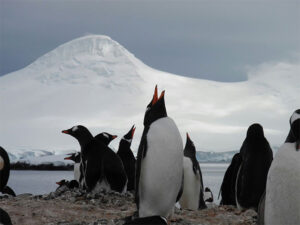
Krill are not distributed evenly across the ocean like salt dissolved in water. They gather in dense super-swarms, often concentrated in specific underwater canyons, shelf breaks, and coastal eddies. Crucially, these exact locations are where land-based predators—such as chinstrap, Adélie, and gentoo penguins—must hunt during their breeding season. A mother penguin raising chicks cannot swim 500 miles out to sea to find an unfished patch of ocean; she has a strict energetic budget and a narrow foraging radius around her colony.
When three or four industrial super-trawlers park directly over a coastal feeding hotspot for weeks at a time, they can locally deplete the krill biomass by 50 to 80 percent in that specific bay, even while the broader regional catch remains under the one percent threshold. The result is localized starvation. Field researchers working along the Western Antarctic Peninsula have documented severe declines in chinstrap penguin colonies, alongside increased frequency of dead whales washing ashore or becoming entangled in trawl gear.
Climate change compounds this spatial conflict. Krill depend on winter sea ice for survival; the algae growing on the underside of the ice sheets serves as a vital nursery and food source for larval krill. As ocean temperatures warm and Antarctic sea ice hits record lows, the habitable zone for krill is shrinking southward. The fishing fleet and the wildlife are being squeezed into the exact same shrinking corridors of cold water.
Historical Echoes of the Southern Ocean
Anyone who has covered maritime resource extraction for long enough recognizes the warning signs. The Southern Ocean has a grim history of boom-and-bust exploitation driven by technological leaps and regulatory complacency.
In the 19th century, sealers wiped out fur seal populations across sub-Antarctic islands within a few decades, moving from island to island until there was nothing left to club. In the 20th century, the invention of the steam-powered catcher boat and the explosive harpoon—pioneered, notably, by Norwegian whaling magnates like Svend Foyn—triggered the industrial slaughter of over two million great whales in the Southern Ocean. Blue whales were reduced to less than one percent of their original population before international moratoriums finally halted the carnage.
In every single era, the industry claimed the resource was inexhaustible. In every single era, regulators moved too slowly, prioritizing immediate economic yield over precautionary science. Today, the target has shifted down the trophic ladder from the largest animals on Earth to the smallest, yet the fundamental dynamic remains unchanged. We are testing the carrying capacity of a stressed ecosystem in real time, betting that the ocean can absorb industrial-scale extraction alongside rapid warming without snapping.
The Myth of the Self-Regulating Fishery
To counter mounting criticism from environmental NGOs and marine biologists, Norwegian krill operators have leaned heavily on third-party sustainability certifications, most notably the Marine Stewardship Council (MSC) blue tick label. They also point to voluntary closed zones—buffer areas around penguin rookeries where the Association of Responsible Krill harvesting companies (ARK) agrees not to fish during the summer breeding months.
Voluntary measures are inherently fragile. A self-imposed buffer zone can be altered, shrunk, or abandoned the moment economic conditions tighten or fuel prices spike. Furthermore, independent observers have repeatedly flagged the inadequacy of current scientific monitoring. CCAMLR relies heavily on data provided by the fishing vessels themselves to assess stock health, a classic case of the fox guarding the henhouse. While Norway maintains a higher standard of onboard observer coverage than many rival fishing nations, data transparency regarding exact tow-by-tow catch locations remains tightly guarded as proprietary commercial information.
Even more concerning is the regulatory inertia inside CCAMLR regarding Conservation Measure 51-07. This rule was designed to spread the krill catch out across four different sub-areas so that no single coastal zone would be overfished. In late 2024, that measure expired after CCAMLR failed to reach consensus on renewing or updating it. Without spatial distribution rules, the entire 620,000-ton catch limit can theoretically be taken from a single vulnerable sub-area, concentrating the entire global fleet into the backyard of the Antarctic Peninsula's wildlife colonies.
Geopolitics and the Territorial Subtext
To view Norway's stance purely through the lens of fish meal and omega-3 pills is to miss the deeper geopolitical game playing out beneath the ice. Norway is one of the seven original claimant states to Antarctic territory. Oslo claims Queen Maud Land, a massive wedge of East Antarctica accounting for roughly one-sixth of the entire continent, as well as Peter I Island and Bouvet Island.
Under the 1959 Antarctic Treaty, all territorial claims are frozen in legal limbo—neither recognized nor extinguished, set aside so the continent can remain a demilitarized zone dedicated to peace and science. Yet claimant states never truly stop asserting their presence. Maintaining an active, dominant commercial footprint in the Southern Ocean, paired with heavy investment in polar research vessels and Antarctic stations like Troll, reinforces Norway's status as an indispensable polar power.
In a world where Arctic and Antarctic geopolitics are heating up, where major powers are eyeing future mineral rights and strategic shipping lanes, ceding commercial dominance in the Southern Ocean is something Oslo's foreign policy establishment views with deep suspicion. Protecting Antarctica through strict, permanent international enclosures can be perceived by hard-nosed strategists in Oslo as diluting Norway's historic influence and operational freedom in the region.
What Accountability Actually Looks Like
If Norway genuinely wants to claim the mantle of global ocean leadership, the path forward is clear, though politically painful for Oslo's business elite. Relying on CCAMLR's broken consensus mechanism as an excuse for inaction is no longer credible. As the dominant operator in the fishery, Norway possesses unilateral leverage that no other nation can match.
First, the Norwegian government can impose stricter domestic licensing conditions on its own flagged vessels. Nothing in international law prevents Oslo from prohibiting Norwegian ships from fishing within 100 kilometers of key penguin and whale foraging hotspots, regardless of whether China or Russia vetoes a formal MPA at CCAMLR.
Second, Oslo must mandate total, real-time public transparency for its fleet. Satellite tracking data, exact catch volumes by coordinate, and incidental bycatch reports—including whale and seal mortalities—should be published openly, stripped of commercial confidentiality protections.
Third, the global supply chain needs to wake up. The retailers, supplement brands, and salmon farming giants that buy Norwegian krill products hold immense sway. If major supermarkets in Europe and North America refuse to stock farmed salmon fed on Antarctic krill, or pull krill oil supplements from their shelves until binding, scientifically robust spatial protections are enacted, the financial calculus in Oslo will shift overnight.
Norway stands at a familiar crossroads in maritime history. It can continue extracting maximum capital from the bottom of the world until the ecological indicators flash irreversible red, hiding behind diplomatic gridlock and selective statistics. Or it can use its unmatched dominance in the Southern Ocean to enforce the precautionary principle before the swarms disappear. Right now, the trawlers are still pumping, and the silence from Oslo speaks volumes.


