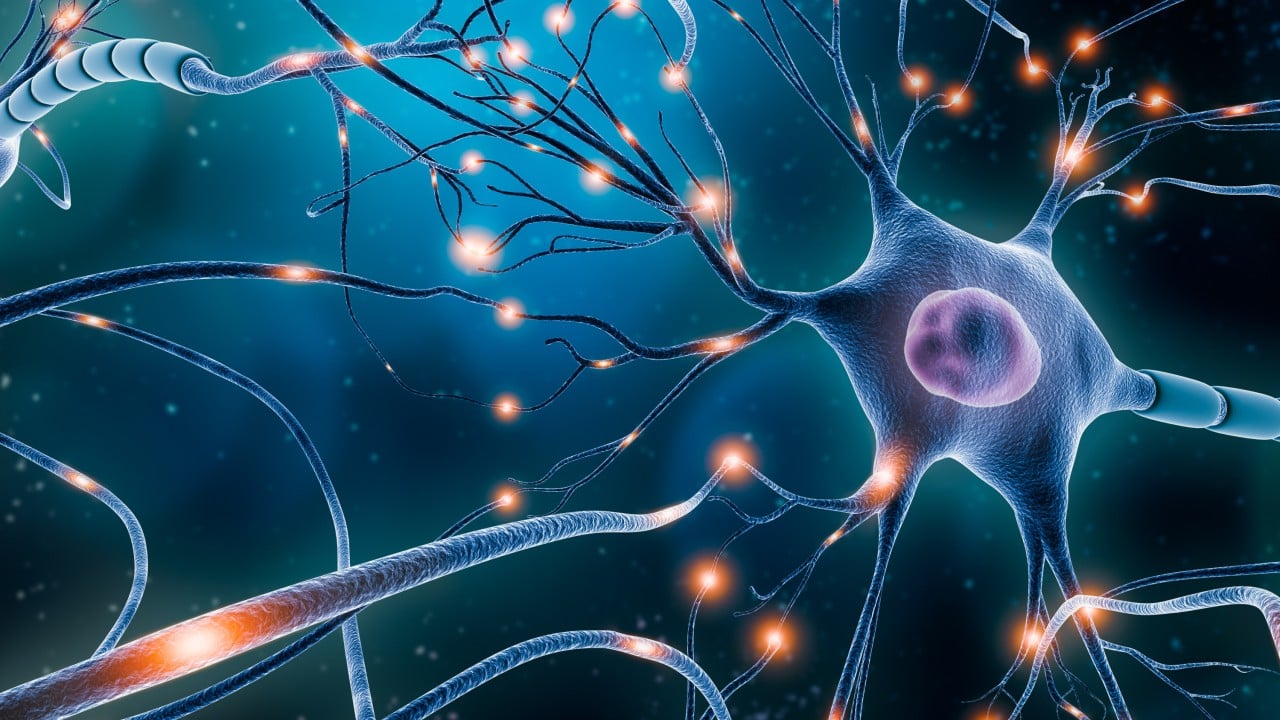
For decades, textbooks told us a neat little story about the brain. Each neuron was supposedly just a simple binary switch, firing off or staying quiet depending on whether incoming signals crossed a basic threshold, while all the real math happened up at the level of big circuits.
Turns out that picture was way too simple.
Research led by scientists in China has added serious weight to a shifting view in neuroscience that neurons may act as minicomputers that help decision making on their own before a single spike ever leaves the cell body. Instead of waiting passively for network-level instructions, individual cells and their branching dendrites appear to weigh inputs, filter noise, and carry out local calculations right inside the cell.
If that sounds surprising, it should. It means the brain isn't just a giant grid of dumb switches wired together like a massive office telephone board. Each single cell has its own local processor, complete with nonlinear math happening along fine branches that used to get treated like passive wires.
Let's be honest about why this matters. When people read headlines about neurons acting as minicomputers, they often picture tiny silicon chips floating around inside human skulls. That's a terrible mental model. A living cell doesn't run binary code with a clock cycle or crisp logic gates like a laptop. Still, calling it a minicomputer gets across a real shift in how we understand neural computation: single neurons do way more heavy lifting during choices, trade-offs, and uncertain moments than classic models gave them credit for.
How Single Neurons Actually Do Local Math
To see why neurons acting as minicomputers changes how we think about choices, look closely at what happens on a neuron's dendrites. A typical pyramidal neuron in the cortex can receive thousands of synaptic inputs across a sprawling tree of branches. Historically, many computational models treated those dendrites like simple cables that just summed voltages up and sent them toward the cell body, known as the soma.
Experiments over the past couple of decades—and newer work coming out of Chinese neuroscience labs studying neural circuits and decision behavior—have pushed back hard against that cable view. Dendritic branches aren't passive pipes. They host voltage-gated ion channels and NMDA receptors that create local nonlinearities. When inputs arrive close together in space or time on a branch, they can trigger localized dendritic spikes or plateau potentials that amplify certain combinations of signals and suppress others.
Think about what that does before a decision even reaches the network level. Suppose you're trying to decide whether to merge into a fast-moving lane on a rainy highway. Your visual and motion pathways are getting bombarded with conflicting cues: brake lights ahead, spray from tires, a gap that looks big enough at first glance and smaller a second later. If every single input had to travel all the way to the soma and compete globally with thousands of other signals before any filtering happened, response times and energy costs would look very different.
Instead, local branches can act like mini-filters or sub-units. One branch might respond strongly when two specific cues line up, while another dampens noisy, scattered inputs. By the time signals reach the cell body, a lot of preliminary sorting has already happened inside the cell itself.
That doesn't mean one lone neuron makes life choices by itself. A human decision—whether picking a career move, deciding when to buy stock, or choosing what to eat after a long shift—still relies on distributed populations across prefrontal, parietal, basal ganglia, and sensory regions. What changes is how those networks compute. If each node is a rich, nonlinear processor rather than a basic threshold unit, a much smaller network can represent complex decision boundaries and weigh competing evidence more flexibly.
Why Chinese Neuroscience Labs Are Driving Key Insights Here
Chinese research institutions have become major contributors to systems and cellular neuroscience, helped by heavy public investment in brain science initiatives, advanced optical imaging, and large-scale electrophysiology. Groups at places like the Institute of Neuroscience under the Chinese Academy of Sciences, Peking University, Tsinghua University, and partnering centers have pushed work on neural circuits, perception, and decision-making in rodents, non-human primates, and computational models.
One practical reason this line of research stands out is technical. Watching subthreshold activity, dendritic events, and population dynamics during active choices used to be brutally hard. You can't easily see fine voltage shifts inside tiny branches while an animal is actively making a choice unless your imaging and recording tools are fast and sensitive enough.
Advances in two-photon microscopy, genetically encoded voltage or calcium indicators, high-density probes, and careful behavioral tasks have let researchers track how neural activity evolves while a subject weighs sensory evidence or risk. When studies connect cellular or dendritic computation directly to behavioral choices—rather than studying isolated slices in a dish—the link to decision-making becomes much harder to ignore.
Still, I want to be straight with you about where the science stands. Whenever a study links cellular or circuit mechanisms to decision making, media coverage loves to stretch the conclusion from "this helps weigh noisy sensory evidence in a lab task" to "scientists cracked human free will." Those aren't the same thing. Lab decision tasks are usually tightly controlled—judging motion direction, picking between two rewards with different probabilities, or deciding when to act under time pressure. Real-world human choices involve memory, social norms, long-term regret, mood, and open-ended goals that go well beyond a two-choice task.
What People Get Wrong About Brain Computing
Most misunderstandings around neurons acting as minicomputers come from three habits people fall into when reading neuroscience news:
- Treating "minicomputer" as literal silicon. A neuron runs on ion gradients, neurotransmitter diffusion, metabolic ATP, and messy biological timing. Calling it a minicomputer is a metaphor for local information processing, not an claim that brains work like x86 processors.
- Confusing component complexity with consciousness. Giving each cell more computational power doesn't mean single neurons are "conscious" or "deciding" in a human sense. Consciousness and subjective agency emerge from large-scale coordination across systems, not from one cell acting like a tiny person.
- Ignoring network context. Even if a single cell acts like a sophisticated local unit, it still lives inside a feedback loop with inhibitory interneurons, neuromodulators like dopamine and norepinephrine, and long-range projections. A smart worker on a chaotic assembly line still depends on the line.
Decision Making Is Messier Than AI Models Pretend
If you spend any time looking at artificial neural networks, you'll notice a funny irony. Modern AI models were originally inspired by biological neurons, yet standard artificial neurons—like a simple dot product passed through a ReLU or sigmoid function—are wildly simplified compared to real cells.
To get huge performance gains, AI engineers leaned on scale: billions or trillions of parameters, massive matrix multiplications, and huge training datasets. Biology took a different route. Your brain runs on roughly 20 watts of power—less than a dim household bulb—while handling real-time motor control, perception, memory, and messy trade-offs under uncertainty.
Local computation inside neurons and dendrites is one of the prime suspects for how biology gets so much mileage out of limited energy and space. If a single biological neuron with complex dendritic trees can approximate functions that would take multiple simple artificial units, the effective computational capacity of a brain region is higher than a simple neuron count suggests.
That's also why neuromorphic engineers pay close attention to findings like these. Building chips that mimic spiking behavior and dendritic processing isn't just about copying nature for fun. It's a practical attempt to cut power consumption and handle noisy, real-time sensory streams without shipping every bit of data back and forth to external memory.
At the same time, don't fall for the hype that every new neuroscience finding immediately turns into better AI or instant self-improvement hacks. Biology has quirks that engineers wouldn't even want in a spreadsheet—like fatigue, drift, and emotional bias. Those quirks are part of why humans make brilliant intuitive leaps one minute and terrible impulsive choices the next.
What This Means for How You Make Decisions
You don't need a microscope to use what we know about brain computation in everyday life. While neurons acting as minicomputers is a cellular story, the broader picture of how brains weigh evidence and settle on a choice has very real takeaways for how you handle tough calls.
First, recognize that your brain constantly filters and pre-processes information before you're consciously aware of a verdict. That gut feeling you get when something feels "off" isn't magic, and it isn't always right either. Often, it's fast, low-level pattern matching and cue weighting happening ahead of slow, deliberate reasoning. Treating a hunch as absolute truth is a mistake, especially in unfamiliar situations where old patterns don't fit. Ignoring it completely can also waste useful early signals.
Second, give noisy decisions room before locking in. When information is ambiguous or incomplete, rushing forces your neural circuits to commit early based on partial cues and prior bias. Stepping back for an hour, sleeping on a non-urgent choice, or gathering one more piece of concrete evidence changes what signals feed into your decision process.
Third, watch your state—fatigue, stress, and rushing genuinely change how you weigh options. When you're exhausted or pressed for time, the brain leans harder on fast shortcuts and immediate relief over careful evaluation of trade-offs. Big career, financial, or relationship decisions made at 11 p.m. when you're wiped out rarely reflect your best judgment.
If you want to put this into practice this week, pick one real decision you've been putting off or overthinking. Write down the two or three options, list the specific evidence for and against each in plain words, and set a concrete cutoff time to decide once you've slept on it. That simple habit keeps fast, noisy impulses from hijacking a choice that deserves slower weight—and honestly, it beats agonizing in circles for days.