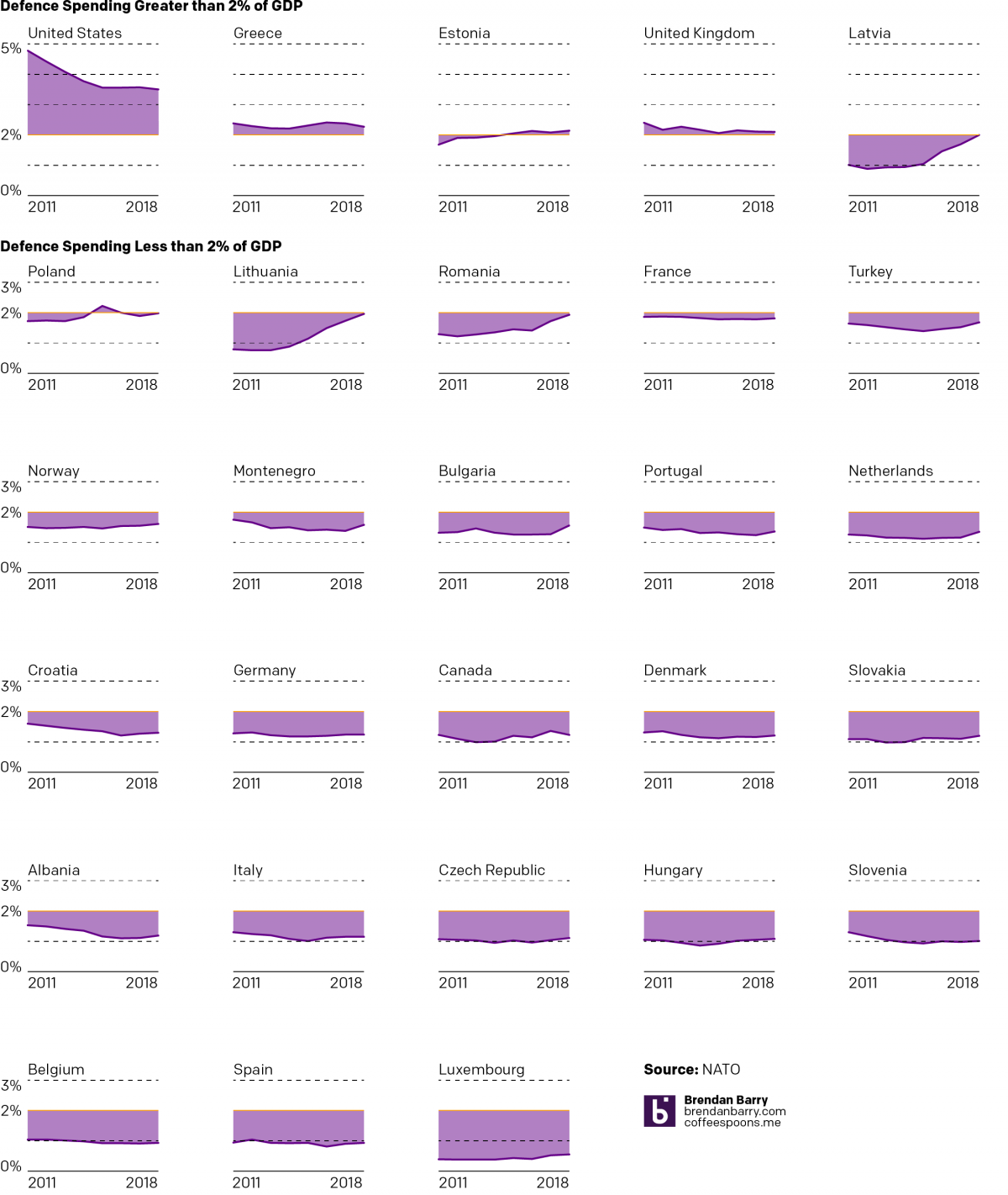
The shift in European defense spending from a discretionary luxury to a structural mandate is not a reaction to rhetoric but a fundamental realignment of the continent’s security architecture. While political commentary often centers on the personality-driven "Trump effect," the underlying mechanics involve a pivot from the Post-Cold War "Peace Dividend" to a high-readiness posture necessitated by the erosion of the rules-based order in Eastern Europe. The current NATO consensus reflects a transition from voluntary compliance with the 2% GDP guideline toward a hard-coded budgetary floor. This transformation is governed by three primary drivers: the institutionalization of spending mandates, the exhaustion of legacy hardware reserves, and the recalibration of the U.S. security guarantee.
The Institutionalization of the 2% Mandate
For decades, the 2% defense spending target established at the 2014 Wales Summit functioned as a soft aspirational goal. This period was characterized by "free-riding" dynamics where European nations prioritized social spending while relying on the U.S. nuclear umbrella and conventional rapid-response capabilities. The failure of this model became evident when the logistical requirements of modern high-intensity conflict far exceeded the capacity of depleted European inventories.
The current strategy among NATO leadership, including Secretary General Mark Rutte and his predecessor, centers on turning this guideline into a baseline. The logic is purely mathematical. To achieve the capability targets set by the New NATO Force Model—which aims to have over 300,000 troops at high readiness—spending must logically exceed the 2% threshold. Many frontline states in the Baltics and Poland have already breached 3% or 4%, creating a tiered alliance where security is proportional to fiscal commitment.
The Cost Function of Modern Deterrence
The price of "defense" has scaled exponentially due to technological sophistication and inflationary pressures within the defense industrial base. Reaching 2% of GDP in 2026 buys significantly less kinetic capability than it did in 1990. Several factors contribute to this cost escalation:
- Technological Complexity: Modern platforms like the F-35 or Leopard 2A8 require specialized maintenance and software integration that drive life-cycle costs upward, often accounting for 70% of total program expenditure.
- Ammunition Depletion: The war in Ukraine revealed that European "just-in-time" supply chains were insufficient for prolonged attrition. Rebuilding stockpiles requires multi-year procurement contracts that must be reflected in long-term national budgets rather than one-off emergency funds.
- Personnel Costs: In an era of demographic decline across Europe, attracting and retaining skilled personnel in the armed forces requires competitive wages, further eating into the "investment" portion of defense budgets.
NATO’s internal metric focuses on the 20% rule: at least 20% of defense spending must go toward major equipment and research and development. Nations failing this metric are effectively spending on bureaucracy and maintenance rather than future-proofing their deterrent.
Recalibrating the U.S. Security Guarantee
The messaging from Washington, spanning both the Trump and Biden administrations, has signaled a strategic "Pivot to Asia." This creates a vacuum in the European theater that cannot be filled by rhetoric. European leaders have recognized that the U.S. can no longer be the "first responder" for every regional contingency while simultaneously managing a Peer-Competitor conflict in the Indo-Pacific.
This creates a "Strategic Autonomy" paradox. While Europe seeks to be more independent, its defense industry remains fragmented along national lines. There are currently over 15 different types of main battle tanks in service across Europe, compared to one primary model in the United States. This fragmentation creates massive inefficiencies in logistics and repair. The "message" Europeans have received is that credibility is now measured in "Interoperability and Interchangeability."
The Three Pillars of European Rearmament
To understand the trajectory of European defense, one must analyze the three specific pillars currently being reinforced by NATO member states.
Pillar I: Physical Mass and Readiness
This involves the expansion of brigade-sized elements and the permanent stationing of troops in forward positions. Germany’s decision to permanently station a brigade in Lithuania marks a departure from its post-WWII "culture of restraint." The cost of maintaining high-readiness forces is a fixed operational expense that cannot be easily cut during economic downturns without compromising the entire alliance's frontline integrity.
Pillar II: The Industrial Ramp-up
European governments are now issuing sovereign guarantees to defense contractors to expand production lines for 155mm shells, air defense systems, and armored vehicles. This moves the defense sector from "boutique production" to "industrial scale." The risk here is "over-capacity" if the threat perception diminishes, but the current strategic outlook suggests a decade-long procurement cycle.
Pillar III: Integrated Air and Missile Defense (IAMD)
The vulnerability of European infrastructure to long-range strikes has led to the European Sky Shield Initiative. This is a multi-national effort to create a layered defense system. The fiscal challenge is that IAMD is prohibitively expensive; a single interceptor can cost millions of dollars to down a drone worth thousands. This asymmetric cost curve is the primary reason why spending must rise above 2%.
Logistical Bottlenecks and Labor Constraints
Increasing the budget is a fiscal act; increasing capability is a physical one. European defense expansion faces significant bottlenecks. The lead time for specialized steel and semiconductors remains high. Furthermore, the defense industry competes with the private tech sector for the same pool of engineers and data scientists needed for electronic warfare and AI-driven systems.
If a nation increases its budget by 20% but the cost of inputs rises by 15% due to supply chain constraints, the real-world increase in capability is negligible. This is the "Inflationary Defense Trap." To escape it, NATO must move toward joint procurement, which leverages the collective buying power of the alliance to drive down unit costs.
The Credibility Gap
The primary risk to the current strategy is the "Credibility Gap" between pledged funds and actual capability. It is easier for a politician to announce a €100 billion fund than it is to integrate a new division into the NATO command structure. The U.S. assessment of European readiness focuses on "Output Metrics" rather than "Input Metrics."
- Input Metric: Spending 2% of GDP.
- Output Metric: The ability to deploy a combat-ready corps within 30 days.
Europe currently lacks the heavy lift capabilities, tanker aircraft, and satellite reconnaissance to act without U.S. enablers. Closing this gap is the true objective of the post-Trump-era defense spending surge.
Strategic Forecast for the European Theater
The era of the "Security Consumer" in Europe is ending, replaced by a "Security Producer" model. The following structural changes are now inevitable:
- The Rise of the "Eastern Flank" Influence: Countries like Poland, the Baltics, and Finland will dictate the alliance's tactical requirements. Their higher spending-to-GDP ratios grant them disproportionate moral and strategic leverage within NATO headquarters.
- Dual-Track Procurement: European nations will continue to buy "off-the-shelf" American systems (like the F-35) for immediate needs while attempting to build sovereign European platforms (like the FCAS or MGCS) for the 2040s. This creates a temporary budgetary "bulge" where nations must fund two generations of technology simultaneously.
- Redefining "Defense" to include Resilience: NATO's mandate is expanding to include the protection of subsea cables, energy pipelines, and cyber networks. This requires a fusion of military and civilian budgets, making the 2% metric even more difficult to track accurately.
The immediate strategic priority for European capitals is the transition from "Signaling" to "Sustaining." The message has indeed been received, but the translation of that message into a durable, multi-decade military capability requires a fundamental shift in national priorities. The fiscal gravity of the new security environment means that defense is no longer a separate line item; it is the prerequisite for all other economic activity on the continent. Governments must now manage the "Guns vs. Butter" trade-off with a transparency not seen since the 1950s.
The final strategic play for European leaders is the normalization of high defense spending within the domestic political discourse. Failure to do so will result in a "hollowed-out" force that meets the 2% accounting target but lacks the kinetic power to deter a peer adversary. Success will be measured not by the size of the budget, but by the absence of conflict on NATO's borders.