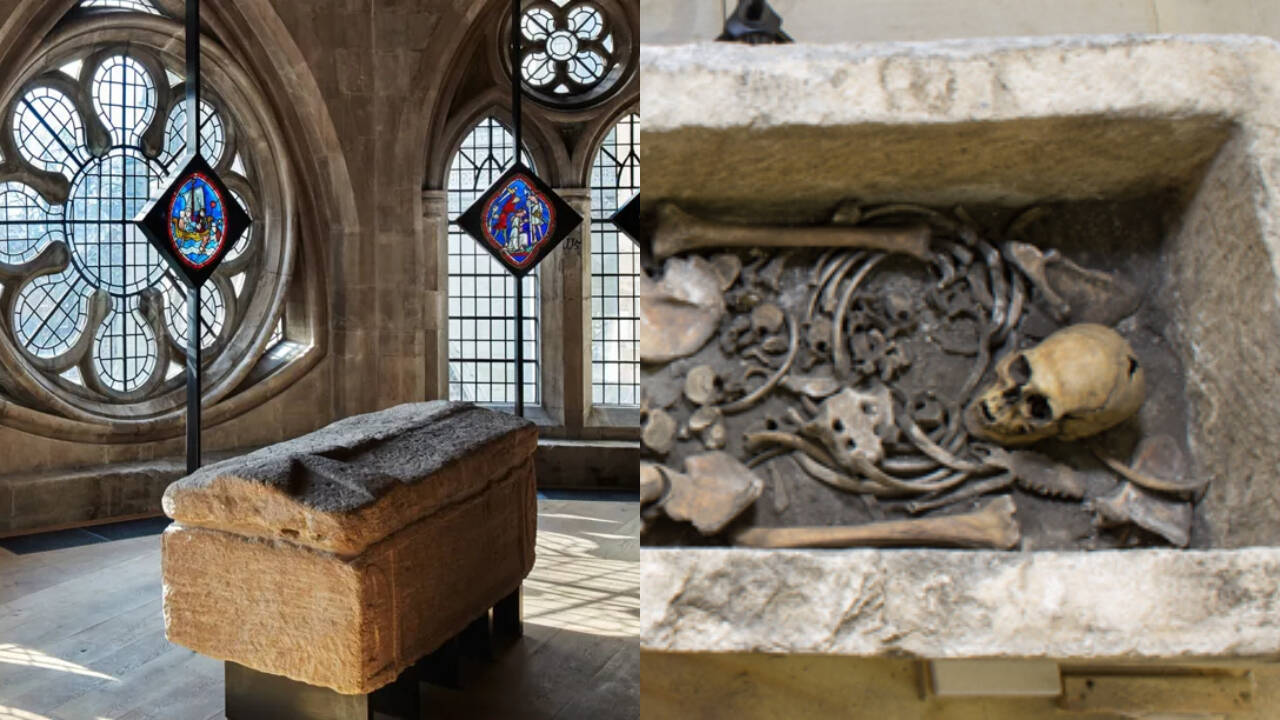
A Roman limestone coffin bearing the name of a fourth-century citizen holds a skeleton that died between AD 987 and 1052, exposing a multi-century fault line between carved inscriptions and biological time.
Standard coverage treats the Westminster Abbey sarcophagus as a tidy mystery solved by a single laboratory test. That framing misses the real mechanics of how physical objects acquire conflicting identities over six centuries of reuse, relocation, and partial record-keeping. One skeleton cannot simultaneously be a fourth-century Roman named Valerius Amandinus and a late Saxon churchman buried half a millennium later.
The confusion starts when observers treat a funerary monument as a closed system. In practice, a heavy stone vessel moves across regimes, gets re-carved, receives a secondary wooden coffin, shifts across monastic grounds, and passes through nineteenth- and twenty-first-century inspections that each capture only a slice of its history.
The Two-Layer Identity Trap in Mortuary Reuse
Surface-level reporting usually sets up a binary choice between the name on the stone and the date of the bones. A sharper analytical model separates container provenance from occupant chronology.
Container provenance tracks the stone basin and its lid: when the limestone was quarried and carved, whose name was inscribed on it, and when a later mason altered the lid. Occupant chronology tracks the human remains placed inside: when the individual lived, what their age and stature were, and whether their body entered during the primary burial or a later reuse event.
When an ancient stone coffin is recycled in the late Anglo-Saxon period, those two timelines decouple. The Roman inscription commemorating Valerius Amandinus remains legible on the limestone, functioning as an inherited stone shell rather than a reliable label for the person inside. Meanwhile, a large Latin cross sculpted onto the lid points to a late tenth- or eleventh-century Christian rework.
A known historical fact is that radiocarbon dating places the skeletal remains within AD 987–1052, and osteological assessment indicates a man roughly 35 to 49 years old standing around 5 feet 9 inches tall. An educated hypothesis—advanced by archaeologist Warwick Rodwell—is that this man was one of two high-ranking Westminster abbots, Ælfwig (who died around 1020) or Wulfnoth (who died around 1049).
Conflating a plausible candidate with a proven identity is where casual summaries go wrong. Radiocarbon windows narrow the field to a generation or two; they do not by themselves write a name onto a bone.
Three Structural Drivers Behind the Misidentification
Why did this monument puzzle observers for more than a century after its nineteenth-century excavation? Three mechanisms explain the persistence of the ambiguity.
- Material Scarcity and Prestige Economics: Quarrying, transporting, and dressing large stone coffins demanded heavy labor and high cost. Reusing an existing Roman sarcophagus in the late Saxon or early medieval era allowed a monastic community to stage a high-status burial using ready-made stone while signaling continuity with antiquity. The presence of traces of a wooden coffin inside the stone basin—a coffin within a coffin—further indicates deliberate ceremonial preparation rather than casual dumping.
- Architectural Churn and Spatial Drift: Monastic complexes are not static museums. During King Henry III's thirteenth-century rebuilding campaign in the 1240s, structural work moved the sarcophagus around 1258 toward a new sacristy courtyard. Every physical move risks separating archival notes from physical contexts and loosening institutional memory of who lay inside.
- Asymmetric Documentation Across Eras: Workers encountered the coffin in 1820—breaking its lid into six pieces—before formal excavation in 1869. Over the intervening decades, conflicting assumptions grew up around whether the skeleton had vanished. Only when conservators opened the lid in the 2010s—reported in accounts across 2016 and 2018—did direct inspection confirm that the skeleton was still present inside.
The second limitation in older interpretations comes from treating nineteenth-century records as complete. Early antiquarians excelled at copying Latin inscriptions and repairing broken stone, yet their chain-of-custody notes often left gaps that modern specialists have to reconstruct forensically.
Cause-and-Effect Chains Standard Summaries Miss
Most retellings list events in sequence—1820 discovery, 1869 excavation, cross on the lid, radiocarbon date of AD 987–1052, two abbots—without showing how each factor alters the evidentiary weight of the others.
One cause-and-effect chain links lid modification to rank inference. A monumental stone sarcophagus re-carved with a large Latin cross and paired with an internal wooden coffin implies institutional investment. In a monastery, an ordinary brother would not command that level of funerary treatment. That status filter is what elevates senior figures like Ælfwig and Wulfnoth above rank-and-file monks.
A second chain links radiocarbon calibration to biographical plausibility. A date range spanning AD 987 to 1052 overlaps the late reign and death of Ælfwig (around 1020) as well as the tenure and death of Wulfnoth (around 1049). Yet knowing a man died within that window does not resolve whether he died in his late thirties, forties, or older, because radiocarbon dates measure when biological carbon exchange ceased, not the person's birth year.
A third chain connects marine or dietary reservoir effects to dating precision. Any radiocarbon reading on human bone is only as clean as its calibration and sample context. Without full isotopic and contextual controls published alongside the raw dates, a date range acts as a strong directional anchor rather than a forensic fingerprint.
How to Audit Similar Archaeological Claims
Anyone evaluating a story about an ancient coffin, a famous name, or a newly dated skeleton can apply a four-step verification routine before accepting a headline conclusion.
- Separate the vessel from the remains. Check whether the dating test ran on the stone, plaster, wood, or human bone, and verify whether the object shows signs of secondary reuse.
- Audit the inscription's relationship to the occupant. Ask whether the text names the original owner of the monument, a later dedicator, or a person added long after carving.
- Cross-check physical anthropology against candidate biographies. Compare estimated age at death, sex, and stature against known historical figures who match the date window.
- Trace every movement since discovery. Map out accidental breakage, past excavations, relocations, and conservation openings to spot where records could have drifted.
This framework has clear boundaries. Where surviving chronicles are thin—as they are for eleventh-century Westminster abbots—even rigorous cross-checking stops short of certainty. Precision means stating the exact boundary between what the evidence proves and what remains probable.
Strategic Play for Heritage Institutions and Researchers
Treat every high-profile re-examination at a historic site like Westminster Abbey as an opportunity to publish a unified provenance ledger that pairs radiocarbon ranges, osteological estimates, masonry modifications, and architectural move histories in one place. Presenting the two abbots as competing hypotheses rather than a settled verdict builds public trust and prevents future headlines from cycling back into oversimplified myths.



