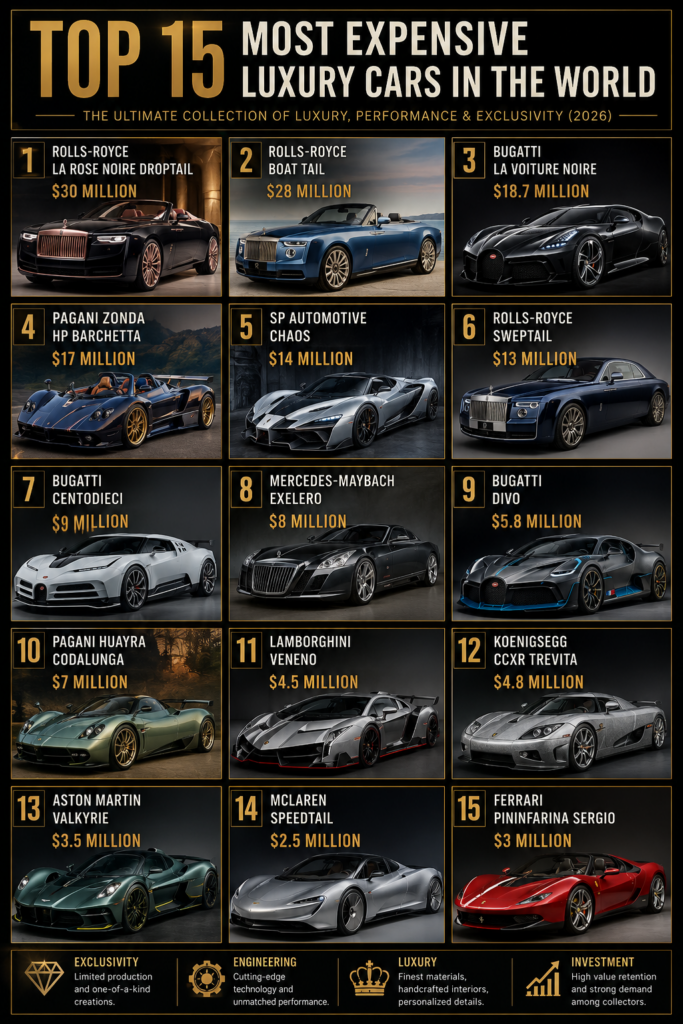
The retail pricing of hyper-luxury vehicles contradicts standard automotive depreciation models. In mass-market automotive manufacturing, value is heavily dictated by utility, production volume, and linear depreciation curves. In contrast, ultra-luxury cars commanding eight-figure transactions operate under an inverted economic model: artificial scarcity, high customization friction, and historical asset-class positioning cause values to appreciate rather than decay.
To evaluate the top tier of automotive pricing requires moving past superficial listicle metrics. Instead, we must isolate the variable cost functions, capital appreciation drivers, and manufacturing bottlenecks that establish these vehicles as alternative asset classes.
The Hyper Luxury Pricing Equation
The MSRP of an ultra-luxury vehicle is not an arbitrary marketing figure; it is the output of a distinct three-part cost and value allocation function. Understanding this equation explains why certain low-volume assets scale past $10 million while high-performance mass production peaks under $500,000.
1. Amortization of Monocoque and Powertrain R&D
Mass-market vehicles spread billions of dollars in development costs across millions of units. Hypercars amortize similar compliance, wind-tunnel testing, and crash-testing costs across production runs restricted to 10, 40, or 100 units total. A bespoke carbon-fiber monocoque requiring rigorous regulatory validation can demand upward of $50 million in baseline development. When split across a production run of 10 vehicles, each unit carries a $5 million fixed-cost burden before a single component is fabricated.
2. The Scarcity Premium and Veblen Mechanics
The relationship between price and demand in this tier is positive, functioning under the rules of Veblen goods. High pricing signals exclusive social status, which directly enhances the asset's utility to the buyer. Manufacturers deliberately constrain supply below market equilibrium to maintain this premium.
$$\text{Scarcity Premium} \propto \frac{\text{Qualified Global Buyers}}{\text{Total Production Units}}$$
When the denominator remains below 50 while the numerator expands globally, the pricing threshold detaches from material costs.
3. Bespoke Coachbuilding and Opportunistic Labor Hours
Vehicles priced beyond $15 million frequently rely on historical coachbuilding methodologies. This involves mounting completely unique, hand-formed carbon-fiber or aluminum bodywork onto an existing high-performance chassis framework. The labor cost switches from automated robotics to highly specialized master craftsmen, where a single body panel may require 500 hours of manual shaping and alignment.
Anatomy of the Top Tier Valuation Drivers
An analysis of the highest-value transactions reveals specific engineering and economic classifications. The vehicles driving these valuations fall into three structural categories.
One-Off Commemorative Coachbuilds
These assets represent the absolute ceiling of modern automotive pricing, often exceeding $20 million. Examples include the Rolls-Royce Boat Tail and Droptail series, or Bugatti’s La Voiture Noire.
- The Mechanism: The manufacturer utilizes an existing powertrain architecture (e.g., Bugatti's quad-turbocharged W16 or Rolls-Royce’s twin-turbo V12) but scraps the standard body, interior layout, and electrical packaging.
- The Valuation Driver: Absolute singularity. The buyer contracts the factory to build a vehicle that will never be replicated, effectively purchasing the intellectual property rights to that specific aesthetic design.
Low-Volume homologation Hypercars
Priced between $3 million and $10 million, this category includes vehicles like the Pagani Utopia, Koenigsegg Jesko, and Aston Martin Valkyrie.
- The Mechanism: These are ground-up engineering exercises designed to push thermodynamic and aerodynamic limits. They introduce bleeding-edge tech, such as Koenigsegg’s Light Speed Transmission or the Valkyrie’s F1-derived structural aerodynamics.
- The Valuation Driver: Extreme mechanical differentiation. Buyers are funding experimental engineering that cannot legally or financially exist in mass-market vehicles due to manufacturing scale constraints.
Historical Re-Imaginations and Restomods
A rapidly growing segment where classic designs are rebuilt using modern materials science, commanding prices from $2 million to $5 million.
- The Mechanism: Companies like Singer Vehicle Design or Automobili Amos take historical chassis (e.g., Porsche 964) and re-engineer them using carbon fiber, advanced telemetry, and modern bespoke engines.
- The Valuation Driver: The mitigation of vintage usability flaws paired with iconic, unrepeatable historical design language.
The Value Retention and Capital Appreciation Matrix
The common assumption that driving a new vehicle off the dealership lot incurs an immediate 20% drop in valuation does not apply to this asset class. In the ultra-luxury segment, the delivery event frequently triggers an immediate arbitrage premium.
The chart below outlines the financial trajectory of hypercars based on their production volume and allocation mechanics:
| Vehicle Classification | Typical Production Volume | 3-Year Value Trajectory | Primary Risk Factor |
|---|---|---|---|
| Bespoke One-Off | 1 to 5 units | Appreciates +15% to 40% immediately | Brand dilution or sudden factory replication |
| Limited Run Hypercar | 20 to 150 units | Appreciates +50% to 100% on secondary market | Mileage accumulation, technological obsolescence |
| Series Ultra-Luxury | 1,000+ units | Depreciates -20% to -45% linearly | High production capacity, lack of allocation gatekeeping |
The primary driver of the secondary-market premium is the allocation bottleneck. Original Equipment Manufacturers (OEMs) do not allow just any wealthy individual to purchase a limited-run hypercar. A buyer must pass a rigorous vetting process, which typically requires a verified history of owning multiple previous models from the brand.
Wealthy individuals who lack these factory relationships are blocked from the primary allocation list. Consequently, they are forced to buy on the secondary market immediately after delivery, paying a massive premium to the original owner to bypass the manufacturer's gatekeeping.
Engineering Bottlenecks That Drive Cost
To fully understand why these vehicles demand such high capital layout, one must evaluate the extreme engineering tolerances required. High prices are fundamentally tied to overcoming specific thermodynamic and aerodynamic limitations.
The Thermal Management Problem
Generating 1,500 to 1,600 horsepower—as seen in Bugatti’s W16 or its hybrid V16 successor—creates immense thermal energy. A standard road car uses one or two radiators. A Bugatti hypercar requires a complex multi-radiator cooling architecture split between high-pressure and low-pressure loops to keep engine oil, transmission fluid, intercoolers, and engine blocks within functional limits under extreme load. The packaging optimization required to fit this cooling matrix inside a sleek, aerodynamic carbon envelope adds hundreds of thousands of dollars in engineering costs per vehicle.
Aerodynamic Drag vs. Downforce Calculations
At speeds exceeding 250 mph, air behaves less like a gas and more like a viscous fluid. Vehicles like the Aston Martin Valkyrie use venturi tunnels running the entire length of the underbody to create a low-pressure zone, sucking the car to the tarmac.
This requires structural components to withstand multiple tons of downforce without deflecting. Carbon-fiber layups must be mathematically optimized using computational fluid dynamics (CFD) supercomputers, requiring thousands of processing hours that inflate development budgets.
Regulatory and Emissions Compliance Interception
Meeting global crash standards while keeping weight low requires expensive materials. Hypercar manufacturers utilize specialized titanium-carbon weaves (carbotanium) or ultra-high-modulus carbon fiber. Additionally, making a 1,000+ horsepower engine comply with stringent Euro 7 or US EPA emissions rules without choking performance demands expensive, custom-developed catalytic converters and hybrid-electric assist systems.
Portfolio Risks and Asset Vulnerabilities
While the financial upside of hyper-luxury car ownership can be significant, treating these vehicles purely as appreciating assets introduces several distinct risks.
- The Illiquidity Bottleneck: Unlike equities or precious metals, selling a $5 million asset requires a highly specialized marketplace. Finding a buyer can take months, and transactions are highly sensitive to broader macroeconomic shifts.
- The Mileage Penalty: The valuation of these assets is highly sensitive to usage. A hypercar with 200 miles on the odometer can easily command double the price of an identical model with 5,000 miles. This dynamic turns the vehicle into a static display piece, completely stripping away its functional utility as a high-performance machine.
- High Maintenance Overhead: Maintenance costs do not scale linearly. A routine annual service fluid change can easily run $25,000, while a replacement set of specialized tires—such as Michelin’s custom compounds for top-speed runs—can cost upwards of $40,000 per set and degrade purely based on age, regardless of use.
Strategic Allocation Framework for Collectors
For capital allocators looking to deploy wealth into the ultra-luxury automotive sector, purchasing based on aesthetic appeal or raw horsepower figures yields unpredictable financial outcomes. To maximize capital preservation and appreciation, allocation decisions should follow a strict structural hierarchy.
Prioritize acquisition targets that feature a manual transmission paired with a naturally aspirated engine architecture. As the automotive industry shifts toward mandatory electrification and automated dual-clutch gearboxes, analog mechanical interfaces are becoming increasingly rare. This growing scarcity drives long-term value retention. Vehicles that retain analog inputs consistently outperform early-generation hybrid or pure electric hypercars on the secondary market. Early digital systems age rapidly and present severe long-term battery degradation risks, whereas mechanical platforms remain serviceable indefinitely.
Furthermore, buyers should look for models where production runs are strictly capped at fewer than 100 units globally. Beyond this volume threshold, a vehicle transitions from an exclusive collector’s piece into a standard luxury commodity, exposing it to traditional depreciation forces. Finally, focus capital on brands that actively guard their secondary market ecosystems through strict anti-flipping contracts and rigorous allocation vetting. When a manufacturer penalizes owners who flip cars for quick profits, it stabilizes secondary market pricing and protects long-term asset values for serious collectors.