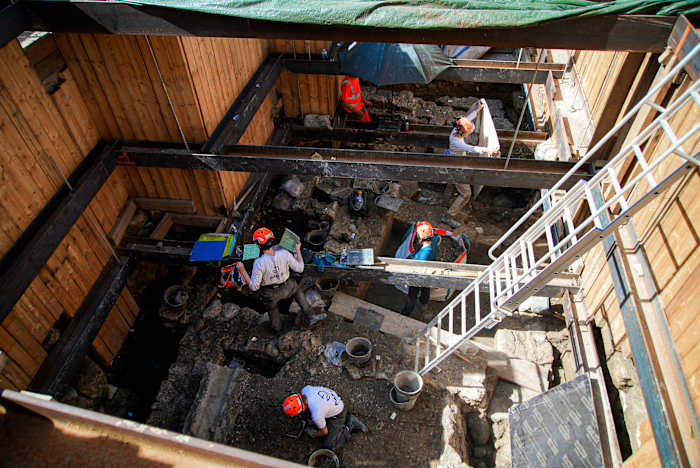
Urban centers with continuous occupation function as physical accumulation mechanisms. When contemporary municipal projects require subterranean disruption, they trigger a structural conflict between infrastructure modernization and archaeological preservation. This dynamic is currently visible in the forecourt of Notre Dame Cathedral in Paris, where a commercial project to lower surface temperatures via urban greening has forced a mandatory rescue excavation.
Within a vertical profile of exactly four meters, the site isolates distinct socioeconomic and architectural shifts spanning two millennia. This text deconstructs the structural layers of this excavation, analyzing the economic and depositional models that govern urban stratigraphy.
The Physical Laws of Urban Accumulation
Urban ground levels do not rise arbitrarily. They are driven by a specific depositional equation: the rate of architectural transformation outpaces the efficiency of debris removal. In ancient and medieval urban planning, the energy expenditure required to haul demolition rubble outside city walls exceeded the utility of using that rubble as a foundation leveling agent for subsequent construction.
The accumulation function is particularly acute on the Île de la Cité, a topographically confined island within the Seine River. Because horizontal expansion was geographically constrained, structural density could only scale vertically or compress internally. This physical constraint creates a predictable stratigraphic sequence where time maps directly to depth, varying based on the compaction of the soil and the materials used by each successive population.
The current excavation isolates this progression across three primary socio-historical operational tiers, visible within the 400-centimeter profile.
0 cm  ------------------------------------ (Modern Ground Level)
-50 cm ----------------------------------- First Archaeological Horizon: 1163 AD Base
       [Tier 1: Medieval Domestic Units & High-Density Settlement]
-200 cm ---------------------------------- Second Archaeological Horizon: 6th–10th Century
       [Tier 2: Post-Roman Sub-Surface Infrastructure & Grain Pits]
-400 cm ---------------------------------- Third Archaeological Horizon: 4th–5th Century
       [Tier 3: Late Roman Urban Fortification and Lutetian Realignment]
Tier 1: The Medieval Domestic Economy (Depth: 50 cm to Sub-Surface Foundations)
The highest archaeological horizon begins roughly 50 centimeters below the modern paving stones, corresponding to the urban topology of 1163 AD, the year construction commenced on Notre Dame. At this juncture, the forecourt was not an open civic plaza but a dense residential grid divided by a narrow thoroughfare.
The structural remains from this period consist primarily of stone cellars belonging to domestic dwellings. The preservation mechanics of this layer yield data through two specific architectural features.
The Preservation Value of Structural Abandonment
When medieval homes were cleared or altered during later civic rezonings, the subterranean cellars were frequently backfilled with contemporary refuse. These sealed contexts act as chronological capsules, preventing the biological and mechanical disturbance typical of active topsoil.
Anaerobic Conservation in Domestic Latrines
The most structurally intact artifactual yields—specifically complete ceramic jugs and cups—originate from domestic latrine pits located beneath these cellars. In typical archaeological contexts, ceramics are found fractured due to mechanical stress from shifting soil and weight distribution. However, the organic, low-density waste inside historical latrines functioned as a physical cushion. This fluid-retaining matrix neutralized structural pressure, preserving brittle pottery forms in their original geometry.
A primary empirical anomaly within this tier involves medieval ceramic shards featuring red markings painted on their interior surfaces. Standard domestic pottery of this era rarely exhibits internal notation. The presence of these markings suggests a specialized distribution or inventory system, though the exact semantic meaning of the script remains unverified by epigraphers.
Tier 2: Post-Roman Sub-Surface Infrastructure (Intermediate Depth)
Beneath the foundations of the 12th-century settlement lies a distinct horizon tracking the Merovingian and Carolingian eras, spanning the 6th through the 10th centuries. The physical signature of this period is characterized by a transition from stone architecture to subterranean earthworks.
The primary features discovered are deep grain storage pits. These excavations indicate a shifting economic strategy centered on localized agricultural security. Rather than relying on large-scale public granaries, early medieval populations utilized localized storage systems dug directly into older structural strata.
These pits present a distinct depositional challenge: as they fell out of functional use for food preservation, they were repurposed as waste receptacles. This intentional backfilling creates a reverse-chronological fill layer within the pit itself, muddying the surrounding stratigraphic lines.
Tier 3: Late Roman Urban Fortification (Depth: 400 cm)
The lowest current operational tier, located at the four-meter threshold, exposes the late Roman period of Paris, then designated Lutetia. The architectural and artifactual signatures here clarify the geopolitical shifts occurring during the 4th and 5th centuries AD as Roman centralized authority fragmented.
During the height of the Roman Empire, the civic core of Lutetia was situated on the higher ground of the Left Bank. The transition of population and administrative focus to the Île de la Cité during the 4th century indicates a defensive pivot. The island functioned as a natural moat against external incursions.
The physical mechanisms of this transition are documented by two key material indicators.
- Spolia and Material Repurposing: The current excavation has exposed structural elements, including a massive Roman stone doorstep, that were salvaged from large public buildings on the Left Bank. This architectural element was transported across the river, inverted, and integrated directly into the island's road beds as paving material. This practice of repurposing stone highlights a clear economic bottleneck: the immediate demand for defensive and transport infrastructure outpaced the labor and resource capacity required to quarry new stone.
- Corrosion-Shielded Numismatic Evidence: Numismatic items recovered from this layer, specifically 4th-century bronze coins, were heavily degraded by copper oxidation, appearing initially as featureless black discs. The application of X-ray radiography bypassed this surface degradation, revealing the profile of Emperor Constantine (who ruled from 306 to 337 AD). This find provides a firm anchor point for dating the stratum. It establishes that the infrastructure layer was actively deposited or modified no earlier than the early 4th century.
Methodological Limitations and Analytical Risks
The Notre Dame forecourt excavation operates under strict operational boundaries that limit the finality of any historical conclusions drawn from the site.
The rescue nature of the excavation means the operational window is fixed by the timeline of the municipal development project. Unlike academic excavations, which can pause indefinitely to analyze complex interfaces, this site must process material at a constant rate, forcing reliance on rapid cataloging and off-site laboratory analysis.
The architectural density of Paris also introduces the risk of stratigraphic truncation. The construction of heavy 19th-century foundations, utility lines, and modern subway systems frequently cuts through historical layers, creating artificial gaps where older evidence is completely destroyed or displaced into younger strata.
The artifacts recovered from the site are routinely transferred to the centralized archaeology facility north of Paris for conservation. Long-term interpretation relies entirely on the cross-referencing of these artifacts with findings from previous urban digs across the Île de la Cité.
The current strategic priority for the field team is to dig past the Roman horizon to search for traces of the initial Celtic settlement established by the Parisii tribe. Reaching this deeper layer depends on navigating the rising water table of the Seine, which presents a hard physical barrier to further downward excavation. Structural stability and water infiltration risks will ultimately dictate whether the pre-Roman history of the site can be safely reached before the ground is sealed for municipal construction.