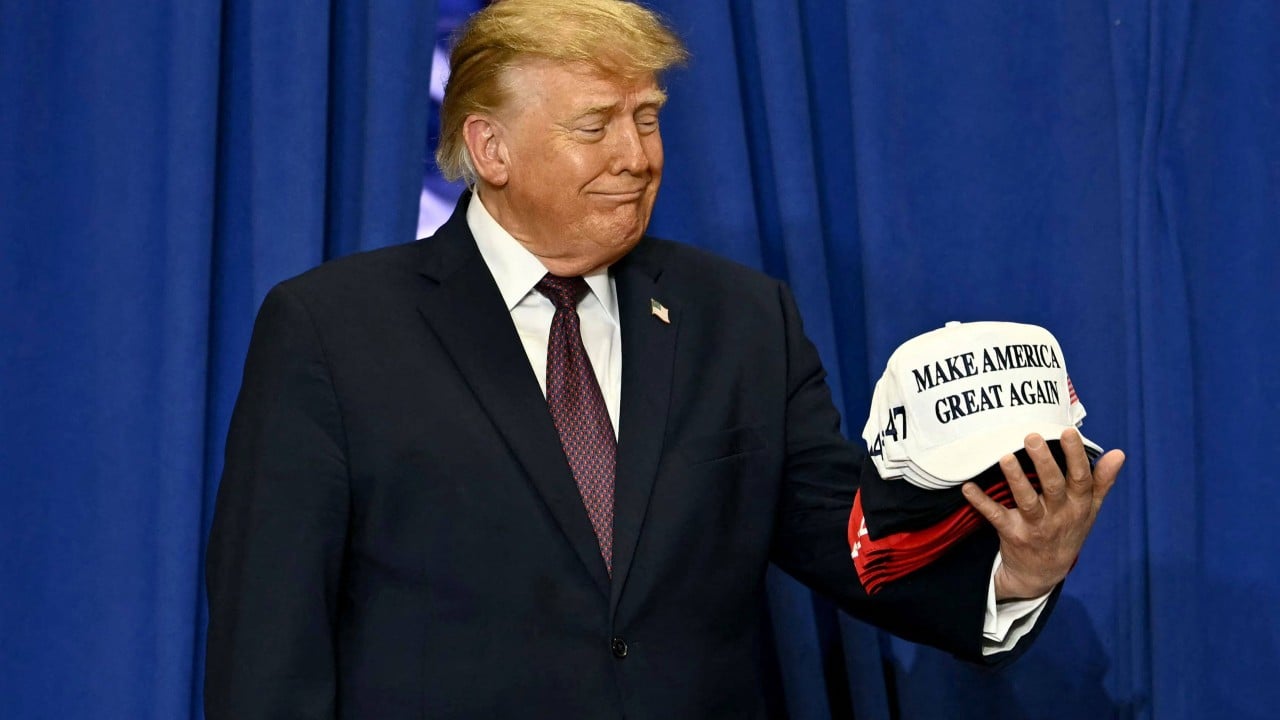
Political coalitions do not collapse overnight; they fracture along preexisting structural fault lines once the centralizing force loses its monopoly on political capital. The conventional media narrative surrounding the Republican Party frames internal friction as an emotional "civil war" triggered by Donald Trump’s fading aura of invincibility. That framing is analytically lazy. What is occurring inside the GOP is a predictable principal-agent problem combined with an approaching succession crisis. When a dominant political figure transitions from an appreciating asset to a depreciating liability—or simply hits constitutional term limits and biological constraints—the incentive structures for every subordinate actor in the coalition invert. Survival no longer depends on absolute loyalty to the center; it depends on positioning for the post-centralized vacuum.
To understand the current destabilization of the Republican coalition, analysts must strip away personality-driven journalism and examine the underlying mechanics of party discipline, primary incentives, and resource allocation. A political party functions as a cartel of ambitious officeholders and interest groups who pool resources to win elections and distribute policy rewards. For nearly a decade, Donald Trump operated as the sole clearinghouse for Republican political capital. His endorsement lowered the barrier to entry in primaries, his fundraising apparatus bypassed the Republican National Committee, and his media dominance dictated the ideological boundaries of the party. Once that monopoly weakens—whether through electoral underperformance, legislative gridlock, or lame-duck dynamics—the cartel fractures into competing factions fighting over three scarce assets: donor liquidity, media attention, and the base's emotional allegiance.
The Three Pillars of the Republican Monopoly
Before measuring the decay of Trump's dominance, we must define the exact mechanisms that sustained it. Standard political commentary attributes his control to charisma or populism. In operational terms, his control rested on three interlocking structural mechanisms that prevented elite defection.
- Asymmetric Primary Enforcement: In safe Republican districts and states, the general election is irrelevant; the primary is the sole point of electoral vulnerability. Trump weaponized this structural reality by maintaining a credible threat of primary intervention. For an incumbent House member or Senator, the expected cost of opposing Trump—facing a well-funded, Trump-endorsed challenger in a low-turnout primary—far exceeded the expected benefit of legislative independence. This created a Nash equilibrium where rational actors publicly conformed regardless of private skepticism.
- Direct-to-Consumer Fundraising: Historically, national party committees controlled the flow of campaign cash, enforcing discipline by withholding funds from rogue members. Trump broke this institutional bottleneck by building a massive small-dollar digital fundraising list owned directly by his political action committees rather than the RNC. When the leader controls the revenue stream independently of the party apparatus, institutional guardrails evaporate.
- Narrative Synchronization: Through direct access to conservative media ecosystems and social platforms, Trump established a single daily news cycle. Competing factions could not build alternative ideological brands because the attention economy rewarded only amplification of, or reaction to, the central figure.
An "aura of invincibility" is simply the market perception that these three mechanisms remain fully operational. When high-profile endorsements fail in swing districts, when down-ballot candidates outrun the top of the ticket, or when lame-duck status limits future patronage, the market reprices the risk of defection.
Anatomy of a Coalition Fracture
When the centralizing force weakens, internal conflict does not erupt randomly. It follows a specific sequence of institutional breakdown across four distinct fault lines within the modern GOP.
The Macroeconomic vs. Populist-Nationalist Split
For decades, the Republican coalition was an alliance between supply-side corporate interests and social conservatives. Trump grafted a third, contradictory element onto this structure: economic nationalism. This faction favors tariffs, industrial policy, entitlement protection, and skepticism of corporate power. As long as Trump enforced compliance, traditional free-market conservatives tolerated protectionist rhetoric in exchange for deregulation and judicial appointments. Without a dominant arbiter to force compromises, these two worldviews cannot coexist in the same legislative platform. Supply-side donors and populist lawmakers hold mutually exclusive positions on trade, corporate taxation, and federal spending. The impending conflict is a direct clash over whether the GOP is a pro-business party or a working-class nationalist party.
Foreign Policy Realism vs. Primacist Interventionism
The post-Cold War consensus within the Republican foreign policy establishment favored forward military posture, global alliances, and interventionism. The nationalist wing successfully challenged this orthodoxy, advocating restraint, skepticism of multilateral commitments, and an "America First" posture that views foreign aid as a domestic transfer loss. In Senate confirmation battles and appropriations bills, this divide is no longer theoretical. Each foreign crisis forces Republican lawmakers to choose between two incompatible strategic doctrines, fracturing voting blocs that previously moved in lockstep.
Institutionalists vs. Disruptionists
A fundamental divide exists regarding the utility of governing itself. One faction views the federal legislature as a mechanism to pass conservative laws, confirm judges, and manage the executive branch. The other faction—incentivized by digital media monetization and zero-sum primary politics—views institutional disruption, government shutdowns, and procedural gridlock as the primary product their voters demand. When party leadership lacks the unilateral backing of a dominant leader to whip votes, the disruptionist wing gains disproportionate leverage through simple veto power in narrow majorities.
The Generational and Succession Arbitrage
Every political movement anchored to a single individual faces a terminal succession problem. Because Trumpism was built around personal loyalty rather than an institutionalized ideological framework, there is no clear mechanism for transferring his political capital to an heir. Ambitious governors, senators, and media figures recognize that waiting passively for a coronation is a losing strategy. Instead, they must engage in early product differentiation. Some attempt to replicate the style without the substance; others pivot toward traditional conservatism to capture alienated suburban voters; a third group doubles down on radical populism to outflank rivals from the right. This multi-front positioning is what external observers mislabel as a "civil war." It is actually standard market fragmentation ahead of an open-seat auction.
The Cost Function of Loyalty and Defection
To predict how individual Republican officeholders will behave over the next twenty-four months, ignore their public statements and calculate their local incentives. Politicians act as rational utility maximizers operating under severe information asymmetry. Every incumbent weighs the probability of surviving a primary against the probability of winning a general election.
In an R+20 congressional district, the cost of defecting from Trumpist orthodoxy remains prohibitively high. Even if Trump's national standing erodes, the local primary electorate remains heavily concentrated with his core supporters. For these lawmakers, maintaining hardline populist positioning is the optimal survival strategy. They will continue to demand ideological purity, oppose bipartisan compromises, and attack party leadership.
Conversely, in R+2 or D+1 swing districts, the cost function inverts. In these territories, the median general election voter penalizes candidates associated with institutional chaos and hardline nationalism. During periods of peak Trump dominance, swing-district Republicans had no choice but to absorb this general election penalty because defying the party leader meant certain death in the primary. As the leader's ability to punish primary defectors diminishes, swing-district incumbents regain the freedom to tack toward the center. They will distance themselves from national party rhetoric, focus hyper-locally on kitchen-table economics, and break ranks on controversial floor votes.
This geographic divergence creates an unmanageable coordination problem for Republican leadership in the House and Senate. The Speaker of the House cannot craft a single legislative agenda that simultaneously satisfies the survival requirements of an R+20 member and an R+2 member. Narrow majorities amplify this friction: when a leadership team can only afford to lose two or three votes on any given bill, both the hardline populist faction and the swing-district moderate faction possess absolute veto power. Legislative paralysis is not an accident of bad management; it is the mathematical result of incompatible district-level incentives.
Why Standard Political Metrics Miss the Shift
Political commentators consistently misread early signs of coalition decay because they rely on lagging indicators rather than leading operational metrics. National favorability polls and primary approval ratings are trailing metrics; voters often profess loyalty to a leader long after elite actors have begun hedging their bets.
To measure the true rate of factionalization, strategists track three leading indicators:
- Bundler and Institutional Donor Reallocation: High-net-worth donors and corporate PACs are the first to reprice political risk. When major bundlers shift capital away from central party committees and toward state-level super PACs, gubernatorial races, or specific ideological caucuses, it signals a loss of confidence in the national brand's return on investment.
- Discharge Petitions and Rule Defections: In the House of Representatives, party discipline is maintained through control of the Rules Committee and floor procedure. When rank-and-file members routinely vote against procedural rules or sign bipartisan discharge petitions to bypass leadership, the central enforcement mechanism has broken down.
- Primary Endorsement Elasticity: Measure the vote-share lift generated by a top-level endorsement in open primaries compared to previous cycles. When endorsed candidates require massive late-stage outside spending to survive underfunded challengers, the endorsement has shifted from a decisive market-maker to a mere signal of baseline support.
The Structural Limits of Party Realignment
Rebuilding a fractured coalition is vastly more difficult than breaking one. Any strategist or party leader attempting to impose order on the post-peak Republican Party faces severe structural constraints that resist top-down solutions.
First, the conservative media ecosystem has permanently decoupled from party leadership. In previous eras, party elders could coordinate messaging through a handful of sympathetic broadcast networks and print publications. Today, independent digital creators, podcasters, and partisan cable hosts generate higher engagement and revenue from internal party conflict than from party unity. Outrage against "establishment betrayal" is a lucrative business model. Party leadership has zero financial or institutional control over these media nodes, meaning internal disputes are immediately amplified and monetized rather than resolved behind closed doors.
Second, campaign finance laws—specifically the rise of unlimited independent expenditures via Super PACs—have permanently weakened formal party committees. Because wealthy individuals can fund entire primary challenges independently of the RNC, NRSC, or NRCC, party leaders have lost their historical monopoly on campaign liquidity. Even if leadership wanted to enforce a unified ideological platform, they lack the financial leverage to starve rogue candidates of oxygen.
Third, the primary electorate itself has undergone a demographic and behavioral shift. Low-propensity, high-intensity voters activated during the Trump era do not exhibit traditional partisan loyalty. Their allegiance is transactional and personal. If the party pivots back toward traditional corporate conservatism, a substantial portion of this working-class base will simply disengage and stay home, creating an immediate turnout deficit in Rust Belt battlegrounds. If the party doubles down on hardline populism without Trump at the top of the ticket, it accelerates the loss of college-educated suburban voters in Sun Belt states. There is no frictionless path back to a unified majority.
Strategic Execution for the Post-Centralized GOP
Because no silver bullet exists to force ideological harmony, operational control of the Republican Party over the next cycle will belong to whichever faction masters decentralized coalition management. Attempting to recreate a single, top-down ideological monopoly without the unique figure who built it will fail.
To prevent total electoral collapse during this transition, Republican strategists and institutional leaders must execute three specific operational shifts:
- Decentralize Message Architecture: Abandon the attempt to run a single nationalized campaign message. Grant swing-district incumbents formal and financial permission to run hyper-localized, moderate campaigns tailored to their specific median voter, while allowing safe-seat populists to maintain high-intensity base mobilization. Leadership must measure success by floor votes on core structural priorities—tax policy and judicial confirmations—rather than rhetorical conformity.
- Re-Institutionalize Donor Infrastructure: Shift major donor capital away from personality-driven PACs with high overhead and low down-ballot distribution, redirecting it into permanent state-level party infrastructure, voter registration operations, and ballot-harvesting parity in battleground states. Institutional muscle must replace personal charisma as the primary driver of turnout.
- Construct a Transactional Policy Platform: Bridge the supply-side and populist divide by focusing exclusively on overlapping policy zones—specifically energy production, deregulation, border enforcement, and targeted domestic manufacturing incentives—while keeping divisive ideological purity tests and unfunded entitlement restructuring off the legislative floor.
The Republican Party is not entering a temporary emotional squabble; it is undergoing a structural transition from a personality-driven monopoly to a fragmented, multi-faction cartel. The factions that adapt early to decentralized incentives and local voter math will dictate the post-Trump era, while those waiting for a new strongman to restore top-down order will be liquidated at the ballot box.