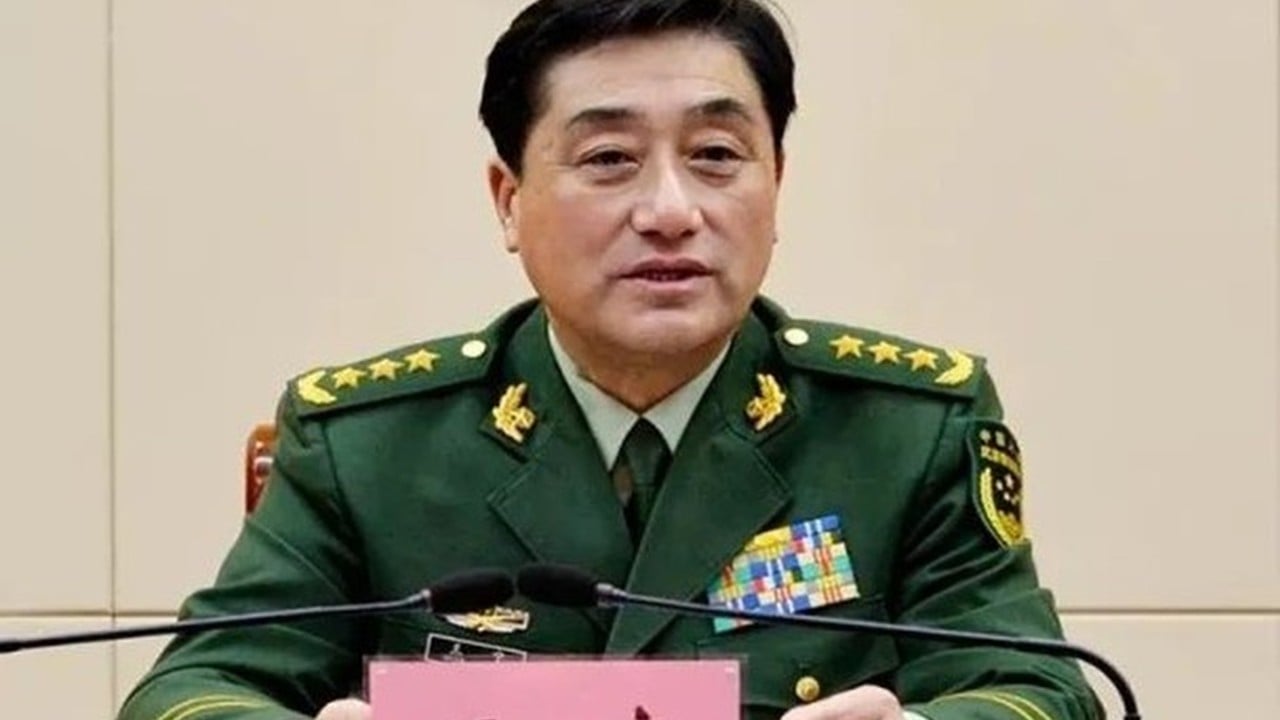
The removal of Wang Ning, former commander of the People’s Armed Police (PAP), from the Chinese People’s Political Consultative Conference (CPPCC) is not a routine administrative retirement, nor is it an isolated disciplinary event. It represents the final institutional stripping of a senior security official whose career trajectory collided with the restructuring of China’s coercive apparatus. When an official of Wang’s rank—a full general who once commanded the paramilitary force responsible for domestic stability—is publicly ejected from a largely ceremonial advisory body, the action serves a dual function: formalizing a fall from political grace and signaling to the broader security establishment that past factional alignments remain active liabilities.
Understanding this ouster requires bypassing superficial commentary about generic anti-corruption drives and examining the structural mechanics of elite Chinese political discipline. To analyze Wang Ning’s removal accurately, we must isolate the institutional functions of the bodies involved, trace the historical vulnerabilities of his specific career path, and map the procedural sequence that precedes a public CPPCC dismissal.
The Structural Architecture of the Ouster
Western reporting frequently mischaracterizes the CPPCC as a powerless debating society, making dismissals from its ranks appear trivial. In reality, the CPPCC functions as a critical parking mechanism and political validation tier for retired or sidelined senior cadres. Retaining a seat on the National Committee of the CPPCC, particularly as a vice-chair of a specialized subcommittee, signals that a retired general or minister remains within the political fold, retaining their rank-equivalent privileges, security details, and access to internal party communications.
Revoking that seat achieves three concrete operational outcomes for the Chinese Communist Party (CCP) leadership:
- Formal Termination of Political Immunity: While CPPCC membership does not confer legal immunity, expulsion is the public administrative step required to strip an official of their remaining institutional status before or alongside formal Central Commission for Discipline Inspection (CCDI) or military discipline proceedings.
- Retroactive Delegitimization: Removing a former service chief broadcasts to their former subordinates within the People’s Liberation Army (PLA) and the PAP that the individual’s patronage network is toxic. Officers promoted under Wang Ning’s tenure are immediately placed on notice to sever ties and demonstrate ideological alignment with the current Central Military Commission (CMC) leadership.
- Public Record Standardization: The CCP maintains strict procedural symmetry. Even when an official has already been neutralized behind closed doors, their public titles must be systematically dismantled through formal votes by the CPPCC Standing Committee to maintain institutional coherence.
The distinction between known facts and analytical inference is essential here. The known facts are clear: Wang Ning served as Commander of the People’s Armed Police from December 2014 to December 2020, transitioned to the National People’s Congress (NPC) Constitution and Law Committee, and subsequently moved to the 14th CPPCC National Committee before his abrupt removal. What remains unconfirmed in public disclosures is the precise indictment—whether his downfall stems from financial corruption in procurement, political disloyalty, or collateral damage from ongoing purges within the PLA Rocket Force and Equipment Development Department. However, the procedural mechanism of his removal follows an established pattern seen in the cases of other fallen generals, such as Fang Fenghui and Zhang Yang, where institutional stripping precedes or accompanies formal expulsion from the Party.
The People's Armed Police as a Political Fault Line
To grasp why a former PAP commander is uniquely vulnerable to retroactive scrutiny, one must examine the institutional history of the PAP over the past fifteen years. Prior to the 2017–2018 military reforms, the PAP operated under a dual-command structure: it answered to both the State Council (via the Ministry of Public Security) and the Central Military Commission. This dual-reporting line created a massive vulnerability. Under the tenure of former security chief Zhou Yongkang, the PAP effectively functioned as a semi-autonomous domestic power base, bloated with patronage networks and opaque budgets.
When Wang Ning assumed command of the PAP in late 2014, his mandate was explicitly transitional. Having come from a traditional PLA ground forces background—specifically the 31st Group Army based in Fujian, a unit historically associated with Xi Jinping’s earlier provincial tenure—Wang was brought in as an outsider to clean up the PAP and dismantle Zhou Yongkang’s lingering influence.
During his six-year tenure, Wang oversaw the most radical restructuring in the PAP's history:
- Centralization of Command: On January 1, 2018, the dual-command system was abolished. The PAP was placed exclusively under the unified command of the Central Military Commission, stripping local governments and the Ministry of Public Security of the authority to deploy paramilitary troops.
- Force Reduction and Realignment: The PAP was stripped of non-combat and commercialized auxiliary units, including gold mining, forestry, hydropower, and border defense forces, which were notorious vectors for rent-seeking and off-the-books revenue generation.
- Integration of the Coast Guard: The China Coast Guard was transferred under PAP jurisdiction, expanding the force's operational domain into maritime gray-zone enforcement.
This operational history exposes a central paradox in elite CCP politics: the very generals tasked with executing anti-corruption purges and structural reforms frequently become targets of subsequent rectification waves. Command over a force undergoing massive organizational contraction and budget reallocation creates immense friction and abundant opportunities for illicit financial transactions. Furthermore, Wang’s operational background in the Nanjing Military Region and the 31st Group Army—credentials that initially secured his appointment—demonstrate that early career proximity to the top leadership does not grant permanent insulation when institutional accountability is enforced.
Mapping the Cause-and-Effect Chain of Elite Discipline
Media coverage often treats the downfall of senior Chinese officials as sudden, unpredictable shocks. In practice, a CPPCC ouster is the final visible domino in a multi-stage administrative sequence that typically unfolds over six to eighteen months. Analysts tracking leadership stability monitor specific behavioral indicators that precede the formal announcement:
- Absence from High-Profile Protocol Events: The earliest verifiable signal is an unexplained absence from mandatory gatherings, such as the annual National Day reception, Lunar New Year greetings for retired military cadres, or major Party plenums. In China’s rigid protocol system, retired full generals do not miss these events without documented medical incapacitation.
- Disappearance from Specialized Committee Dockets: Before a full Standing Committee vote strips a member of their CPPCC seat, the individual ceases to appear in the operational readouts of their assigned subcommittee—in Wang’s case, his duties within the CPPCC’s internal apparatus quietly halted prior to the formal expulsion vote.
- Collateral Network Contraction: Investigations rarely target a single node in isolation. The timing of Wang’s removal coincides with an aggressive, multi-year campaign targeting corruption in military equipment procurement, logistics, and personnel promotion across the PLA. Because the PAP underwent massive modernization of its riot-control, counter-terrorism, and maritime equipment during Wang’s 2014–2020 command, procurement audits inevitably intersect with his tenure.
- The CPPCC Standing Committee Vote: The final public step is a brief, clinical communique issued at the close of a CPPCC Standing Committee session, announcing the revocation of membership qualification without providing an explanatory narrative.
This sequence highlights a fundamental operational reality of the CCP’s disciplinary system: the separation of political neutralization from legal prosecution. By the time the public reads that a former commander has been ousted from the CPPCC, the investigative phase is largely complete, their assets and communications have long been frozen, and their organizational influence has already been excised.
Systemic Risk and the Limits of Institutional Reform
The ouster of Wang Ning illustrates a structural limitation inherent in authoritarian governance systems that rely on top-down disciplinary campaigns rather than independent institutional checks. The CCP’s approach to military and paramilitary governance operates on a principal-agent model where the principal (the CMC Chairman) attempts to enforce absolute loyalty and financial probity over agents (service commanders) who control vast budgets, personnel pipelines, and coercive hardware.
To solve the principal-agent problem, Beijing relies on three primary mechanisms:
- Frequent Rotation: Preventing commanders from remaining in a single theater or service branch long enough to build entrenched personal loyalties.
- Retroactive Auditing: Holding retired commanders indefinitely liable for financial or disciplinary infractions committed during their active service—a policy codified under the slogan of "lifelong accountability."
- Dual-Track Surveillance: Embedding discipline inspection teams directly within military and paramilitary commands, reporting vertically to the CMC Discipline Inspection Commission rather than the local unit commander.
However, this control architecture carries a measurable operational cost. While lifelong accountability deters overt factionalism, it simultaneously induces acute risk aversion among active-duty commanders. When senior officers observe that even a trusted reformer brought in to clean up the PAP can be publicly stripped of all honors years into retirement, rational self-preservation dictates strict bureaucratic compliance over operational initiative. Decisions regarding procurement, force deployment, and personnel promotion become bottlenecks as mid- and senior-level officers seek exhaustive multi-signature approvals to diffuse personal liability.
Moreover, the reliance on opaque purges creates an information vacuum that degrades institutional trust. Without transparent legal proceedings detailing whether Wang Ning fell due to bribery in equipment contracts, failure to curb corruption among subordinates, or political missteps, surviving cadres cannot accurately calibrate their risk exposure. The resulting environment prioritizes political survival over warfighting readiness or administrative efficiency.
Strategic Implications for Tracking PLA and PAP Stability
For analysts, risk consultants, and institutional observers monitoring China’s domestic security apparatus, Wang Ning’s expulsion establishes a clear analytical baseline. First, analysts must discard the assumption that career ties to Fujian or the former 31st Group Army serve as a reliable predictor of political survival. As the consolidation of power enters its second decade, factional origin stories are increasingly subordinated to strict performance, procurement cleanliness, and contemporary ideological alignment.
Second, monitoring methodologies must shift away from waiting for formal CCDI indictments and focus instead on granular institutional attendance data and budget audit trails. The PAP’s post-2018 integration into the CMC command structure means that any procurement scandal affecting the PLA ground forces, logistics support, or maritime militias now carries direct spillover risk for PAP leadership.
Finally, observers should anticipate continued turbulence across the upper echelons of China’s security and defense establishment. The removal of a former PAP commander confirms that the current rectification wave is not confined to technical branches like the Rocket Force or the Equipment Development Department; it encompasses the core domestic stability apparatus itself. Until Beijing establishes a transparent, rule-bound mechanism for leadership transition and procurement oversight, periodic high-level purges will remain a permanent structural feature of the Chinese political system rather than a temporary phase of reform.


