The map on the wall of a small office in Ottawa does not look like the ones from twenty years ago. The borders are the same, inked in neat, reassuring strokes, but the invisible currents pulling at those borders have shifted. North is still north. The Atlantic still rolls cold and gray between two worlds. Yet something has tightened in the cable connecting the New World to the Old, a sudden, desperate pull of twine as the anchor drifts.
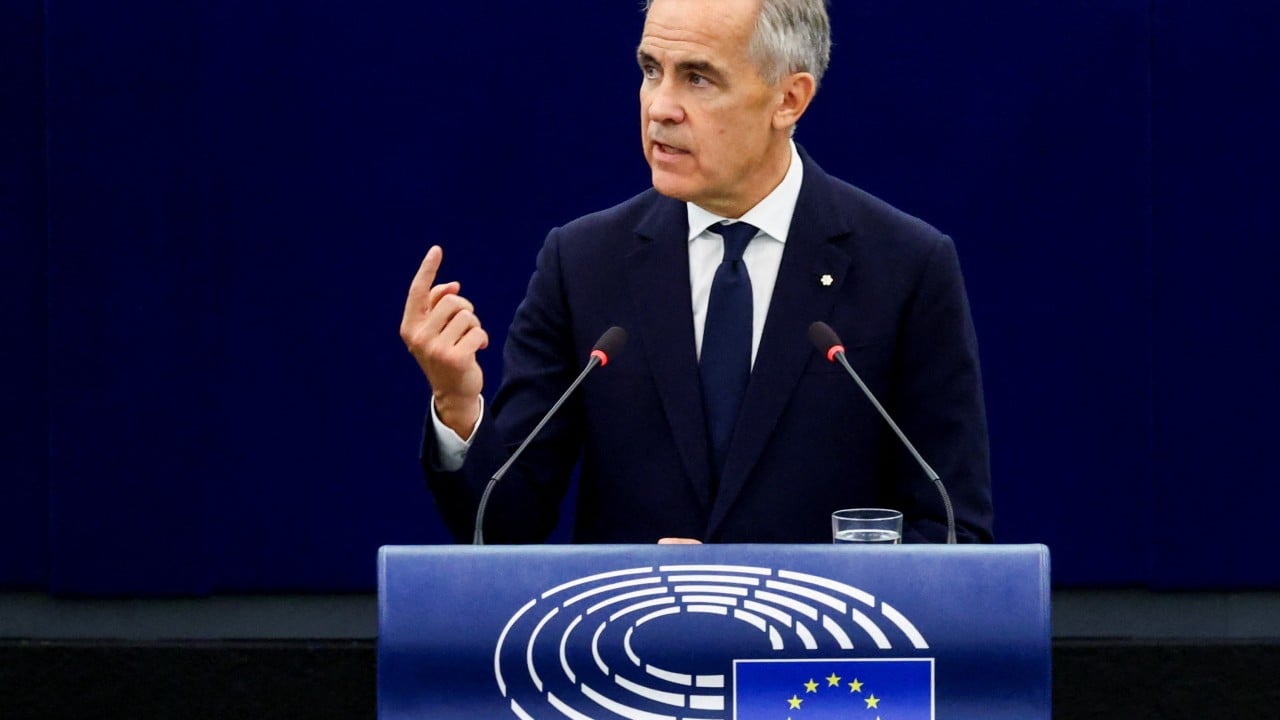
Consider Mark Carney, a man who has spent his professional life translating the frantic whispers of central bankers into the steady drone of a language everyone pretends to understand. When he steps into a room, the temperature drops three degrees. He does not wave his arms. He does not shout. But lately, his voice carries a distinct urgency, the kind of quiet panic that precedes a sudden squall at sea.
Across the ocean, the capitals of Europe are waking up to a realization they have spent a decade trying to avoid. They are alone. Or, at least, they are dangerously close to it. In Washington, the political weather changes with the temperament of a single man whose name is shouted on every television screen, a man whose shadow stretches long and cold over the northern border of the United States. Donald Trump does not merely renegotiate treaties; he treats them like old furniture to be kicked down the basement stairs.
Canada has always lived in that shadow. It is a comfortable, polite geography, built on the assumption that the giant to the south would always leave the porch light on. But porches change owners. Lights go out. And when the rhetoric from the south turned from friendly ribbing to economic threats—tariffs designed to bruise, ultimatums delivered like slaps—Ottawa had to look for another door.
Associate membership.
The phrase sounds dry, bureaucratic, born in a windowless room in Brussels where men in charcoal suits argue over the percentage of cocoa in chocolate. It sounds like something that belongs in a footnote of a trade agreement, buried beneath appendices and legal disclaimers.
It is nothing of the sort.
It is a lifeline thrown across four thousand miles of dark water.
To understand why a nation defined by its fierce, quiet independence is suddenly looking across the Atlantic with hungry eyes, you have to stand on a dock in Halifax on a raw November morning. The wind smells of salt and old diesel. A crane hovers over the deck of a container ship, swinging a massive steel box through the mist. Every container represents a job, a mortgage paid, a winter coat bought for a child in Dartmouth or Moncton. When the rules of trade are stable, that crane moves with a rhythmic, hypnotic grace. When the rules are broken by a president who views international alliances through the lens of a real estate transaction, that crane stops.
Fear is a terrible economic advisor, but it is an exceptionally honest one.
Canada’s economy is an engine built to run on a single track pointing south. For generations, the mathematics were simple. You dig it out of the ground, you chop it down, you pipe it through the earth, and you send it across the 49th parallel. It was efficient. It was profitable. It was lazy. It created a dangerous dependency, a tether that could be yanked at the whim of an administration indifferent to the survival of towns whose entire existence depends on the price of lumber and crude.
So Carney, operating with the sharp calculation of a former central banker who has seen financial systems melt down in real time, started looking at the map again. If the southern gate is bolted, what about the eastern one?
The European Union is not an easy partner. It is a lumbering giant of twenty-seven nations, each with its own domestic grievances, its own stubborn farmers, its own political paranoia. Getting them to agree on anything more complex than the color of passport covers is an exercise in diplomatic torture. Yet, beneath the friction, Europe is terrified of the same ghosts that haunt Ottawa. They look across the Atlantic and see an unpredictable superpower retreating into isolationism, demanding tribute, tearing up the old architecture of the post-war world.
When fear meets fear, strange alliances are forged.
The idea of Canadian associate membership in European structures—closer integration, shared regulatory standards, a formalized seat at tables where the future of green energy and digital security is carved out—was once dismissed as a geopolitical fantasy. Europe does not hand out keys to the house easily. Canada is not in Europe. It has a monarch in London on its coins, but its heart beats to the rhythm of North American hockey nights and prairie harvests.
Except geography is no longer destiny. Digital fiber-optic cables do not care about oceans. Supply chains do not care about continents; they care about security, predictability, and shared values.
Trump’s ire, when it came, was predictable.
In the calculus of populist politics, loyalty is a one-way street. To Washington, any nation seeking shelter elsewhere while under the American economic umbrella is viewed not as a sovereign partner making rational choices, but as a runaway child testing the boundaries of the household. The social media posts were predictable. The cable news pundits flared their nostrils. How dare Ottawa look to Brussels? How dare a neighbor with a trillion-dollar trade relationship seek insurance policies in foreign capitals?
The irony is lost on no one. The very hostility coming from the south is the engine driving Canada north and east. You cannot threaten to annex an economy through punitive tariffs and then act offended when that economy buys an umbrella.
Down on the docks of Halifax, the crane keeps swinging. The men and women in high-visibility vests do not talk about associate membership during their smoke breaks. They talk about the price of groceries. They talk about whether the plant down the road will still be hiring next spring. They do not know the name of the European commissioner for trade, and they could not point to Brussels on a blank map without squinting.
Yet their lives are being rewritten in those distant rooms.
This is the hidden cost of the great decoupling. We are watching the architecture of the twentieth century—the neat boxes of the nation-state, the dependable alliances of the Cold War—rust and buckle under the weight of political vanity. In its place, something jagged and provisional is rising.
Carney understands that you do not wait for the storm to blow the roof off before you buy lumber. You secure the beams while the wind is still howling in the distance.
The Atlantic is wider than it was a decade ago, measured in trust and political goodwill. But it is also busier. Ships are crossing it with new cargo, laden not just with potash and wheat, but with the quiet, desperate determination of countries refusing to be held hostage by the moods of a single unpredictable neighbor. The line is being drawn, ink on parchment, salt on steel, pointing away from the sun as it sets in the west, toward the ancient, stubborn shores of the old world.


