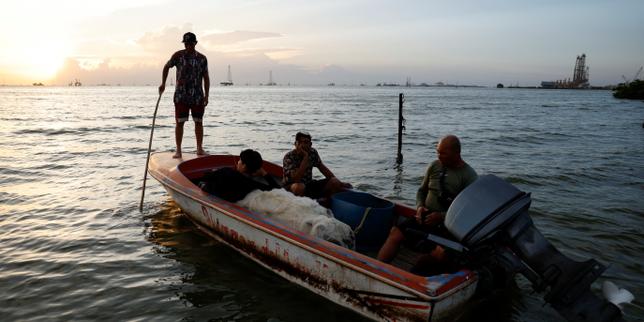
Environmental journalism loves a corpse. The formula never changes. Find a body of water in the Global South, photograph an oil sheen at sunset, write a melodramatic obituary about an dying ecosystem, and collect your awards. The mainstream narrative surrounding Lake Maracaibo follows this exact tired script. Journalists point to the thousands of kilometers of decaying pipeline, the spills leaking crude from state-run infrastructure, and the thick mats of green duckweed choking the shores, declaring South America's largest lake an environmental casualty waiting for a tombstone.
They have the tragedy right. They have the mechanics completely wrong.
Lake Maracaibo is not dying. It is metabolizing industrial failure with terrifying efficiency.
Strip away the emotional hand-wringing and look at the actual ecology. What happens when you dump decades of unrefined petroleum, municipal sewage lacking proper treatment, and agricultural runoff rich in nitrates and phosphates into a hyper-productive tropical estuary? You do not get a dead zone devoid of life. You get a biological pressure cooker. The system is choked, yes, but it is hyper-active, mutating, and fighting back with an organic resilience that proves nature does not need our permission to endure our garbage.
Let us start by dismantling the primary panic button: the oil. Everyone assumes that a century of extractions from the Bolivar Coastal Field turned the water into sterile sludge. Spend a week talking to marine biologists who actually spend time on the water rather than filing reports from Caracas or Washington, and a different picture emerges. Hydrocarbons are toxic, persistent, and visually offensive. They coat pilings and kill sensitive benthic organisms. But crude oil is also a carbon source. Certain microbial consortia naturally present in tropical waters eat hydrocarbons for breakfast. They multiply exponentially when fed an endless buffet of leaking petro-leum.
The lake is undergoing forced evolution in real-time. Native bacteria and planktonic strains are shifting their metabolic pathways to process pollutants that human engineering failed to contain. This is not a pristine paradise. It is a harsh, hybrid wasteland where biology has weaponized itself against industrial neglect.
Then comes the duckweed panic, locally known as nea. Every few years, nitrogen-heavy agricultural drainage and untreated sewage collide with the lake's brackish salinity, triggering massive surface explosions of Lemna minor. Headlines scream about suffocation, blocked sunlight, and ecological collapse. The conventional fix proposed by academic committees is millions of dollars in mechanical dredging and chemical treatments.
That approach is an expensive exercise in treating symptoms while ignoring the root engine. Duckweed is a hyper-accumulator of heavy metals and excess nutrients. It acts as an organic sponge, dragging pollutants out of the water column and binding them in its rapid plant tissue growth. The weed is literally doing the job that municipal water treatment plants were supposed to do since the mid-twentieth century. If you simply dredge it away without fixing the upstream fertilizer runoff and sewage inflows, you are treating a fever by breaking the thermometer.
The tragedy of Lake Maracaibo is not that it is a lifeless desert of oil. The tragedy is that it has become too resilient for its own good. Because the ecosystem keeps absorbing blows, absorbing sewage, and absorbing crude without entirely collapsing into a dead anaerobic soup, the politicians and corporate entities responsible have zero incentive to fix the infrastructure. The lake’s stubborn refusal to die completely is the primary excuse for letting it rot halfway.
To understand why traditional conservation models fail here, you have to look at the economic architecture holding the pipes together. Petroleos de Venezuela, known as PDVSA, operates under conditions of extreme capital starvation and sanctions. Expecting a cash-strapped state oil monopoly to prioritize pipeline pigging and cathodic protection over basic cash flow is an exercise in corporate fantasy. The infrastructure is ancient. Thousands of miles of steel pipe laid down in the mid-1900s have exceeded their structural lifespans by decades. They leak because replacing them costs capital that does not exist in local ledgers.
The standard western response is to demand immediate regulatory compliance and massive international cleanup funds. That ignores the political economy on the ground. When a region's entire survival depends on extracting oil from beneath a lake, the environmental conversation cannot be divorced from survival economics. Artisanal fishermen curse the oil slicks that ruin their nets, yet many of those same fishermen siphon fuel from those exact same pipelines or work odd jobs for the operators just to put food on the table. It is an interdependent ecosystem of extraction where the human population and the industrial pollutants are locked in a codependent spiral.
If you want to save Lake Maracaibo, stop treating it like a pristine national park and start treating it like the high-stress industrial estuary it actually is.
First, abandon the myth of restoration to a pre-industrial baseline. That lake no longer exists. The water that Christopher Columbus sailed onto in 1499 is gone, replaced by a modern, high-nutrient, petroleum-seasoned aquatic machine. Conservation efforts must focus on functional mitigation rather than impossible purity.
Second, redirect capital away from vanity dredging projects and toward targeted bioremediation. Instead of fighting the duckweed with chemical poisons, harvest it systematically and process it into high-protein animal feed or organic fertilizer. Turn the pollutant into a commodity. Close the nutrient loop.
Third, fix the wellhead integrity where the leakage is catastrophic, not by trying to overhaul the entire thousand-mile network at once, but through modular, localized shut-offs funded by direct oil-for-infrastructure swaps that bypass bureaucratic state bottlenecks.
Lake Maracaibo is an open-air laboratory for how nature handles the worst of the anthropocene. It is messy, oily, stinking of hydrogen sulfide, and teeming with hardy microbial life that refuses to quit. It does not need your pity. It needs functional pragmatism that acknowledges reality over romanticism.
Stop mourning the lake. Start managing the engine.