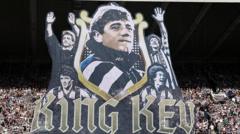
When Kevin Keegan passed away last month at the age of 75, the collective grief expressed across English football carried a specific weight for two institutions above all others. Newcastle United and Liverpool were not merely two clubs sharing a fixture on opening weekend; they were the primary canvases upon which Keegan painted his chaotic, brilliant, and utterly romantic vision of the sport. St James' Park played host to an emotional tribute before their Premier League meeting, uniting black-and-white and red in a rare moment of shared mourning. Yet beneath the pre-match mosaic, the specialized "Keegan 7" warm-up shirts, and the sweeping chorus of "There's only one Kevin Keegan", lay an uncomfortable truth about the modern game.
Football has engineered out the very qualities that made Keegan an immortal figure.
The Architecture of Romance Versus the Data Lab
Modern tactical discourse treats football as an exercise in risk mitigation. Managers arrive armed with defensive blocks, possession metrics, and micro-adjustments designed to strangle unpredictability. Keegan viewed the pitch through an entirely different lens. His Entertainers era at Newcastle in the mid-1990s defied the cautious orthodoxy of the Premier League, producing matches that finished 4-3 not by design error, but by philosophical preference. He believed supporters paid money to feel alive, not to watch an automated chess match played out by robotic positional structures.
Out on the turf during Sunday's emotional fixture, echoes of that swashbuckling ethos flickered briefly back to life through a frantic, chaotic encounter that ended in a 2-2 draw. But the contrast between the afternoon's memorialized romanticism and the clinical, corporate reality of contemporary club operations could not have been starker.
A famous banner hoisted by the Wor Flags collective in the Gallowgate End captured the core of his philosophy:
“I want people to dream about their football club. They should. We should all be dreamers at heart. Some people are the opposite and say, 'We can't do that'. But when you ask them why, they can't give a reason. Well, I say, 'Why not?'”
Try uttering "why not?" to a sporting director operating within a multi-club ownership model backed by algorithmic recruitment data. You will receive a spreadsheet detailing expected goals, wage-to-revenue ratios, and amortized asset depreciation. The romantic impulse has been systematically replaced by the audit culture.
The Last of the Outliers
What made Keegan unique—and why his loss feels so seismic for Liverpool and Newcastle supporters alike—was his total lack of cynicism. He won two Ballon d'Or crowns as a player through sheer kinetic energy, running himself into exhaustion before transitioning into a manager who connected with ordinary fans on a visceral level. When he arrived on Tyneside in 1992, the club was staring down the abyss of relegation to the third tier. He rescued them not with a low-block defense, but by injecting absolute belief into the veins of the city.
The presence of his former players in the stands at St James' Park—men like Alan Shearer, Peter Beardsley, and Les Ferdinand—served as living monuments to an era when personalities were allowed to catch fire. Today's media-trained athletes offer carefully curated soundbites dictated by PR agencies. Keegan spoke from the gut, wept on live television when things went wrong, and embraced supporters as equals.
When a sport sanitizes its heroes, it loses its soul. The joint tribute on Tyneside was magnificent, but it also functioned as a memorial for an entire archetype of football figure that no longer has space to exist. The game is richer, faster, and infinitely wealthier than it was during Keegan's heyday. Yet as the final whistle blew on a frantic opening-day draw, one lingering question remained for a sport caught inside its own analytical cage: who is left to tell us to dream?