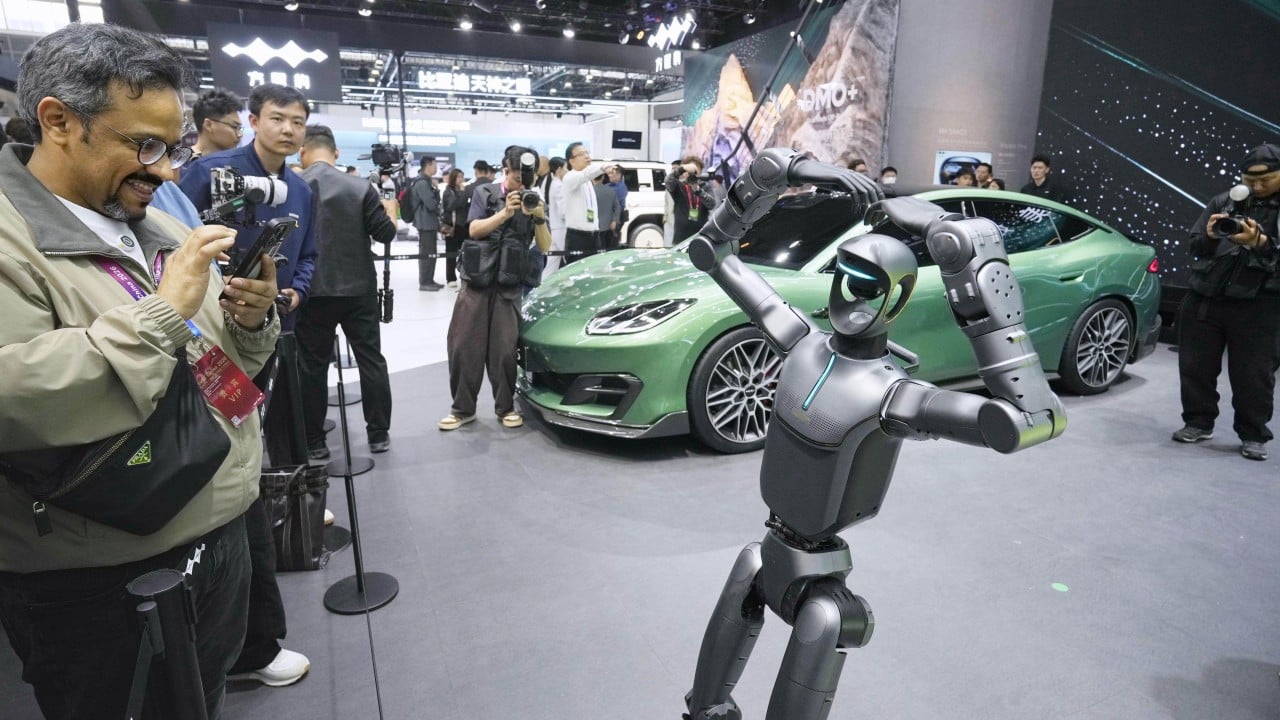
The floor of an electric vehicle factory in Shenzhen does not sleep, but it does grow oddly quiet in the hours before dawn. If you stand near the stamping presses, the air smells of ozone, hot hydraulic fluid, and the faint, sweet scent of coolant. For decades, this space belonged to a specific rhythm of human muscle. Sparks flew, foremen shouted over the din, and the physical toll of building the future was etched into the lower backs and swollen wrists of thousands of migrant workers.
Now, a different sound is creeping into the bays. It is a rhythmic, metallic click-whir. It is the sound of a machine trying to walk like a man.
We have spent the last decade watching Tesla define the narrative of the modern automobile. We watched Elon Musk take the stage to show off Optimus, a humanoid robot that shuffled awkwardly, waved to a cheering crowd, and promised to erase the boundary between biological labor and digital efficiency. The western tech world gasped. It felt like a glimpse into a distant century.
But while the headlines focused on California design studios and late-night tweets, a massive, quiet shift was already happening across the Pacific. China’s EV giants—companies like BYD, NIO, and a phalanx of state-backed tech firms—looked at Tesla's humanoid ambitions and didn't see a sci-fi fantasy. They saw an immediate, desperate logistical necessity.
They are not building these machines to explore the cosmos or write poetry. They are building them because the human hands that built the modern world are running out.
The Empty Benches
To understand why a car company would suddenly care about mechanical knees and opposable synthetic thumbs, you have to look past the glitz of tech keynotes and stare directly into a demographic abyss.
Consider a hypothetical worker named Chen. At twenty-four, Chen left his village in Hunan province to work in a battery assembly plant. He spent ten hours a day performing a precise, twisting motion to secure high-voltage cables. It paid well enough to send money home, but it ruined his shoulders by thirty. Today, Chen’s younger cousins have no interest in repeating his sacrifice. They have smartphones, degrees, and access to the gig economy. They would rather deliver food or livestream than spend their youth locked inside a windowless manufacturing hub.
This isn't just a localized grievance. It is a statistical reality. China is facing a massive manufacturing labor shortage, a shortfall expected to hit nearly thirty million workers by 2025. At the exact same time, the country’s electric vehicle industry has exploded, churning out millions of cars to dominate the global market.
The math simply does not track. You cannot run the world's most aggressive industrial expansion without hands to do the heavy lifting.
When Tesla announced Optimus, the American giant was thinking about long-term automation and stock valuations. China's industrial titans looked at the same technology and saw a lifeline. They realized that the factory floor is the perfect incubator for humanoid robotics. Unlike a chaotic domestic home filled with scattered toys and unpredictable pets, a car factory is structured, mapped to the millimeter, and repetitive. If a robot can survive here, it can survive anywhere.
Moving Past the Magic Trick
Building a robot that looks like a person is relatively easy. Toy stores have been selling them for fifty years. Building a robot that can gently pick up a fragile plastic door clip, orient it correctly in three-dimensional space, and snap it into place without scratching the paint is an entirely different engineering nightmare.
The human hand is a miracle of biological engineering. It contains twenty-seven bones, a dense network of nerve endings, and a subconscious feedback loop that tells your brain exactly how much pressure to apply so you don't crush an egg or drop a hammer. Capturing that in steel and silicon requires immense computational power.
This is where the EV companies have a hidden, unfair advantage.
An electric vehicle is not just a car; it is a massive, rolling computer. The autonomous driving systems developed by companies like NIO or XPENG rely on vision processing, neural networks, and massive datasets to navigate busy city streets. They use cameras and radar to see a pedestrian, recognize they are walking a dog, and predict their path.
Turn that car on its end, reshape its chassis into a torso and two legs, and you have the brain of a humanoid robot.
The same artificial intelligence that allows a sedan to park itself can be trained to help a bipedal machine navigate a cluttered factory floor. The investment in automotive AI is directly funding the robotic uprising. When a company like BYD pours billions into self-driving software, they are simultaneously teaching their future mechanical workforce how to see the world.
The Race for the Factory Floor
Walk into a modern NIO factory today, and you might spot Walker S, a humanoid robot developed by UBTECH. It stands roughly five feet tall, its metallic chest gleaming under the fluorescent lights. It doesn't look like a movie monster; it looks like an appliance with joints.
In recent trials, these machines were tasked with quality inspections. They walked up to newly assembled vehicles, scanned the body panels for microscopic misalignments, and verified the integrity of headlight seals. They didn't tire. They didn't take cigarette breaks. They didn't complain about the glare of the lights.
But the real challenge isn't technical viability. It is cost.
Elon Musk has mused that Optimus could eventually cost less than twenty thousand dollars. That is a tantalizing figure, but achieving it requires a massive, established supply chain. And that is precisely where the traditional tech strongholds face their toughest competition.
Southern China is the world's workshop for electronics. The specialized motors, sensors, and actuators needed to make a robot move smoothly are manufactured in the same industrial parks that produce your laptop and your smartphone. Chinese robotics startups are leveraging this dense network to drive costs down at a speed that terrifies Western competitors. They aren't trying to make the most perfect, beautiful robot in the world. They are trying to make the most affordable, reliable worker that can start a shift tomorrow morning.
The Human Cost of Automation
It is easy to get swept up in the engineering triumph of it all. To marvel at a machine balancing on two legs while carrying a thirty-pound battery pack is to witness the peak of human ingenuity. But there is an underlying tension that cannot be ignored.
What happens to the workers who are still there?
When we talk about automation, we often treat it as a sudden, cataclysmic event—a day when the factory doors open and a fleet of machines marches in to throw the humans out into the street. The reality is far slower, quieter, and more insidious.
It begins with integration. A human worker is paired with a mechanical partner. The robot handles the heavy, ergonomically disastrous lifting, while the human manages the fine tuning and troubleshooting. It feels like a relief. The physical strain eases.
But gradually, the metrics change. The pace of the line accelerates because the robot doesn't get sluggish at 3:00 AM. The human worker is forced to match the unyielding, mechanical cadence of their partner. The stress shifts from the muscles to the mind. You are no longer just building a car; you are racing a ghost that never gets tired.
The fear isn't just losing a job. It is losing the agency over how we work. As these machines become more autonomous, the value of human intuition on the assembly line begins to erode. We risk turning our remaining human workers into supervisors of a system that no longer understands them.
The Quiet Evolution
The competition between Tesla and China's industrial machine is often framed as a battle for global dominance, a geopolitical chess match played out in press releases and quarterly earnings calls. But on the ground, the stakes are profoundly local.
This isn't a race to see who can build the smartest sci-fi companion. It is a race to sustain the basic infrastructure of modern civilization. The cars, the electronics, the consumer goods that define our daily lives require an unimaginable amount of physical labor to exist. As the human population ages and shifts away from manual toil, the gap between what we want and what we can produce widens every day.
The machines are coming because we built a world that cannot function without them.
Back on the factory floor, the dawn light begins to filter through the high windows, cutting through the haze of the assembly bays. A technician connects a diagnostic cable to the shoulder of a prototype unit. The machine's head tilts slightly, its optical sensors clicking as they focus on the long line of half-finished chassis stretching into the distance.
There is no malice in the gesture. There is no triumph. There is only the steady, unblinking readiness of a tool waiting to be used, standing at the edge of an empty space that used to belong to us.