When footage circulates showing smoke rising near naval installations in the Persian Gulf, the immediate reaction is panic. Iran targets US military assets in Bahrain not merely to cause physical destruction, but to exploit a glaring geographic vulnerability sitting less than two hundred miles across the water from Iranian soil. Bahrain hosts the headquarters of the United States Navy’s Fifth Fleet, making this tiny island kingdom the nerve center for American maritime operations across roughly 2.5 million square miles of water, including the Persian Gulf, Red Sea, Arabian Sea, and parts of the Indian Ocean.
Understanding these flashpoints requires looking past grainy social media videos and examining the cold military calculus driving Tehran and Washington. Meanwhile, you can explore other events here: Why Tensions Between Iran and Bahrain Keep Flaring Up.
The Geography of Vulnerability
Bahrain is small. You can drive from one end of the island to the other in less than an hour. Yet this compact footprint holds immense strategic weight.
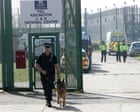
Naval Support Activity (NSA) Bahrain sits right on the edge of Manama, the capital city. Unlike sprawling desert bases in Qatar or remote airfields in the United Arab Emirates, the Fifth Fleet headquarters is woven directly into a dense urban environment. This proximity creates an immediate dilemma for military planners. There is no vast empty buffer zone to absorb stray munitions or debris, meaning any incoming threat immediately endangers both American service members and Bahraini civilians. To see the complete picture, check out the excellent report by NPR.
Across the water lies Iran. At its narrowest points, the Persian Gulf offers almost zero reaction time for early warning radars. A ballistic missile or low-flying drone launched from the Iranian coast can reach Manama in minutes. Compare that to missiles launched from Yemen or Iraq, which must traverse hundreds of miles of airspace monitored by overlapping radar networks before reaching their targets. When Tehran looks at a map, Bahrain represents the shortest possible distance between its launchpads and the command-and-control heart of American naval power in the Middle East.
Beyond the Explosions Why Tehran Focuses on Manama
Surface-level coverage usually frames these incidents as simple tit-for-tat retaliation. Something happens in Syria, Iraq, or the Red Sea, and suddenly Bahrain is in the crosshairs. That explanation is incomplete.
Tehran operates on a doctrine of asymmetric deterrence. Iranian military commanders know they cannot match the United States carrier strike group for carrier strike group in a conventional naval battle. Instead, they rely on demonstrating that American forward-deployed bases are living inside a glass house. By threatening or targeting US military assets in Bahrain, Iran sends a calculated message to two distinct audiences.
The first audience is Washington. Tehran wants to raise the perceived cost of American military presence in the region, hoping domestic political pressure in the United States will eventually force a drawdown. Every air defense interceptor fired over Manama costs millions of dollars, whereas the drones or rockets forcing those launches often cost a fraction of that amount. Over time, this economic asymmetry becomes a weapon of attrition.
The second audience is Manama and its Gulf neighbors. Gulf Arab states rely heavily on the American security umbrella. When Iran demonstrates it can reach inside Bahraini airspace, it subtly undermines confidence in Washington’s ability to guarantee absolute protection. Tehran wants Gulf capitals to constantly second-guess their security arrangements and remain hesitant about joining American-led maritime coalitions.
The Mechanics of Modern Asymmetric Strikes
When Iranian forces or their regional proxies target military infrastructure in the Gulf, they rarely rely on a single weapon system. Modern strikes are designed to overwhelm, confuse, and exhaust layered defenses.
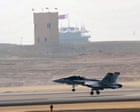
A typical saturation attack relies on a mix of low-cost one-way attack drones, cruise missiles, and short-range ballistic missiles. Drones fly low and slow, hugging the surface of the water to stay beneath traditional radar horizons. Cruise missiles follow programmable flight paths, turning mid-flight to approach defenses from unexpected angles. Meanwhile, ballistic missiles arc high into the atmosphere before plunging downward at supersonic speeds.
Defending against this cocktail requires seamless integration between Patriot missile batteries, ship-based Aegis combat systems, and regional early warning networks. Even when air defenses intercept ninety-five percent of incoming threats, that remaining five percent carries catastrophic potential. Furthermore, falling debris from successful mid-air interceptions still rains down over densely populated neighborhoods, creating diplomatic headaches for the host government and fuel for online propaganda campaigns.
The Information Warfare Layer
Notice how the competitor's headline emphasized "(VIDEOS)". That parenthetical addition is no accident.
In modern conflict, the camera is just as vital as the warhead. Whenever sirens wail or interceptors streak across the night sky in Bahrain, smartphones immediately go up. Within minutes, unverified clips flood Telegram channels, X, and TikTok. Often, old footage from entirely different conflicts in Ukraine, Gaza, or Yemen gets recycled and labeled as a fresh strike on the Fifth Fleet.
Tehran’s information apparatus thrives on this chaos. Even if a physical attack fails completely—with every drone splashed into the Persian Gulf miles offshore—the resulting videos of explosions in the sky create an illusion of vulnerability. Global oil markets jitter. Shipping insurance rates spike. Casual observers scrolling their feeds assume a major base has been leveled, handing Tehran a psychological victory without landing a single direct hit.
The Domestic Tightrope in Bahrain
Reporting on US bases in the Middle East frequently treats host nations as passive parking lots for American hardware. That perspective misses half the story.
Bahrain’s ruling Al Khalifa family governs a complex demographic landscape. The country has a Shia Muslim majority ruled by a Sunni monarchy, a dynamic that has historically fueled internal political tensions and drawn intense scrutiny from Iran. While the Bahraini government maintains deep, decades-old defense ties with Washington—even signing the Comprehensive Security Integration and Prosperity Agreement to formalize defense cooperation—the leadership in Manama has to walk a razor-thin line.
Publicly hosting the primary hub of US naval power makes Bahrain an automatic lightning rod whenever regional tensions boil over. At the same time, Manama has worked quietly in recent years to lower the temperature with Tehran, restoring diplomatic ties and seeking economic stability. When Iranian projectiles fly toward Bahrain, it puts the local government in an agonizing bind. Align too aggressively with American retaliatory strikes, and Manama risks domestic unrest and further Iranian escalation. Appear too passive, and the security partnership with Washington suffers friction.
How the Fifth Fleet Adapts Under Pressure
The United States Navy is acutely aware of its exposure in Manama. Walk around the command centers today, and you will see an institution actively rethinking how it operates under persistent surveillance and threat.
For years, the Fifth Fleet operated under the assumption of regional sanctuary. Ships pulled into Mina Salman port on predictable schedules, command staff worked in concentrated buildings, and logistics moved along established corridors. That era is dead.
Today, naval planners emphasize distributed maritime operations. Rather than clustering high-value ships and personnel in one vulnerable location, assets are dispersed across multiple ports, underway at sea, or rotated through partner facilities in Oman, Saudi Arabia, and the UAE. Command-and-control capabilities are increasingly redundant; if a facility in Manama goes dark, operational authority can shift seamlessly to commanders aboard an amphibious assault ship at sea or another regional headquarters.
Alongside physical dispersion, the Navy has turned Bahrain into a testing ground for unmanned systems and artificial intelligence. Task Force 59, established specifically within the Fifth Fleet area of responsibility, deploys networks of unmanned surface vessels, underwater drones, and aerial sensors across the Persian Gulf. These robotic sentinels act as an extended tripwire, spotting suspicious naval movements or launches off the Iranian coast long before traditional patrols could detect them.
What Most Analysts Miss About Escalation
Pundits love to predict that every strike or near-miss in the Gulf will trigger World War III. History suggests otherwise.
Both Washington and Tehran operate within unspoken guardrails, even when trading blows. Iran understands that mass-casualty strikes killing dozens of American sailors in Bahrain would cross a bright red line, triggering devastating direct retaliation against Iranian naval infrastructure, oil terminals, and leadership compounds. Conversely, the Pentagon knows that an all-out war with Iran would immediately choke off the Strait of Hormuz, halting roughly a fifth of the world's petroleum liquids consumption and crashing the global economy.
Because neither side wants an uncontrollable conflagration, military actions in and around Bahrain tend to remain tightly calibrated. Strikes are often telegraphed through backchannels, timed to minimize loss of life, or executed through proxy networks to preserve a thin veneer of plausible deniability.
This calibration does not make the situation safe. Quite the opposite. Operating permanently on the edge of a cliff leaves zero margin for technical malfunction or human miscalculation. A single errant missile veering off course into a crowded barracks or a civilian apartment tower in Manama could shatter those unspoken guardrails overnight.
Reading the Signals Behind Future Incidents
The next time breaking news alerts flash across your screen claiming Iran targets US military assets in Bahrain, resist the urge to react to the first viral clip. Look instead at the underlying indicators that reveal whether an incident is routine signaling or a genuine shift toward regional war.
Watch the tanker traffic through the Strait of Hormuz; commercial shipping captains react to real danger much faster than cable news anchors. Pay attention to whether the Pentagon orders non-essential dependents to evacuate Manama, a concrete step the military avoids unless intelligence points to sustained, unavoidable danger. Above all, watch how quickly Bahraini and Iranian diplomats speak to one another in the aftermath, because the quiet phone calls between Manama and Tehran usually tell the real story long before the smoke clears over the Gulf.