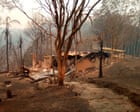
The air tastes like copper and dried eucalyptus long before you actually see the smoke. You smell it in the kitchen while pouring morning coffee, a thin, metallic tang that makes the hair on your arms lift. You walk to the front porch, look out toward the blue ridge of the horizon, and notice the sky has turned the color of a bruised peach.
That is how the Black Summer began for thousands of families across New South Wales. Not with sirens, but with a quiet, ominous change in the atmosphere.
We like to think of bushfires as raging, sentient walls of orange fury that march across the map with indiscriminate malice. Movies love this image. Roaring flames leaping from peak to peak, devouring ancient trees in giant, cinematic bites. But reality is much more intimate, and far more mechanical. When researchers later picked through the charred skeletons of thousands of New South Wales homes destroyed during those catastrophic months, they found a stark, undeniable pattern.
Almost every single house that burned to the ground shared a single geographic vulnerability. They were not swallowed by miles-wide walls of forest fire. They were breached within one hundred meters of flammable vegetation.
Consider what that distance actually means. One hundred meters is the length of a football field. It is the space between two casual neighbors, or the backyard boundary that merges into the local bushland. It feels safe. It feels far enough away. When you sit on your back deck and look out at the wall of gum trees, the dry scrub, the wild grasses swaying in the summer breeze, you see a view. You see nature.
The fire sees fuel.
To understand why homes fall, we have to look past the drama of the front-page photographs and examine the quiet physics of disaster. A bushfire rarely destroys a house by direct contact with a towering wall of flame. Instead, it kills through a relentless, multi-pronged assault that begins long before the first spark crosses your property line.
First come the embers. Millions of them.
During an extreme fire event, violent winds pick up glowing fragments of bark and wood—known scientifically as spotting embers—and launch them miles ahead of the main front. These embers do not care about your brick walls or your freshly painted window frames. They fly on the wind like tiny, malevolent fireflies, hunting for a place to land. And they look for accumulation.
They drop into the dry leaves packed neatly in your gutter. They settle into the mulch bed beneath the decorative shrubs beside your front window. They lodge in the small gap under the floorboards of an elevated timber deck. Within minutes, a fire starts not from the outside in, but right against the vulnerable skin of the house itself.
This is where the one-hundred-meter zone becomes critical. Trees and heavy brush standing within that boundary act as a thermal battering ram. As a crown fire races through the canopy, it radiates intense heat waves. Think of opening the door of a blazing wood stove on a freezing winter night—that sudden, blinding wave of thermal energy that forces you to step back. Now imagine that heat radiating continuously from fifty meters away against the wooden siding of a house.
The paint bubbles. The glass in the windows expands, groans, and shatters from the thermal shock. Once the glass gives way, the interior of the house becomes an open invitation. The superheated air rushes inside, instantly igniting curtains, carpets, and furniture. The house does not necessarily burn from the outside; it detonates from within.
We spent decades believing that living near the bush was simply a romantic gamble, a roll of the dice against an unpredictable nature. But data collected after the smoke cleared told a different story. Nature is not entirely unpredictable. Her movements follow rules as strict as mathematics.
Vegetation density within that crucial one-hundred-meter perimeter dictates survival. It is a harsh equation of proximity and volume. Every eucalyptus tree holds volatile oils in its leaves, essentially acting as a stored bottle of lighter fluid waiting for a spark. When dense brush meets an unmanaged canopy right at the edge of suburbia, it creates a continuous highway of combustion. The fire does not have to jump; it walks right up to your doorstep.
Yet, acknowledging this reality does not mean we must retreat from the places we love. Australia’s coastal towns, mountain villages, and suburban fringes are deeply tied to our sense of home. The bush is our neighbor, our backyard, and our sanctuary. We cannot pave it over or clear-cut every tree in sight. That would destroy the very beauty that draws us to these landscapes in the first place.
The answer lies in understanding the invisible line.
Management within that hundred-meter zone is meticulous, exhausting, and entirely unglamorous. It means cleaning out gutters until your fingers are black with dry soot. It means sacrificing the sprawling gum tree that casts wonderful shade over your roof because its dropped leaves form a continuous carpet of tinder. It means replacing wooden decks with non-combustible stone patios, installing fine metal mesh over every vent to block flying embers, and creating a defensible space where fire loses its momentum.
It feels counterintuitive to look at a beautiful, overgrown garden and see a hazard. We want our homes to blend seamlessly into the natural world. We want the ferns at the window and the canopy overhead. But the Black Summer taught us a brutal lesson about boundaries.
The landscape does not negotiate. It simply follows the laws of heat, oxygen, and fuel.
When the next dry season arrives—and it always does, returning with the shift of the wind and the baking heat of an Australian summer—the sky will change color again. The copper taste will return to the air. On that day, the difference between loss and survival will not come down to luck or the heroics of a fire truck parked in the driveway.
It will come down to the invisible work done months before, in the quiet space between the front door and the edge of the trees, where we finally learned to draw the line.