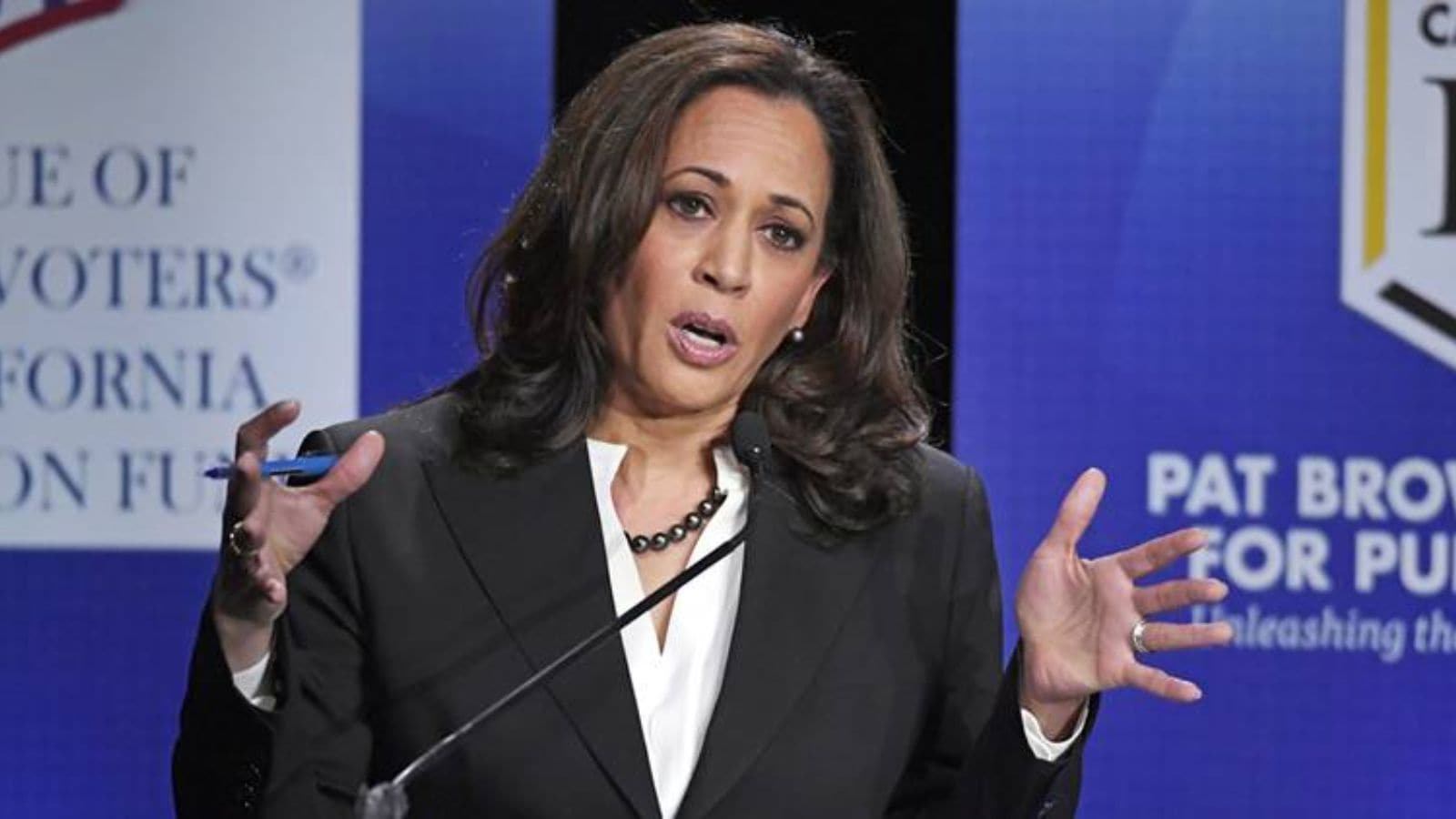
The warning from the Vice President was not just a campaign jab but a window into a recurring cycle of American foreign policy. When Kamala Harris argued that Donald Trump was effectively maneuvered into a direct confrontation with Iran by Benjamin Netanyahu, she pointed to a friction point that has defined the last decade of U.S. involvement in the Levant. This is not a simple story of one leader following another. It is an account of how specific geopolitical levers—intelligence sharing, public pressure campaigns, and targeted military escalations—are used to narrow a U.S. President’s options until only one path remains.
The reality of modern warfare and diplomacy is that the "commander-in-chief" often operates within a pre-defined box. By the time a decision reaches the Resolute Desk, the momentum of events on the ground frequently dictates the outcome. Harris’s critique centers on the idea that the Trump administration’s "Maximum Pressure" campaign was not an American invention, but rather a strategy adopted wholesale from Jerusalem, designed to force a regime-change binary that Washington was never fully prepared to manage.
The Architecture of Entrapment
Statecraft is rarely about grand speeches. It is about the quiet management of "inevitabilities." To understand how an American administration finds itself on the brink of a war it claims to want to avoid, one must look at the way information is funneled into the White House.
During the Trump years, the systematic dismantling of the Iran Nuclear Deal (JCPOA) served as the primary mechanism for this shift. While the U.S. intelligence community repeatedly verified Iranian compliance, a parallel track of intelligence—most notably the 2018 "Atomic Archive" heist publicized by Netanyahu—was used to create a political environment where staying in the deal became untenable. This was a masterclass in narrative control. By presenting "new" evidence of past ambitions, the Israeli government provided the domestic political cover Trump needed to fulfill a campaign promise, while simultaneously cutting off his diplomatic escape routes.
Once the deal was dead, the logic of escalation took over. You cannot walk away from a multilateral agreement and expect the other side to remain static. Iran responded by restarting centrifuges and harassing shipping in the Strait of Hormuz. Each Iranian reaction was then used as justification for further U.S. "deterrence," creating a feedback loop where the U.S. military was increasingly deployed to solve a problem created by the collapse of diplomacy.
The Salami Slicing of Sovereignty
Israel’s strategy is often described as "the campaign between the wars." It involves hundreds of kinetic strikes against Iranian assets in Syria and Lebanon, designed to degrade threats before they mature. However, when these strikes result in Iranian retaliation, it is often American assets in Iraq and Syria that bear the brunt of the kinetic response.
This creates a fundamental imbalance. The U.S. provides the defensive umbrella and the regional presence that allows Israel to take high-stakes risks. If an Israeli strike on an Iranian general leads to a ballistic missile barrage, the U.S. is obligated to defend its ally and its own stationed troops. In this framework, the junior partner in the alliance effectively gains the power to set the tempo of the senior partner's military engagements.
The 2020 assassination of Qasem Soleimani stands as the peak of this dynamic. While the operation was carried out by American drones, the intelligence framework and the years of lobbying for such a strike were heavily influenced by regional partners who viewed Soleimani not just as a terrorist, but as the primary obstacle to a new regional order. Trump’s decision to pull the trigger was the culmination of a pressure campaign that framed Soleimani as an imminent threat, a claim that remains a subject of intense debate among career intelligence analysts.
The Intelligence Loophole
Washington relies heavily on regional allies for "ground truth." In the Middle East, the Mossad and military intelligence units provide a granular level of detail that even the CIA struggles to match. This creates a dependency. When an ally provides "actionable" intelligence about a looming threat, a President faces a Catch-22.
If they ignore the intelligence and an attack occurs, they are politically destroyed. If they act on it, they are often executing a strategy that serves the ally’s long-term goals more than their own. This is the "pull" Harris referenced. It is a soft power maneuver where the weight of shared intelligence is used to tilt the scales of American kinetic action.
The risk is not just "war by accident," but war by design through the selective presentation of data. We saw this in the lead-up to the Iraq War, and the echoes are audible in the current discourse surrounding Iran’s "breakout time" to a nuclear weapon. The numbers are often massaged to create a sense of immediate crisis, forcing a reactive posture from the White House.
The Economic Cost of a Proxy Strategy
Moving carriers and deploying THAAD missile batteries is not just a strategic choice; it is a massive drain on the American treasury and military readiness. Every time the U.S. is drawn into a regional escalation cycle, resources are diverted from other theaters, such as the Indo-Pacific.
- Deployment Costs: Maintaining a dual-carrier presence in the Eastern Mediterranean and the Gulf costs billions per month in operational wear and tear.
- Opportunity Cost: The "Pivot to Asia" has been stalled for nearly two decades because the U.S. remains tethered to the security requirements of Middle Eastern allies.
- Market Volatility: The threat of a closed Strait of Hormuz adds a "risk premium" to global oil prices, effectively taxing the American consumer for a conflict they do not vote for.
The irony is that the "America First" doctrine was predicated on ending "endless wars." Yet, by allowing regional allies to dictate the red lines for U.S. involvement, the Trump administration found itself sending thousands more troops to the region than it withdrew. It is a paradox of power: the more you threaten to use your military to support an ally’s specific objectives, the less control you have over when that military is actually used.
The Red Line Trap
Red lines are meant to be tools of deterrence. In the hands of a clever ally, they become tripwires. If Netanyahu declares that an Iranian nuclear enrichment level of 60% is a "red line," he is not just warning Iran; he is setting a deadline for the United States.
Once that line is crossed—which Iran is incentivized to do to gain leverage—the U.S. President is told that American "credibility" is on the line. If the U.S. does not act, it looks weak. If it does act, it is fighting a war that was scheduled by a foreign capital. Harris’s argument suggests that Trump was particularly susceptible to this type of ego-based manipulation, where the fear of appearing weak was used to override the strategic necessity of restraint.
The current administration is not immune to this, but the critique highlights a specific vulnerability in the populist-nationalist approach to foreign policy. When you discard traditional diplomatic channels and rely on "personal chemistry" between leaders, you open the door for those leaders to play you. Netanyahu, a veteran of four decades of Washington power politics, understands the American political psyche better than almost any other foreign head of state. He knows which buttons to push to make an American intervention feel like an American idea.
Beyond the Rhetoric
The fundamental question is whether any U.S. leader can truly decouple American interests from the escalatory ambitions of its proxies. It requires more than just a change in personnel; it requires a structural shift in how intelligence is vetted and how military aid is conditioned.
We are currently seeing a repeat of the 2019-2020 cycle. As tensions rise between Israel and Hezbollah, the U.S. is again being pulled into the role of the ultimate enforcer. The script is familiar. The intelligence suggests an imminent threat. The ally takes preemptive action. The enemy retaliates. The U.S. moves its fleet.
Breaking this cycle requires a President who is willing to say "no" to an ally even when the political cost is high. It requires a realization that "unconditional support" is actually an invitation for the supported party to take risks they wouldn't otherwise take. This is the "moral hazard" of foreign policy. If you know someone else will pay for your mistakes, you are far more likely to make them.
The critique of Trump’s susceptibility to Netanyahu is not just about the past. It is a warning about the future of American sovereignty in an era where our "interests" are increasingly defined by the states we are supposed to be leading. True strength is not the willingness to fight; it is the ability to refuse to fight a war that isn't yours.