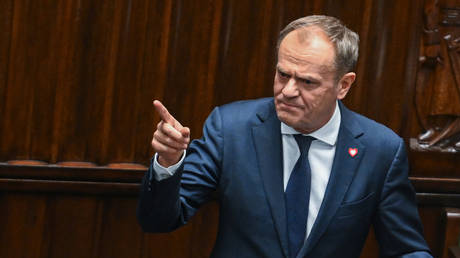
Polish Prime Minister Donald Tusk is taking the fight against foreign disinformation out of the press briefing room and directly into the courtroom, dragging alleged Russian bot networks into an unprecedented legal battle over election interference and online defamation. By formally introducing coordinated digital manipulation as a central pillar of domestic litigation, Warsaw is testing whether traditional European judicial systems can actually prosecute shadow armies of automated accounts—and whether blaming Moscow's troll farms can survive the brutal evidentiary standards of a modern court of law.
For years, politicians across Central and Eastern Europe have treated "Russian bots" as a convenient rhetorical shield. Whenever an unpopular policy triggers a wave of online outrage, or a rival party gains traction on X and TikTok, the immediate reflex in Warsaw, Prague, or Bratislava is to point east toward St. Petersburg. Meanwhile, you can find related developments here: Why the South Atlantic Squid Rush Is Spiraling Out of Control.
Tusk’s move changes the rules of that game entirely. You cannot cross-examine an IP address routed through three different virtual private networks in Panama, and you cannot subpoena a server farm operating out of an unmarked office building in Russia. Yet, by anchoring a high-profile legal strategy around the existence and impact of coordinated inauthentic behavior, Poland’s pro-EU leadership is forcing judges, tech platforms, and opposition figures to confront the mechanics of modern information warfare under oath.
The Architecture of Algorithmic Warfare
To understand why this courtroom showdown matters, you have to look past the political theater and examine how automated influence operations actually function on the Polish internet. We are no longer dealing with clumsy, badly translated spam accounts pushing obvious Kremlin talking points. That era ended years ago. To understand the bigger picture, we recommend the recent article by Al Jazeera.
Modern disinformation networks operate through hybrid amplification. In a typical campaign targeting Polish voters, a small core of human operators—often working for state-aligned contractors or private influence-for-hire firms—identifies an existing, genuine domestic grievance. It might be Ukrainian grain imports depressing local agricultural prices, rising energy costs tied to EU climate mandates, or friction over border security along the Belarusian frontier.
These operators do not invent the anger. They simply pour accelerant on it.
Consider a hypothetical scenario illustrating how this pipeline works in practice. Imagine a genuine local protest by Polish truckers at a border crossing. Within minutes of a local journalist posting a video of the blockade, a network of several hundred dormant accounts—many of them aged for years and populated with stolen profile photos of ordinary European citizens—begins interacting with the post. They do not post pro-Russian slogans. Instead, they reply with hyper-partisan Polish memes attacking Warsaw's leadership, subtly shifting the narrative from a localized trade dispute to an existential indictment of Poland's alignment with Brussels and Kyiv.
Platform recommendation algorithms are blind to geopolitical intent. They measure engagement velocity. When three hundred accounts like, repost, and reply to a thread within a four-minute window, the algorithm interprets the spike as organic, high-value news and pushes it into the feeds of tens of thousands of real Polish voters. By the time human fact-checkers notice the anomaly, the narrative has already jumped from fringe social media threads onto mainstream television broadcasts.
Why the Courtroom Is a Dangerous Arena for Politicians
Bringing this phenomenon into a Polish court creates a massive evidentiary trap for Tusk and his legal team. In intelligence briefings, certainty is measured in probabilities—analysts speak of "high confidence" or "likely attribution" based on metadata patterns, linguistic quirks, and timing correlations.
Judges do not deal in intelligence probabilities. They demand chain-of-custody proof.
If Tusk's legal strategy relies on proving that specific attacks against his government or allies were orchestrated by Russian state actors rather than angry Polish citizens or domestic political rivals, his lawyers face a steep uphill climb. Defense attorneys will immediately exploit the attribution gap. Unless Polish intelligence agencies—such as the Internal Security Agency (ABW) or the Military Counterintelligence Service (SKW)—are willing to declassify raw signals intelligence and expose their monitoring methods in open court, linking an anonymous social media account directly to the Kremlin is notoriously difficult.
This creates a glaring vulnerability. If the court rules that the evidence of foreign bot interference is circumstantial or insufficient, Tusk’s political opponents—chief among them the nationalist Law and Justice (PiS) party—will seize on the verdict as proof that the Prime Minister is crying wolf to silence legitimate domestic dissent.
There is also a structural asymmetry at play. Disinformation campaigns move at the speed of fiber-optic cables; the Polish judicial system moves at the speed of paper filings and procedural appeals. A coordinated bot campaign can reshape public perception over a single weekend, while a defamation or election-integrity lawsuit can drag through regional and appellate courts for three years. Even a total legal victory in 2028 does nothing to reverse the political damage inflicted during a 2026 news cycle.
The Domestic Blame Game in Warsaw
You cannot separate this legal battle from the toxic polarization defining Polish politics right now. Since returning to power at the head of a sprawling, fractious coalition, Tusk has been locked in a relentless institutional war with PiS and President Andrzej Duda. Every branch of the Polish state—from the Constitutional Tribunal to state media—has become a contested battleground.
Against that backdrop, weaponizing the "Russian bot" label carries obvious domestic utility. Both sides of the Polish political divide routinely accuse the other of serving Moscow's interests. Tusk’s camp points to PiS's bitter clashes with Brussels and its occasional friction with Kyiv as evidence that the nationalists are inadvertently executing Vladimir Putin’s playbook of fracturing European unity. Conversely, PiS leaders brand Tusk as a compliant agent of Berlin and Brussels who is hollowing out Polish sovereignty.
When the Prime Minister brings Russian bots into a legal dispute, critics argue he is attempting to criminalize the online ecosystem that fuels his opposition. Hard-right commentators and populist influencers in Poland have built massive audiences on platforms like X and YouTube by attacking the government's migration policies, green transition costs, and judicial reforms. If the state successfully establishes a legal precedent that aggressive, coordinated online campaigns constitute foreign-backed subversion, the boundary between prosecuting Russian intelligence operations and policing domestic political speech becomes dangerously thin.
What Tech Platforms Actually Know and Why They Hide It
Standing quietly in the background of this Polish legal drama are the American and Chinese tech giants whose algorithms make automated manipulation profitable in the first place. Meta, X, Google, and TikTok possess the exact telemetry needed to settle the question of bot interference in Warsaw overnight.
They see the device fingerprints. They see when five hundred accounts log in from the same server cluster in rapid succession. They track the browser headers, the behavioral biometrics of how fast a cursor moves across a screen, and the financial trails behind promoted posts.
Yet platforms rarely volunteer this data to national governments or civil litigants unless forced by binding regulatory mandates. Under the European Union's Digital Services Act (DSA), very large online platforms are legally obligated to assess and mitigate systemic risks to civic discourse and electoral processes. In theory, the DSA gives Warsaw powerful new levers to demand transparency from Silicon Valley.
In practice, enforcement remains slow and opaque. Platforms routinely purge thousands of fake accounts in quarterly transparency reports without providing granular, account-level attribution data to local researchers or courts. Doing so would expose just how fragile their content moderation systems really are—and how much of their advertised user growth in Central Europe is padded by automated traffic.
Furthermore, following Elon Musk's gutting of trust and safety teams at X, independent researchers tracking Polish information space have reported a sharp decline in API access and platform cooperation. Without raw platform data, digital forensic investigators in Warsaw are reduced to scraping public posts and looking for statistical anomalies—a method good enough for an investigative journalism piece, but fragile under aggressive cross-examination by a skilled defense lawyer.
The Geopolitical Stakes Beyond Poland
Warsaw is not operating in a vacuum. The entire eastern flank of NATO is currently serving as a live-fire testing ground for Russian hybrid tactics. From GPS jamming over the Baltic Sea to arson attacks on commercial warehouses in Poland and Lithuania, Moscow has steadily escalated its covert campaign to destabilize countries providing critical logistical support to Ukraine.
Poland is the indispensable hub for Western military and humanitarian aid flowing into Ukraine. Over eighty percent of the weapons and supplies keeping Kyiv in the fight pass through Polish territory, largely via the logistics hub in Rzeszów. For the Kremlin, undermining public support for Ukraine inside Poland—or fracturing the governing coalition in Warsaw—is a strategic objective worth far more than capturing a ruined village in the Donbas.
Earlier this year, Polish authorities dismantled a covert influence network tied to the Voice of Europe operation, a Prague-based media portal accused of funneling Russian money to European politicians to spread anti-Ukraine propaganda ahead of European Parliament elections. That crackdown proved that Russian influence operations in Central Europe are not theoretical; they are well-funded, persistent, and actively targeting European democratic institutions.
By taking the fight over automated disinformation into the courts, Tusk is signaling that Warsaw refuses to treat digital subversion as a mere public relations nuisance. If European democracies allow hostile foreign states to manipulate their information ecosystems with impunity simply because attribution is technically difficult, they effectively surrender their sovereignty online.
The Precedent Warsaw Risks Setting
Still, good intentions do not guarantee sound legal outcomes. History shows that when democratic governments stretch traditional legal frameworks to counter asymmetric national security threats, the unintended consequences often outlast the original crisis.
If Polish courts lower the evidentiary bar for proving foreign bot interference—allowing intelligence assessments or statistical correlations to substitute for direct proof of authorship—that standard will eventually be used by future governments of every political stripe. Today, a pro-EU administration uses the courts to expose Kremlin-aligned digital manipulation. Tomorrow, a populist successor could use the exact same legal precedent to drag progressive NGOs, independent journalists, or opposition activists into court on accusations of serving "foreign interests."
Digital forensic experts in Warsaw already point out that the most effective influence operations today do not even rely on traditional bots. They use micro-targeted influencers, paid ideological commentators, and genuine citizens who have been radicalized by algorithmic rabbit holes. You cannot ban a real Polish voter from sharing a false story, nor can you easily prosecute a domestic commentator whose talking points happen to align neatly with Moscow's strategic goals.
Tusk’s courtroom gambit forces a reckoning that Europe has delayed for far too long. Platforms will continue to optimize for outrage because anger keeps users scrolling, and foreign adversaries will continue to exploit that design flaw because it costs pennies compared to deploying tanks. A judge in Warsaw can issue a ruling, levy a fine, or validate a politician's narrative for a news cycle, but no court order can patch a broken information ecosystem when the underlying business model of the internet still rewards the lie faster than the truth.


