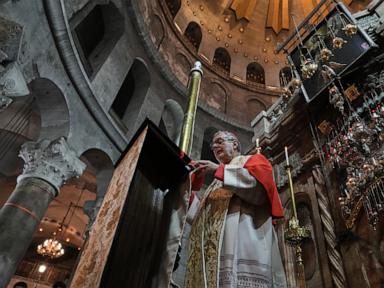
When a papal envoy steps off a plane in Tel Aviv or crosses a checkpoint into the West Bank carrying a message of comfort and unity from Pope Leo, the press releases write themselves. Vatican communications officers emphasize spiritual solidarity, shared prayer, and enduring hope. Yet behind the diplomatic choreography lies a blunt demographic emergency that threatens to reduce the birthplace of Christianity into a museum without a living congregation. The envoy is not merely delivering a pastoral blessing; the envoy is executing an emergency institutional intervention to halt an accelerating Christian exodus driven by economic collapse, movement restrictions, and acute political isolation.
To understand why Rome deploys high-level emissaries to Jerusalem, Bethlehem, and Gaza, you have to look past the incense and the ceremonial handshakes. The Holy See operates on centuries-long timelines, but its local infrastructure in the Levant faces an immediate survival test. Over the past century, the Christian share of the population in the historic region has dropped from roughly ten percent to less than two percent today. In cities like Bethlehem, once overwhelmingly Christian, believers now represent a shrinking minority. When a population drops below a critical threshold, schools close, parishes consolidate, and the social fabric required to sustain a distinct religious community unravels.
The Anatomy of a Papal Envoy Mission
Standard media coverage treats a papal envoy like a traveling chaplain. That reading misses the mechanics of Vatican diplomacy. An envoy dispatched by Pope Leo—whether a senior cardinal from the Secretariat of State or the Prefect of the Dicastery for the Eastern Churches—carries plenipotentiary moral authority combined with direct administrative oversight over vast financial and institutional networks.
These visits serve three concrete operational functions that rarely make the evening news:
- Financial Triage and Aid Auditing: The Vatican channels millions of dollars annually through agencies like the Catholic Near East Welfare Association and the Equestrian Order of the Holy Sepulchre of Jerusalem. An envoy inspects how those funds are keeping hospitals, schools, and housing subsidies afloat when local tax bases evaporate.
- Inter-Denominational Crisis Management: Jerusalem’s Christian landscape is famously fractured among Greek Orthodox, Latin Catholic, Armenian Apostolic, Franciscan, and Protestant authorities. Friction over property taxes, municipal encroachments, and the Status Quo agreements governing holy sites constantly threatens to divide the churches. The envoy acts as an external mediator to force a unified front before local governments.
- Direct Intelligence Gathering: Diplomatic cables from the Apostolic Nunciature in Jerusalem provide baseline reporting, but nothing replaces a senior curial official walking through shuttered workshops in Beit Sahour or damaged parish compounds in Gaza. The envoy brings unfiltered ground truth back to Pope Leo to shape upcoming bilateral negotiations with Israeli, Palestinian, and Jordanian officials.
Numbers tell the story best. Consider the economic engine of Christian families in the West Bank. For decades, up to seventy percent of Christian households in the Bethlehem governorate relied directly or indirectly on religious tourism—running guesthouses, carving olive wood, guiding pilgrims, or managing transport fleets. Whenever regional conflict flares, pilgrim flights vanish overnight. Unlike state-backed sectors, these small family enterprises have zero sovereign safety net. Without rapid liquidity injections from church institutions, families sell their land and apply for visas to Chile, Canada, Australia, or the United States.
Why Comfort and Unity Are Hard Sells on the Ground
Preaching unity is easy in St. Peter's Square. Enforcing it in the Old City of Jerusalem is another matter entirely.
Local Christians often view official Vatican pronouncements with a mix of deep reverence and quiet frustration. While Rome must maintain delicate diplomatic neutrality to preserve access to holy sites and protect its standing as an international mediator, believers living under military occupation, rocket fire, or municipal pressure often crave explicit political advocacy rather than measured pastoral language. The envoy walks a razor's edge between comforting a traumatized flock and avoiding diplomatic ruptures that could result in denied visas for foreign clergy or frozen church bank accounts.
Furthermore, internal unity remains elusive. The Assembly of the Catholic Ordinaries of the Holy Land brings together leaders from the Latin, Melkite, Maronite, Syriac, Armenian, and Chaldean rites, alongside the Franciscan Custody of the Holy Land. Each community possesses its own liturgical traditions, historical grievances, and political instincts. A Maronite parishioner in northern Israel faces entirely different civic realities than a Latin Catholic living in East Jerusalem or a Greek Orthodox family sheltering in Gaza.
"A church that only preserves stones while losing its people becomes a archaeological park. The stones matter because of the living community that prays among them." — A recurring warning echoed by Jerusalem Patriarchs for over three decades.
When Pope Leo’s representative calls for unity, the subtext is survival through consolidation. Individual parishes can no longer afford to duplicate administrative costs, run separate youth programs, or negotiate independently with municipal tax authorities. The push for unity is an urgent call to pool dwindling human and financial capital before individual communities become too small to defend their legal rights.
The Structural Pressures Driving the Exodus
To grasp the urgency behind Pope Leo’s outreach, one must examine the specific mechanisms squeezing Christian communities across different jurisdictions. The pressures are not uniform; they shift dramatically depending on which side of a checkpoint or border a family lives on.
East Jerusalem and the Tax Squeeze
In Jerusalem, the battle is largely bureaucratic and financial. Historically, Christian churches enjoyed broad exemptions from municipal property taxes, known as Arnona, on properties used for worship, education, and charitable work. In recent years, municipal authorities have aggressively sought to tax church-owned commercial properties—such as pilgrim hostels, office buildings, and leased land—arguing that these generate revenue and do not qualify for religious exemptions.
Church leaders argue that revenue from these properties directly subsidizes non-profit schools, clinics, and social welfare programs for the poor, regardless of religion. In 2018, the dispute escalated so severely that church leaders took the unprecedented step of closing the Church of the Holy Sepulchre for three days in protest. While temporary freezes have been negotiated, the underlying legal vulnerability remains unresolved. Every time tax assessments land on church desks, the Vatican has to mobilize diplomatic backchannels to prevent municipal liens on historic properties.
The West Bank Economic Trap
Across the separation barrier in Bethlehem, Beit Jala, and Ramallah, the crisis is defined by spatial confinement and economic suffocation. Movement restrictions, permit regimes, and the collapse of tourism create a relentless push factor for educated, multilingual young Christians.
Christian schools in the West Bank consistently produce some of the highest academic test scores in the region. Ironically, that educational excellence accelerates emigration. A twenty-four-year-old software engineer or pharmacist from Beit Jala who speaks fluent Arabic, English, and French can secure a skilled-worker visa abroad far more easily than a peer without those credentials. Once a young professional establishes a foothold in Toronto or Santiago, they sponsor their parents and siblings. Chain migration hollows out entire neighborhoods within a single generation.
Gaza and the Existential Threat
In the Gaza Strip, the Christian population has dwindled to fewer than a thousand individuals, centered primarily around the Greek Orthodox Church of Saint Porphyrius and the Catholic Holy Family Parish. Here, the challenge is not long-term demographic drift; it is immediate physical survival. During periods of intense warfare, nearly the entire Christian community crowds into church compounds for shelter, relying on Vatican-backed relief networks for water, fuel, medicine, and food. When Pope Leo’s envoy speaks of comfort, the words carry literal weight for families living under constant bombardment with nowhere to flee.
What the Vatican Actually Controls and Where Its Power Ends
Critics frequently overestimate what Rome can achieve with a single diplomatic mission. The Holy See has no army, no sovereign territory in the Levant beyond a handful of extraterritorial properties, and no power to rewrite local zoning laws or lift border closures. Recognizing the limits of papal power is essential to evaluating whether an envoy’s visit succeeds or fails.
| Lever of Influence | Vatican Capability | Hard Limitation |
|---|---|---|
| Financial Aid | Direct funding for schools, hospitals, housing, and emergency relief via global Catholic charities. | Cannot replace a functioning local economy or generate permanent private-sector jobs. |
| Diplomatic Pressure | High-level access to heads of state, UN bodies, and bilateral commissions in Israel and Palestine. | Must maintain strict neutrality to remain a credible mediator, limiting public condemnation. |
| Legal and Property Defense | International treaties, including the 1993 Fundamental Agreement, protect church status. | Final ratification and implementation of tax and visa rules remain stalled in local courts. |
| Institutional Infrastructure | Operates dozens of premier schools, universities like Bethlehem University, and major hospitals. | Rising operational costs and visa restrictions on foreign clergy strain daily management. |
Look closely at that third row—the 1993 Fundamental Agreement between the Holy See and the State of Israel. Signed with immense optimism during the Oslo peace process, the accord established full diplomatic relations and promised a subsequent legal and fiscal agreement to codify church tax exemptions and property rights. More than three decades later, the bilateral commission tasked with finalizing those fiscal details still meets periodically without producing a ratified treaty. A papal envoy can nudge the diplomatic machinery forward, yet cannot force a sovereign parliament to sign off on tax concessions during periods of domestic political turmoil.
Similarly, the Vatican’s influence over clergy visas remains fragile. Catholic institutions in the Holy Land rely heavily on priests, religious sisters, and professors from abroad to staff seminaries, hospitals, and universities. Delays in issuing multiple-entry visas or arbitrary reductions in visa durations directly disrupt parish life and academic calendars. Raising these administrative bottlenecks is standard agenda item number one whenever a papal emissary sits down with government ministers.
The Overlooked Role of Christian Institutions in Regional Stability
An angle routinely ignored in mainstream coverage is what happens to the broader society if the Christian presence collapses. Christian institutions punch vastly above their demographic weight in the Holy Land.
Across Israel, the West Bank, East Jerusalem, and Gaza, Christian schools educate tens of thousands of students—and in many institutions, the majority of the student body is Muslim. Hospitals like Saint Joseph in East Jerusalem, the Holy Family Maternity Hospital in Bethlehem, and Caritas Baby Hospital provide critical healthcare infrastructure that public systems cannot match.
If the local Christian laity disappears through emigration, those institutions lose their indigenous leadership, cultural rooting, and moral legitimacy. Foreign NGOs cannot replicate centuries of deeply embedded community trust. Furthermore, local Christians historically serve as a vital social bridge between Israelis and Palestinians, fluent in both cultures and committed to civic pluralism. Losing that middle ground hardens sectarian divides and strips the region of one of its most resilient moderating forces.
Measuring Real Impact Beyond the Press Releases
How do veteran Vatican watchers judge whether Pope Leo’s envoy actually accomplished anything once the motorcade departs? You ignore the homilies and watch four concrete indicators over the subsequent six months:
- Emergency Housing and Micro-Grant Disbursements: Does the Latin Patriarchate or the Franciscan Custody announce new subsidized housing units in Jerusalem and Bethlehem? High real estate prices force young couples out faster than almost any other factor. Concrete keys handed to newlyweds matter infinitely more than speeches.
- Visa Approvals for Foreign Clergy and Educators: Watch whether stalled residency permits for seminarians, nuns, and visiting faculty at Bethlehem University suddenly clear bureaucratic hurdles. That signals behind-the-scenes diplomatic traction.
- Joint Patriarchal Statements on Property and Taxes: When the Greek Orthodox, Latin, and Armenian patriarchs issue coordinated legal challenges against municipal tax assessments, it indicates the envoy successfully smoothed over internal rivalries and enforced strategic discipline.
- Sustained Humanitarian Corridors: In conflict zones like Gaza, success is measured by the uninterrupted flow of medical supplies, solar power equipment, and cash assistance into parish compounds without seizure or blockade.
The envoy’s mission reflects a sobering reality in modern Vatican statecraft. Pope Leo cannot single-handedly broker a comprehensive Middle East peace settlement, nor can Rome halt the geopolitical forces reshaping the Levant. What the papacy can do—and what this mission is engineered to execute—is fortify the institutional scaffolding that keeps a two-thousand-year-old community from vanishing on its watch. Every school kept open, every family clinic funded, and every young household housed in Jerusalem or Bethlehem buys another generation of survival for a minority standing on the fault line of history.