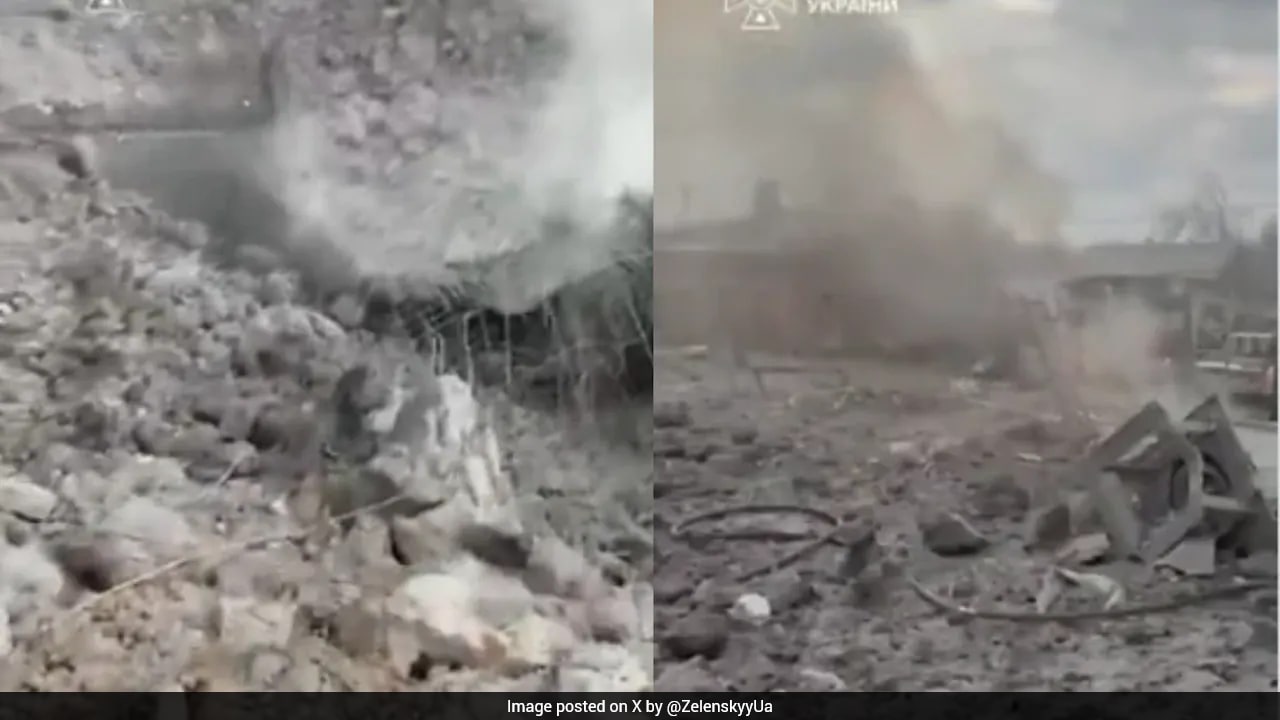
When long-range munitions reduce a Ukrainian school to rubble and kill dozens of people, the tragedy is rarely an isolated navigation error. Since the full-scale invasion began in February 2022, the targeting of educational facilities and civilian infrastructure has functioned as a deliberate strategic mechanism to fracture social cohesion, deplete air defense stockpiles, and force demographic displacement.
Standard news dispatches focus heavily on the immediate casualty counts and the visceral shock of rescue workers pulling survivors from concrete debris. Those numbers matter. Yet stopping at the body count obscures the broader military doctrine driving these strikes, the severe resource attrition facing Ukrainian air defense networks, and the long-term generational damage inflicted on a nation trying to educate its youth under ballistic threat. Meanwhile, you can read similar events here: What We Actually Know About the Learjet Crash Involving Tech CEO Adam Robinson.
The Anatomy of Modern Aerial Attrition
To understand how a school building becomes a crater, you have to look at the mechanics of the strikes themselves. Russian forces do not rely on a single weapons platform for these bombardments. Instead, they execute complex, multi-layered salvos designed specifically to overwhelm radar arrays and exhaust interceptor supplies.
A typical large-scale strike begins with waves of low-cost, long-range one-way attack drones, primarily Iranian-designed Shahed variants or domestically produced equivalents. These drones fly low and slow, forcing Ukrainian mobile fire groups and short-range air defense units to reveal their positions and expend relatively inexpensive ammunition. Hours later, once radar operators are fatigued and tracking multiple low-altitude threats, cruise missiles like the Kh-101 or Kalibr enter the airspace, altering flight paths mid-course to exploit gaps in coverage. To see the full picture, we recommend the excellent article by The New York Times.
Finally come the ballistic weapons. Missiles like the Iskander-M or air-launched Kinzhal travel at hypersonic speeds during their terminal phase, leaving defenders on the ground with mere minutes—sometimes seconds—to react. Only a handful of Western-supplied systems, such as the Patriot or SAMP/T batteries, possess the kinetic capability to reliably intercept these warheads.
Ukraine simply does not have enough of these high-end batteries to cover every population center, industrial hub, and school district simultaneously. Military planners in Kyiv are forced into an agonizing triage, prioritizing critical energy grids, major metropolitan centers, and front-line logistics hubs. Smaller cities, regional towns, and secondary urban areas frequently remain exposed to ballistic trajectories.
Why Educational Facilities Are Struck
International humanitarian law, codified in the Geneva Conventions, explicitly prohibits attacks on civilian objects, granting special protection to schools and hospitals. Under these rules, an educational facility only loses its protected status if it is actively being used for military purposes, such as housing troops or storing ammunition.
In practice, the distinction between military and civilian targets blurs rapidly in high-intensity urban warfare, often by design. Russian military doctrine has repeatedly demonstrated a willingness to accept—or actively seek—high civilian casualties as a form of psychological warfare. Striking a school sends an unmistakable message to every parent in the country that no sanctuary exists, even miles away from the active front lines.
There is also the persistent issue of intelligence failure and munition inaccuracy. Russian targeting cycles frequently rely on outdated Soviet-era maps, flawed human intelligence, or unverified social media chatter. If a local rumor suggests territorial defense forces briefly used a gymnasium for a meeting weeks prior, that building may be entered into a targeting queue that takes months to execute. By the time a multi-ton warhead impacts the structure, the building is housing civilians, teachers, or displaced families seeking shelter.
Furthermore, older munitions still in circulation, such as repurposed S-300 surface-to-air missiles used in a ground-attack role or aging Kh-22 anti-ship missiles, suffer from notoriously wide circular error probable (CEP) metrics. A missile designed to hit an aircraft carrier at sea lacks the terminal guidance precision required to strike a specific military warehouse in a dense neighborhood without obliterating the school two blocks away.
The Silent Collapse of In-Person Education
The physical destruction of brick and mortar is only the visible half of the crisis. According to data compiled by Ukraine’s Ministry of Education and Science alongside international monitoring bodies like UNICEF, thousands of educational institutions have been damaged or completely destroyed since 2022.
When a school is flattened, the educational pipeline for an entire community severs overnight. Even in regions where buildings remain standing, the constant threat of ballistic strikes—which often hit before air raid sirens can even sound—has made traditional classroom learning impossible for millions of children.
The Underground Shift
In front-line and border cities like Kharkiv, Zaporizhzhia, and Kryvyi Rih, local authorities have resorted to extraordinary measures to keep students learning. Municipal governments have excavated deep subterranean spaces, converting metro stations and reinforced basements into fortified underground schools.
These facilities are engineering marvels built out of sheer necessity. They feature blast-resistant doors, independent ventilation systems, backup generators, and thick concrete ceilings capable of withstanding direct hits from certain artillery and rocket systems. Yet they can only accommodate a fraction of the student population, forcing children to attend in staggered shifts while the majority remain tethered to unstable internet connections at home.
The Generational Deficit
Remote learning in a war zone is fundamentally broken. Rolling blackouts caused by targeted strikes on thermal and hydroelectric power plants routinely cut off electricity and cellular networks for hours or days at a time. A child sitting in a dark apartment during a winter freeze cannot participate in an online algebra lesson.
Education analysts warn that Ukraine is facing a severe human capital deficit. Years of disrupted schooling, compounded by acute psychological trauma and the mass emigration of millions of mothers and children to Western Europe, threaten the country's post-war economic recovery. A nation cannot rebuild its advanced manufacturing, technology, and agricultural sectors without an educated workforce, and every destroyed school pushes that recovery further out of reach.
The Geopolitical Bottleneck of Air Defense
Every time a high-casualty strike hits a civilian structure, diplomatic cables light up with urgent requests for additional air defense interceptors. The underlying reality, however, is that Western defense manufacturing has struggled to match the sheer volume of Russian munitions production.
Russia has transitioned its economy onto a full war footing, prioritizing missile and drone assembly lines despite sweeping international sanctions. Through complex grey-market procurement networks spanning multiple continents, Russian defense contractors continue to acquire Western-made microelectronics, optical sensors, and ball bearings essential for guidance systems.
Meanwhile, Ukraine’s allies face severe industrial bottlenecks. Producing a single Patriot interceptor missile requires specialized components, rigorous testing, and months of assembly time. Global demand for these systems has surged across Europe, the Middle East, and the Indo-Pacific, creating multi-year backlogs.
Politicians frequently announce aid packages worth billions of dollars, creating the public impression of an impenetrable shield being erected over Ukrainian cities. On the ground, commanders deal with the harsh arithmetic of interceptor ratios. Firing a four-million-dollar missile to shoot down a fifty-thousand-dollar drone is economically unsustainable, yet failing to intercept that drone risks the destruction of an apartment block or a schoolhouse.
Accountability and the Limits of International Law
Following strikes that kill dozens of civilians, international prosecutors and war crimes investigators routinely descend on the wreckage. Teams from the International Criminal Court (ICC), alongside Ukrainian domestic prosecutors and independent open-source intelligence (OSINT) researchers, catalog shrapnel serial numbers, analyze blast patterns, and trace flight trajectories back to specific Russian military units.
The forensic trail is often remarkably clear. Serial numbers stamped onto circuit boards recovered from the rubble allow investigators to identify the exact factory where the missile was assembled and the specific brigade responsible for launching it.
Yet documenting a war crime and prosecuting it are vastly different challenges. International legal mechanisms move at a glacial pace, and without the physical apprehension of the commanders who authorized the strikes, indictments remain largely symbolic. Deterrence relies on immediate, tangible consequences, and the absence of direct accountability emboldens further disregard for the laws of armed conflict.
The Reality on the Ground
For the rescue workers sifting through pulverized concrete with heavy machinery and bare hands, geopolitical strategy and international legal frameworks offer zero comfort. The immediate reality is defined by dust, twisted rebar, and the agonizing search for survivors beneath collapsed floor slabs.
Each strike forces local communities to adapt to a grim new baseline of survival, burying their dead, clearing the debris, and attempting to salvage whatever fragments of normal life remain beneath the constant hum of reconnaissance drones overhead.