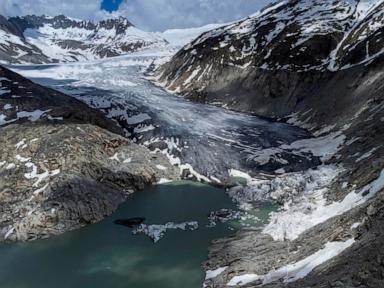
Switzerland has lost nearly 20 percent of its glacier ice volume over the past five years, driven by low-snow winters, scorching summer heatwaves, and an accelerating shift in high-altitude weather patterns. Annual measurements from the Glacier Monitoring in Switzerland network (GLAMOS) and the Swiss Academy of Sciences show that ice volume dropped by about 5.5 percent in 2026 alone, bringing five-year cumulative losses since 2021 to roughly 19.4 percent.
Headline numbers make for clean copy. They also flatten a far more disruptive reality.
A glacier is not a static block of ice sitting quietly on a mountain shelf. It is a slow-moving hydraulic engine, a seasonal reservoir, and a structural anchor holding fractured rock together. When nearly a fifth of that mass vanishes in half a decade, the damage does not arrive evenly. It shows up as exposed rock faces losing their thermal shields, small ice bodies dying out completely, and infrastructure planners realizing that past meltwater surpluses were a temporary illusion rather than a permanent windfall.
Why Five Years of Melt Hit So Hard
Anyone who has watched mountain reporting over the last twenty years knows the broad outline. Warmer air melts ice faster. Longer summers eat into winter snowpacks.
What separates the recent five-year stretch from earlier decades is the compounding sequence of thin winters and punishing heat. Winter snow acts like reflective armor over bare ice. When winter snowfall comes up short—as happened again in the 2025–2026 season, which ranked among the ten least snowy winters on record—that protective blanket disappears early. Once bare glacier ice is exposed to high-elevation sun, reflectivity drops, heat absorption rises, and melt accelerates sharply.
Then came the summer heat. Between May and September 2026, dry weather and repeated heatwaves pushed the freezing level above 4,000 meters on 76 days—more than twice the historical average. By September, snow cover had vanished even at 3,500 meters. Across individual glaciers, average thickness fell by roughly 2.5 to 4 meters in a single year, while thinner lower tongues lost up to 10 meters. Even major ice streams like the Rhône Glacier and Aletsch Glacier recorded their heaviest annual melt on record.
Yet heat alone does not explain every twist in the data. Glaciologists pointed out that although the 2026 summer heat half-year from April to September set historic warmth and dryness records in Switzerland, overall ice loss still fell just short of the record-setting volume drop seen in 2022. Why? Because Saharan dust deposits were lighter in 2026 than in some recent years, leaving slightly cleaner, more reflective snow surfaces for part of the season.
Dust blown north from the Sahara darkens alpine snow and lowers its albedo, meaning the surface reflects less sunlight and absorbs more thermal energy.
That detail matters for analysts. If two summers can bring extreme heat and produce noticeably different melt totals depending on dust transport and late-winter snow survival, single-year rankings tell only part of the story. The five-year trajectory is the real signal.
The Myth of Endless Meltwater
For years, a common misconception in casual commentary was that melting glaciers automatically mean more water for rivers, farms, and power plants. In the short term, shrinking ice can boost runoff during hot spells. Over time, that buffer erodes.
Swiss glaciers lost roughly 2.2 trillion liters of water between July and September 2026 alone—more than four times the annual freshwater use of Swiss households. At first glance, that sounds like a flood of supply. In practice, glaciological assessments have warned that peak meltwater release from Swiss glaciers has likely already passed in recent extreme years because the total ice reservoir and surface area have shrunk so dramatically.
Consider a hypothetical example to see how the math shifts. Imagine a mid-sized alpine catchment with 100 units of glacier ice that sheds 6 units during a brutal heatwave. A decade later, after repeated shrinkage, only 65 units of ice remain. Even if the summer is hotter and the melt rate per square meter is higher, the shrinking ice footprint cannot supply the same total volume of water late in a dry season.
For Switzerland, this hits several practical systems at once:
- Hydropower intakes: Water intakes built decades ago near glacier margins now sit stranded above receding ice, forcing operators to adjust routing and seasonal expectations.
- Summer river flows: Late-summer runoff helps sustain river temperatures, navigation, and aquatic habitats when rainfall is scarce.
- Agricultural irrigation: Downstream valleys rely on steady summer flows when soil moisture dries out.
- High-mountain stability: Retreating ice and thawing permafrost loosen rock slopes and destabilize moraines, raising rockfall and debris-flow hazards.
Why Small Glaciers Are Vanishing First
Big name glaciers grab the cameras. Small glaciers are the first to die.
Across the Swiss Alps, smaller ice bodies—such as Bella Tola in Valais and Griessfirn in Glarus—have disappeared completely or been reduced to scattered remnants sitting on sun-baked rock. More than 1,000 Swiss glaciers had already vanished between 1973 and 2016, and recent extreme years have turned thin, low-elevation ice patches into fragmented rock deserts.
There is a hard physical reason for this. Thin ice has almost no thermal cushion when a sequence of warm years hits. Once a small glacier loses its accumulation zone—the upper slope where winter snow survives summer melt—it stops functioning as a living glacier and simply wastes away in place.
| Metric or Feature | What Recent Data Shows | Practical Implication |
|---|---|---|
| Five-year ice loss (2021–2026) | Roughly 19.4 percent of Swiss glacier ice volume lost | Rapid structural reshaping of high-alpine basins |
| 2026 annual volume loss | About 5.5 percent lost following a low-snow winter and hot summer | Near-record single-year shrinkage even without extreme Saharan dust |
| Thickness change in 2026 | Mean loss of 2.5 to 4 meters; up to 10 meters on some tongues | Faster surface lowering and tongue disintegration |
| Small alpine glaciers | Multiple smaller glaciers lost completely; others down to scattered ice | Permanent loss of localized cold-water and landscape features |
What Policymakers and Operators Miss
After covering resource and infrastructure stories long enough, you learn to watch where institutions lag behind physical reality. Too many plans still treat glacier retreat as a distant end-of-century problem rather than an active operational constraint right now.
A counter-argument often heard in policy circles is that Switzerland has abundant rainfall, diversified energy sources, and strong engineering capacity, so losing 20 percent of its glacier ice is mostly a scenic tragedy. That view misses the timing mismatch. Glaciers matter most not on average days, but during hot, dry late-summer weeks when rain is scarce and demand for cooling, irrigation, and reliable river flows collides.
There is also a gray area in forecasting that honest analysts should state plainly. Glaciologists can measure mass balance with high precision and project long-term retreat trajectories, yet exact year-to-year melt still swings with jet-stream weather patterns, winter snowfall totals, and atmospheric dust. Pretending every single summer will break the previous year's ice-loss record is lazy journalism; pretending the five-year trend is reversible on human timescales is denial.
Anyone managing alpine infrastructure, water allocation, or mountain safety should audit their assumptions against post-2021 baselines immediately rather than relying on twentieth-century averages.