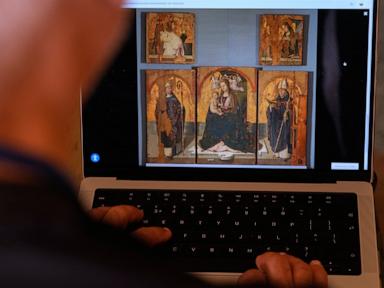
The timing was too precise to be mere coincidence. On the night of August 15, while the historic port city of Messina distracted itself with the thunderous pageantry of the Ferragosto holiday and the massive La Vara procession, professional operatives slipped into the Museo Regionale di Messina. Their target was not a randomized sweep of high-end loot, but a calculated amputation of cultural memory. Four irreplaceable wood panels painted by fifteenth-century master Antonello da Messina vanished into the Mediterranean night.
Three of the stolen pieces constituted the core surviving fragments of the 1473 San Gregorio Polyptych, an altarpiece that miraculously survived the catastrophic 1908 earthquake which leveled much of the city. The fourth was a delicate, double-sided panel depicting the Virgin Mary and the dead Christ in a powerful Pietà, extracted directly from an armored display case. Two additional panels were dragged out but ultimately abandoned behind a low exterior wall, signaling a panicked exit or an operational glitch.
This was a strike against the very bedrock of Sicilian identity. Yet, the mechanics of the crime point to structural vulnerabilities that plague regional institutions across Southern Europe.
The Anatomy of a Calculated Extraction
Security systems at the museum, locally known as MuMe, were operational. Cameras watched the perimeter, and alarm architecture was active. Despite these measures, the perpetrators breached the facility shortly before ten o'clock in the evening, bypassing complex electronic grids with chilling efficiency.
Professional art theft rarely resembles Hollywood fiction. It relies on internal intelligence, familiarity with response times, and the exploitation of predictable municipal distractions. Ferragosto represents the absolute apex of the Italian summer holiday cycle. Public services run on skeleton crews, local law enforcement units redirect manpower toward crowd control for massive street celebrations, and public attention remains fractured.
The thieves knew precisely which panels to pull from the frames and how to defeat the protective housing of the Pietà. They targeted wood panels created by an artist whose market valuation has skyrocketed following high-profile international acquisitions. Earlier this year, the Italian culture ministry shelled out fourteen million dollars at Sotheby's in New York to secure Antonello's devotional piece Ecce Homo. That transaction thrust the early Renaissance painter back into global headlines, inadvertently flashing a neon sign over regional museums holding his sparse inventory.
The Unsalable Asset Paradox
Amateur criminals assume that stealing a masterpiece guarantees instant wealth. Experienced investigators know the exact opposite is true.
Art-crime analysts point out that an Antonello da Messina original is radioactive on the open market. You cannot list a sixteenth-century polyptych fragment on secondary online marketplaces or walk it into a reputable auction house in London or Geneva. The art world is tightly networked, and these panels are cataloged down to every microscopic crack in the oil-and-tempera glaze.
Instead, high-value thefts of this caliber usually follow one of two dark trajectories.
- The Collateral Exchange: The paintings circulate through underground syndicates, acting as high-value currency or security collateral for narcotics trafficking, weapons smuggling, or money laundering operations.
- The Ransom Extraction: Perpetrators hold the pieces in clandestine, climate-controlled environments, hoping to negotiate a confidential return or a reduced sentence through intermediaries with insurance companies or sympathetic state officials.
Neither path offers an easy exit strategy when law enforcement units like the Carabinieri art recovery squad deploy their resources across international borders.
The Vulnerability of Regional Heritage
The Messina heist underscores a brutal reality for secondary museums housing world-class treasures. Major institutions in capital cities maintain fortress-like security infrastructure, complete with multi-layered biometric access, dedicated armed response teams, and climate-controlled vaults.
Regional facilities often operate on constrained municipal budgets. They balance public accessibility with asset protection, leaving priceless cultural artifacts exposed to determined criminal syndicates. When a museum houses the only surviving works of a hometown master who bridged Flemish realism with Italian perspective techniques, it becomes a soft target for organized crime groups looking to exploit bureaucratic friction.
The recovery rate for stolen high-art varies wildly, depending heavily on whether the objects fall into the hands of professionals who respect their fragility or volatile criminal elements who might compromise the delicate wood panels through improper storage. Climate fluctuations alone can warp and destroy fifteenth-century oil-on-wood works within weeks.
As investigators comb through digital surveillance logs and interrogate local informants, the missing panels of the San Gregorio Polyptych remain hidden somewhere in the criminal underworld. The city that survived a century-old earthquake now confronts a different kind of ruin, watching structural negligence and opportunistic criminality strip away its Renaissance soul