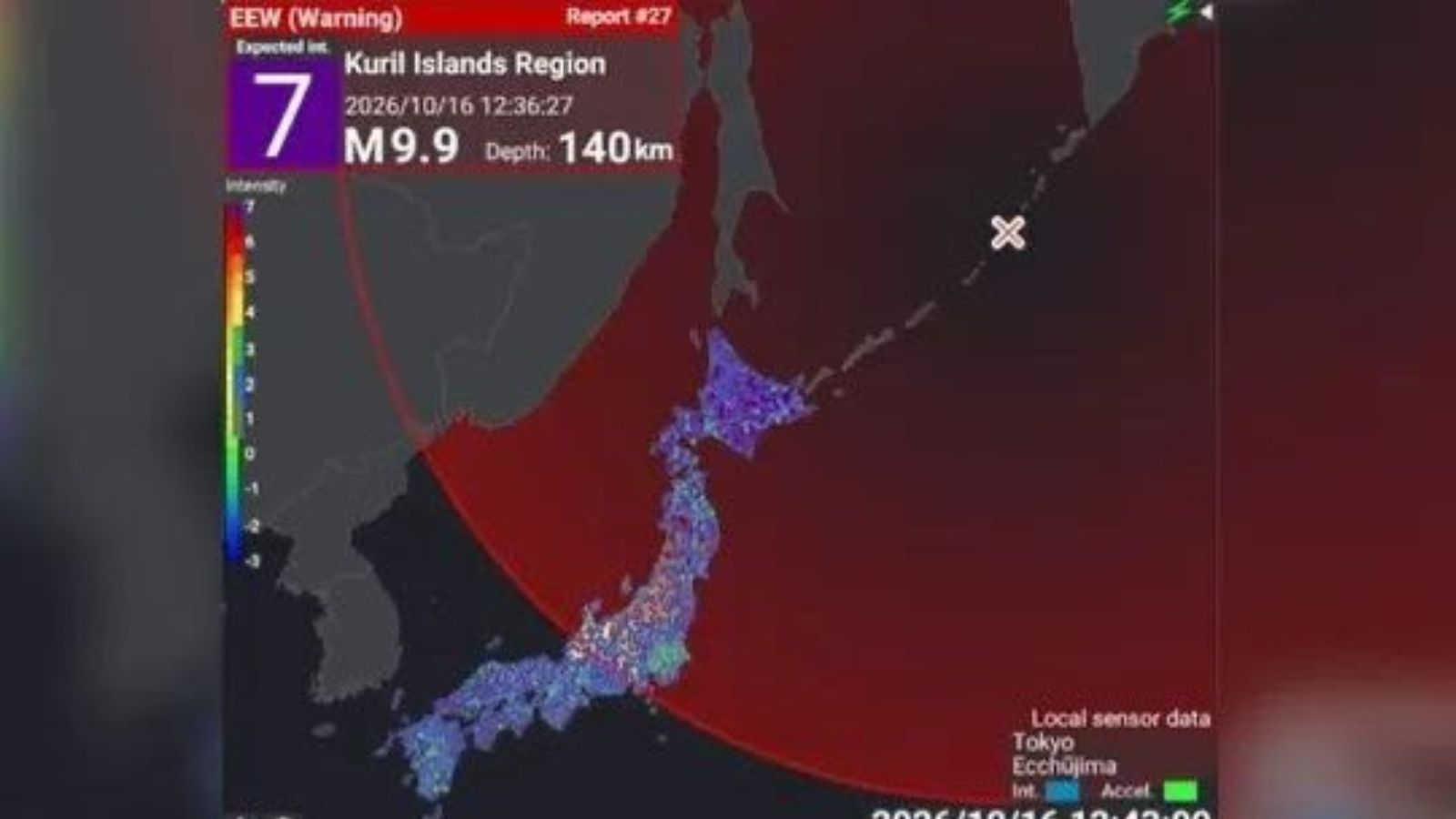
A false 9.9-magnitude megaquake alert issued in Japan following a tremor in Russia exposed a critical fault line in how automated early warning systems process extreme seismic events and cross-border data. When an algorithm flags a theoretical 9.9-magnitude megaquake on a planet whose recorded seismic ceiling sits just above magnitude 9.5, the glitch is rarely a harmless software hiccup. It is a stress test of public trust, automated infrastructure, and international sensor coordination along the Pacific Ring of Fire.
I have spent decades covering disasters, crisis communications, and industrial risk from Tokyo to San Francisco. Every major failure I have investigated starts the same way. Someone builds a system designed for speed, strips out human friction in the name of milliseconds, and then acts surprised when an edge case detonates across millions of screens. If you liked this post, you might want to read: this related article.
A false 9.9-magnitude megaquake alert does not happen in a vacuum. It happens at the intersection of high-frequency seismic telemetry, automated magnitude estimators, cross-border fault geometry, and human psychology conditioned by real catastrophes.
Why Magnitude Estimates Break When Ruptures Grow Large
Measuring an earthquake sounds simple until you try to do it in real time. Early warning networks rely on initial seismic waves—primarily P-waves, which travel faster than the more destructive S-waves and surface waves—to estimate where an event is happening and how big it might become before shaking peaks. For another look on this story, see the latest coverage from Al Jazeera.
Speed is the entire point. Seconds matter when a high-speed train needs to cut power or when coastal residents need to head for high ground.
Yet early magnitude estimation has a well-known physical ceiling. Initial wave amplitudes from a small or moderate quake scale predictably with total energy release. Once a rupture grows massive, the initial signal saturates or behaves differently depending on rupture velocity, fault roughness, and depth. Estimating final size from the opening seconds of a giant event is like judging the total tonnage of an avalanche by watching the first three rocks roll down a ridge.
When a tremor occurs far away—such as across the sea in Russia's Far East or Kuril-Kamchatka subduction zone—the signal arriving at distant stations carries different frequency characteristics than a local shallow rupture beneath Honshu or Hokkaido. If an automated classification routine misidentifies distant wave phases, misreads station telemetry, or applies an uncalibrated scaling factor to a saturated input, the math can spit out a number that violates geological history.
A 9.9-magnitude figure is not merely large. Seismologists generally treat magnitude 9.0 as the threshold of a true megaquake, with the largest instrumentally recorded event—the 1960 Valdivia earthquake in Chile—measured around 9.5. Each whole number on the moment magnitude scale represents roughly 31.6 times more energy release than the previous integer. Pushing toward 9.9 implies energy release on a scale that strains known fault lengths and crustal mechanics.
When an alert flashes a number that extreme, the public does not read a confidence interval. People read doom.
The Cross-Border Blind Spots of Pacific Seismology
Tectonic plates do not respect national borders. The Pacific plate dives beneath neighboring plates along thousands of kilometers of trenches, creating shared hazard zones where a rupture in one jurisdiction can send tsunami waves toward another hours later.
Cross-border seismic monitoring sounds straightforward on paper. Share station feeds, standardize formats, and run unified calculations.
In practice, international data exchange is messy. Different agencies operate different hardware, sampling rates, latency tolerances, and processing pipelines. A station feed might drop packets, suffer clock drift, or route through an intermediary node that delays a timestamp.
Consider a hypothetical example to see how a small data anomaly can snowball. Suppose a coastal station logs a spike caused by a local instrument glitch or a misrouted waveform packet while an actual tremor is occurring across the water in Russia. If an automated correlation engine merges two mismatched signals—or assigns a distant source location to a local amplitude spike—the resulting distance-to-magnitude calculation can inflate wildly. Distance squared or cubed factors heavily into attenuation models; tell the software a strong signal came from farther away than it actually did, and the implied source energy jumps.
Even without a dramatic software bug, cross-border events create a split-screen problem. A tremor in Russia might pose a tsunami threat to parts of the Pacific rim without producing violent local ground shaking in Japan, or vice versa. Public warning systems are built to trigger rapidly when local shaking or tsunami criteria are crossed, leaving very little margin for cross-checking foreign agency bulletins before sirens sound or mobile alerts buzz.
The Boy Who Cried Megaquake
Public alerting depends on a fragile social contract. Authorities ask citizens to drop, cover, and evacuate immediately when an alarm sounds, promising that false positives will be rare and that the cost of reacting to a dud is always lower than ignoring a real killer.
That contract erodes fast when people see an impossible number.
Think about what happens inside a household or an office when a 9.9-magnitude megaquake alert hits phones. First comes shock. Then comes disbelief. Someone checks social media, looks at a glass of water on the table, or refreshes a news feed to see if buildings are swaying.
When nothing shakes—or only mild tremors arrive—the emotional whiplash sets in. Relief mixes with irritation, and irritation hardens into skepticism.
Skepticism is dangerous in seismic zones. If residents dismiss a future warning because they remember a phantom 9.9-magnitude megaquake alert, the next warning could cost lives. You cannot engineer human attention the way you engineer fiber-optic cables. Trust is accumulated slowly over decades of accurate warnings and quiet drills, and it can be damaged in thirty seconds by an absurdly inflated number.
| Failure Mode | Technical Mechanism | Operational Consequence | Public Trust Impact |
|---|---|---|---|
| Signal Saturation & Misclassification | Early wave amplitudes or distant phase arrivals are over-scaled by automated routines | Inflated magnitude output far above historical norms | Confuses residents with impossible seismic figures |
| Cross-Border Telemetry Mismatch | Latency, packet drops, or misaligned source-distance pairs across regional networks | Faulty distance-energy inversion during foreign tremors | Fuels rumors and conflicting official updates |
| Alert Threshold & Display Rigidity | Raw or unguarded model outputs pass directly to public notification channels | Mass alarms triggered before human or multi-sensor verification | Risks "cry wolf" fatigue during genuine events |
Why "Better Algorithms" Are Not a Complete Cure
Whenever a high-tech warning system misfires, the reflex inside engineering teams is to tune the model, add another filter, or push a patch. That instinct is understandable. Engineers fix code.
Yet treating a false 9.9-magnitude megaquake alert purely as a tuning problem misses the deeper trade-off at the heart of earthquake early warning. Every second spent verifying an anomaly is a second lost if a catastrophic local rupture is actually underway.
Add a strict sanity cap—say, blocking any automated public magnitude above 9.2 without secondary confirmation—and you prevent absurd numbers from reaching phones. What if a genuine, unprecedented event pushes past that cap? Add a mandatory human review step before sending alerts, and you slow down response during a fast, shallow rupture where seconds decide survival.
There is no free lunch in real-time hazard detection. A system tuned for zero false alarms will be too slow for worst-case ruptures. A system tuned for hair-trigger speed will occasionally embarrass its operators with wild estimates.
In disaster management, gray areas are the norm rather than the exception. Sensors fail during storms and power surges. Seismic waves refract through complex crust. Communications networks choke right when everyone reaches for a phone or when automated systems flood bandwidth. Anyone promising a glitch-free global warning grid is selling fiction.
What Industries and Agencies Actually Get Wrong
Look beyond the immediate public panic and you find a second set of casualties: automated infrastructure and supply chain decision-makers.
Modern industrial facilities, rail networks, utilities, and semiconductor fabs increasingly tie automated shutdown protocols or safety stand-downs to seismic feeds. A train slows or stops. A valve closes. A high-precision manufacturing line pauses to protect expensive equipment from vibration.
Those automated stops are often smart precautions. Nobody wants a derailment or a damaged lithography tool.
The trouble starts when organizations treat a single alert stream as an infallible command rather than one input among several. When a false 9.9-magnitude megaquake alert ripples through a region, operations teams have to figure out within minutes whether to keep lines halted, inspect facilities, reroute freight, or reassure anxious staff. If internal playbooks lack clear verification steps—such as cross-checking multiple seismic agencies, inspecting local accelerometer readings, and separating tsunami risk from ground-shaking risk—companies waste hours reacting to phantom severity.
I have watched plant managers and logistics coordinators make costly calls in the fog of conflicting alerts. A tremor in Russia might warrant coastal vigilance for distant wave travel while posing zero threat to an inland factory, yet a dramatic headline or raw magnitude figure can trigger blanket panic across an entire supply chain.
Practical Steps for Operators and Citizens
Fixing the fallout from an erroneous alert requires action on both sides of the screen, without pretending perfection is around the corner.
For seismic agencies and alert operators:
- Enforce physical plausibility bounds on unverified automated outputs so raw calculation errors do not surface as apocalyptic magnitudes.
- Separate shaking alerts from tsunami advisories clearly in public messaging, especially for distant events across borders like Russia and Japan, so people understand what physical hazard actually applies to their location.
- Publish transparent post-incident technical reviews quickly, explaining whether the glitch came from sensor noise, cross-border data lag, or magnitude estimation limits, rather than offering vague assurances.
For businesses, critical infrastructure, and individuals:
- Build multi-source verification into operational protocols, pairing automated alerts with local sensor data and official follow-up bulletins before making major operational shutdowns.
- Maintain basic physical readiness—secure heavy items, know local evacuation routes for coastal areas, and keep emergency supplies accessible—regardless of how noisy alert feeds become.
- Treat every alert as a prompt to check conditions, never an excuse to tune out warnings just because a previous number looked impossible.
A false 9.9-magnitude megaquake alert after a tremor in Russia is a reminder that our instruments are fast, our crust is complex, and our margin for error is thinner than we like to admit. Build your habits and your systems for reality, not for the comforting illusion of a flawless screen.



