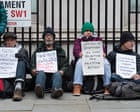
Defense lawyers representing Palestine Action activists in British courts have increasingly invoked the militant tactics of the early twentieth-century suffragette movement to justify property damage and direct action. By drawing direct parallels between smashing windows at weapons manufacturers and the Women's Social and Political Union's campaign for the vote, legal teams are attempting to reframe criminal damage as a historically validated necessity. This strategy tests the boundaries of UK criminal law, forcing juries to weigh modern statutory restrictions against a long, complex tradition of British civil disobedience.
The courtroom argument is rarely about whether the defendants physically broke the glass, sprayed the red paint, or locked themselves to factory gates. Those facts are almost always captured on high-definition CCTV and body-worn cameras. Instead, the battleground is mens rea—the criminal intent behind the act—and the statutory defenses available under British law. When a defense barrister brings up Emmeline Pankhurst or Emily Davison in front of a Crown Court jury, they are doing more than offering a history lesson. They are attempting to establish a moral and legal precedent that turns a criminal trial into a referendum on state complicity and political necessity.
The Mechanics of the Suffragette Defense
To understand why this historical comparison carries weight in a modern courtroom, you have to look at how British juries operate. Unlike judges, juries do not have to explain their verdicts. They possess the ancient, uncodified power of jury nullification—the ability to acquit a defendant even when the strict letter of the law suggests guilt, simply because the jury believes a conviction would be unjust.
In recent trials involving Palestine Action, defense teams have leaned heavily on the Criminal Damage Act 1971. Under Section 5(2) of this Act, a person has a "lawful excuse" for damaging property if they acted to protect property belonging to themselves or another, believing that the property was in immediate need of protection and that the means adopted were reasonable.
Historically, activists argued they were smashing parts at factories owned by defense contractors like Elbit Systems to prevent those components from being used to destroy homes and lives in Gaza. When appellate courts began narrowing the scope of this statutory defense, lawyers pivoted toward broader moral and historical arguments. They needed a cultural touchstone that every British juror would instantly recognize as a righteous struggle that was initially condemned as criminal.
Enter the suffragettes.
Between 1903 and 1914, the Women's Social and Political Union (WSPU) abandoned peaceful petitioning in favor of "deeds, not words." They shattered storefront windows on Oxford Street, burned down empty buildings, slashed paintings in the National Gallery, and chained themselves to railings outside Downing Street. At the time, the establishment media, politicians, and magistrates labeled them terrorists, vandals, and dangerous extremists. Yet today, statues of Pankhurst stand outside Parliament, and their faces appear on commemorative coins.
Defense counsel uses this historical arc to ask juries a pointed question. If history absolved those who broke property to secure basic human rights a century ago, how will history judge those breaking property to stop alleged war crimes today?
The Legal Pushback from the Bench
Judges have grown increasingly impatient with this line of argument. Over the past several years, the Court of Appeal and senior judges have systematically tightened the rules regarding what defenses can be put before a jury in protest cases.
Following high-profile acquittals of Extinction Rebellion and Insulate Britain activists, the Attorney General referred key points of law to the Court of Appeal to clarify the boundaries of lawful excuse. The resulting rulings established that the connection between damaging property in the UK and preventing harm overseas—or mitigating climate change—is often too remote to qualify as a valid legal defense.
Judges now routinely issue strict directions to juries, instructing them to set aside their personal political views and focus strictly on whether the elements of the criminal offense were met. In several trials, judges have barred defendants from mentioning Gaza, international law, or historical movements altogether, limiting testimony strictly to the physical actions taken on the day of the arrest.
When the suffragette comparison does make it into the courtroom, it usually survives only through careful framing during closing speeches, or when a defendant testifies about their personal state of mind and belief that they had a lawful excuse. Even then, prosecutors aggressively dismantle the analogy.
Where the Historical Parallel Breaks Down
Prosecutors and legal historians point out several critical flaws in equating Palestine Action's operational model with the WSPU's campaign. While the visual aesthetics of shattered glass and public disruption look similar on the surface, the underlying political realities and tactical boundaries differ significantly.
First is the question of democratic recourse. In 1910, British women were entirely disenfranchised. They had no vote, no representation in Parliament, and no constitutional mechanism to change the laws that governed them. Their argument was that because they were excluded from the democratic process, they were not bound by its laws. Modern activists operating in the UK possess full voting rights, access to free speech, the ability to lobby elected officials, and the freedom to organize peaceful mass demonstrations. Prosecutors argue that resorting to property destruction when legal avenues remain open undermines the very democratic system the suffragettes fought to enter.
Second, the suffragettes operated under a strict internal code regarding human life. Despite engaging in arson and bombings of empty buildings, the WSPU leadership explicitly forbade actions that would endanger human life, though critics at the time argued their methods recklessly risked it. In modern direct action trials, prosecutors emphasize the psychological impact and physical fear experienced by factory workers, security guards, and administrative staff when masked individuals breach a facility with sledgehammers and flares.
Third, there is a distinct difference in how the two groups engaged with the judicial system. Suffragettes routinely refused to pay fines, went on hunger strikes in Holloway Prison, and used the dock as a political platform without necessarily expecting legal acquittal under existing statutes. They accepted the legal consequences of their actions to expose the brutality of the state's response, such as the Cat and Mouse Act and force-feeding.
Palestine Action defendants, conversely, frequently seek full legal vindication within the existing statutory framework, arguing their actions are entirely lawful under British and international law. They want the system to validate their tactics, whereas the suffragettes sought to break the system's legitimacy entirely.
The Corporate and State Counter-Offensive
The rise of the suffragette defense has not happened in a vacuum. It is a direct reaction to an aggressive legislative and prosecutorial crackdown on direct action across the United Kingdom.
Over the past few years, the UK government has introduced sweeping public order legislation, including the Police, Crime, Sentencing and Courts Act 2022 and the Public Order Act 2023. These laws created new criminal offenses, such as "locking on" and interfering with key national infrastructure, while dramatically increasing maximum penalties and restricting traditional defenses.
Simultaneously, private defense contractors and their insurers have applied immense pressure on the Crown Prosecution Service (CPS) and police forces to treat protest-related property damage not as minor public order offenses, but as organized criminal conspiracies.
This shift has changed the charges activists face. Instead of being tried in Magistrates' Courts for simple criminal damage—where penalties are relatively low and cases are heard by a single district judge or lay bench—activists are increasingly charged with conspiracy to commit criminal damage, burglary, or aggravated trespass.
These charges push trials into the Crown Court. Ironically, this strategic escalation by prosecutors created the exact opening defense lawyers needed. By elevating the charges to secure harsher prison sentences, the state guaranteed that these cases would be heard by twelve ordinary citizens rather than state-appointed judges.
And juries are unpredictable.
The Economics of Disruption
To understand why the state and defense contractors are fighting so hard to shut down the suffragette narrative, you have to follow the money. Palestine Action does not aim to win a single courtroom debate; their stated goal is to make it financially and logistically impossible for targeted companies to operate in Britain.
Every time activists occupy a roof, flood a factory floor, or smash specialized manufacturing equipment, the targeted company faces immediate financial bleeding. Production halts. Supply chains stall. Specialized machinery requires months to repair or replace.
More importantly, insurance premiums skyrocket. Commercial insurers evaluate risk based on frequency and severity of incidents. When a facility is repeatedly breached, underwriters either demand exorbitant premiums or withdraw coverage entirely. Security costs balloon as companies are forced to hire round-the-clock private guards, install military-grade perimeter fencing, and upgrade surveillance networks.
In at least two high-profile instances—the closure of an Elbit Systems factory in Oldham and the sale of its Elite KL subsidiary in Tamworth—activists claimed their sustained campaign forced the company to retreat. While the company cited commercial restructuring and changing business priorities, the financial toll of continuous disruption was undeniable.
From the perspective of the defense industry and the Home Office, allowing juries to acquit activists based on historical analogies threatens the rule of law and national security. If a jury decides that breaking into a defense contractor's facility is morally equivalent to a suffragette smashing a post office window, the deterrent effect of criminal prosecution evaporates.
The Media Framing Battle
Outside the courtroom, the suffragette comparison serves an entirely different purpose. It is a calculated exercise in narrative warfare.
Mainstream media coverage of direct action typically focuses on the immediate disruption: the cost of the repairs, the arrests made, and the inconvenience to local workers. Headlines routinely use words like "vandals," "mobs," or "extremists." When defense barristers introduce the suffragette parallel during a trial, it forces journalists covering the court proceedings to print a completely different framing.
Suddenly, the headline is no longer just about broken glass. It becomes a story about historical precedent, political philosophy, and the definition of legitimate protest.
This framing exploits a well-documented phenomenon in British political culture: the retrospective sanitization of radical history. The British establishment loves to celebrate past rebels once their demands have been absorbed into the status quo. The Chartists, the Tolpuddle Martyrs, and the suffragettes are all taught in schools as heroes who expanded British democracy.
By tether-balling their current actions to these universally admired figures, activists force critics into an uncomfortable rhetorical corner. To condemn the tactic outright requires explaining why property destruction was acceptable in 1912 for women's suffrage, or in 1980s Britain against South African apartheid interests, or in 2003 when anti-war activists damaged US military aircraft at RAF Fairford, yet is completely unacceptable today.
The Limits of the Analogy in the Jury Room
Despite the power of the narrative, veteran trial lawyers know that historical comparisons are a double-edged sword. A jury is not a university seminar. Twelve people pulled at random from the electoral roll will bring wildly different political instincts, class backgrounds, and views on law and order into the deliberation room.
For every juror who sees a parallel with Emmeline Pankhurst, there is another who sees privileged activists destroying the workplace of ordinary British engineers and technicians.
When defense teams overplay the historical comparison, they risk alienating jurors who care more about local jobs and basic community safety than geopolitical conflicts thousands of miles away. If a defendant comes across as self-righteous or dismissive of the workers whose livelihoods were disrupted, the suffragette defense collapses instantly.
The most successful acquittals in recent protest trials have rarely hinged on grand historical speeches alone. Instead, they succeeded when defense teams meticulously connected the specific actions of the defendants to the immediate prevention of harm, backed by expert testimony on international humanitarian law and specific export licensing data. The suffragette reference works best as a subtle psychological permission slip—a way to remind jurors that the law is not always synonymous with justice, and that ordinary citizens have a constitutional right to act as a check on state power.
The Unintended Consequences of Judicial Crackdowns
The British legal system is currently caught in a tense standoff between the judiciary's demand for strict statutory compliance and the unpredictable conscience of the British jury.
As judges strip away legal defenses and restrict what defendants can say in the witness box, a troubling pattern has emerged. Several defendants have been held in contempt of court and jailed simply for mentioning the root causes of their protests after being ordered not to do so by the judge.
This judicial hardline carries significant risks for the credibility of the courts. The British jury system relies on a delicate compact: the judge explains the law, and the jury decides the facts. When judges aggressively police the boundaries of what a defendant is allowed to explain about their own motivation, it can look to outside observers—and to the jurors themselves—like the state is rigging the game to guarantee a conviction.
Even when the suffragette comparison is banned from the courtroom, the ghost of the argument remains. Jurors live in the real world. They read the news, they watch debates unfold on television, and they understand the historical context of British protest even if a barrister is forbidden from naming Emmeline Pankhurst in closing arguments.
The ongoing trials involving Palestine Action are ultimately testing whether modern British democracy still has room for the messy, disruptive, and legally ambiguous tradition of direct action. The suffragettes did not win the vote because judges approved of their methods; they won because the political and social cost of suppressing them eventually became higher than the cost of granting their demands. Whether modern jurors, lawmakers, and defense contractors reach a similar tipping point remains the central, unresolved question hanging over every Crown Court dock where these cases are heard.