Yes, the United States should worry, though not for the reasons Washington policymakers usually cite. The real threat is not a single breakthrough reactor design coming out of Beijing, nor is it merely the existence of more than twenty Chinese small nuclear reactor start-ups. The danger lies in industrial velocity, state-backed supply chains, and the quiet capture of global export markets while American developers remain trapped in regulatory amber.
For three decades, the nuclear energy sector has promised a renaissance built on small modular reactors, or SMRs. The pitch was simple enough. Instead of building massive, bespoke gigawatt-scale power plants that routinely run years behind schedule and billions of dollars over budget, companies would manufacture smaller units in factories, ship them on trucks or railcars, and assemble them on-site like industrial Lego bricks. Standardization would drive down costs. Modularity would slash construction timelines. If you found value in this article, you might want to read: this related article.
Western startups took that thesis to venture capitalists and the Department of Energy. Chinese planners took it to their heavy manufacturing base.
The Illusion of the American Head Start
In Silicon Valley and Washington, the prevailing wisdom holds that American nuclear startups maintain a comfortable technological lead. Companies like NuScale Power, TerraPower, X-energy, and Kairos Power boast sophisticated engineering, advanced fuel concepts, and deep ties to national laboratories. On paper, their designs look formidable. For another look on this story, check out the recent coverage from TechCrunch.
Paper does not generate megawatts.
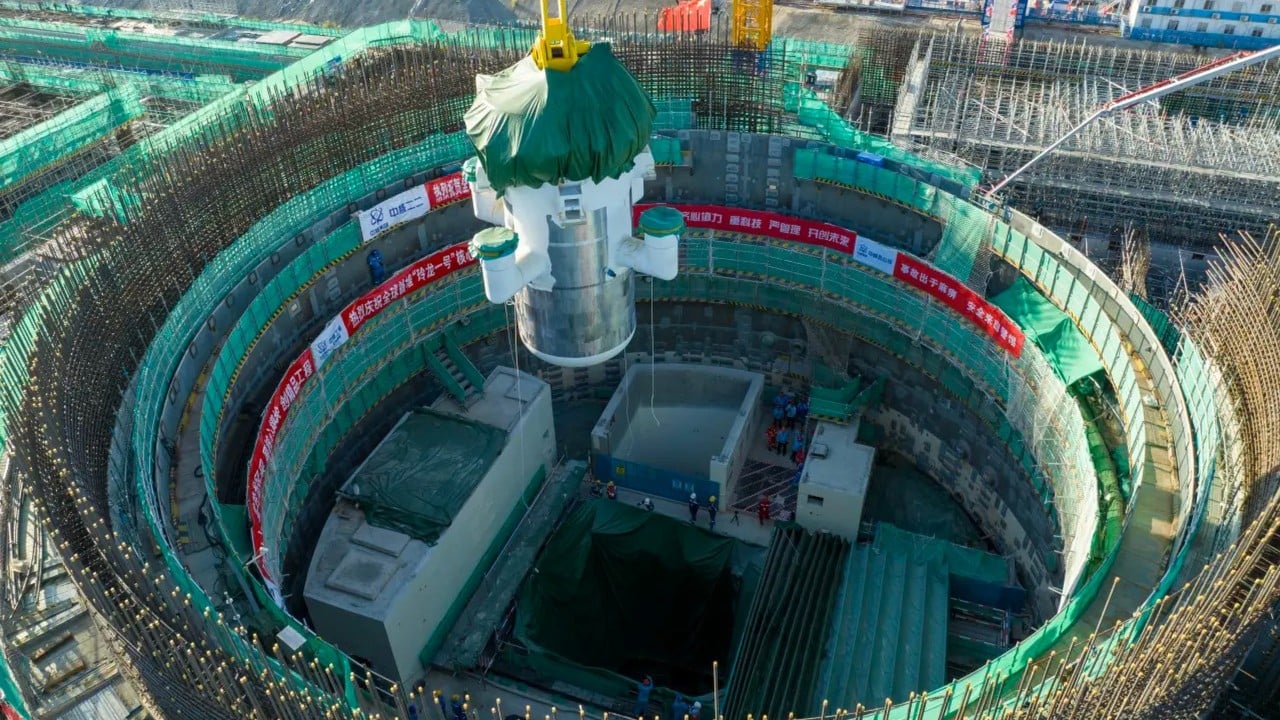
While American firms spend hundreds of millions of dollars navigating the Nuclear Regulatory Commission’s licensing maze, China has already connected its first commercial high-temperature gas-cooled pebble-bed reactor, the HTR-PM, to the grid in Shandong province. It has also pushed forward with the ACP100, known commercially as Linglong One, a pressurized water SMR under construction in Hainan. These are not PowerPoint slides or test loops. They are pouring concrete and welding pressure vessels.
The emergence of more than twenty private and semi-private nuclear startups in China signals a structural shift in how Beijing approaches atomic energy. Historically, Chinese nuclear development was the exclusive domain of massive state-owned enterprises like China National Nuclear Corporation (CNNC) and China General Nuclear Power Group (CGN). Now, provincial governments, state investment funds, and private capital are pouring money into agile ventures exploring everything from molten salt reactors and lead-cooled fast reactors to microreactors designed for remote mining operations and offshore platforms.
Many of these twenty-plus startups will fail. That is the point. Beijing is running a classic venture-style filtration process backed by state-scale patience, allowing dozens of teams to test designs, fail fast, and consolidate around the winners. The United States, by contrast, has placed massive bets on a handful of domestic champions while starving the broader ecosystem of the physical infrastructure needed to build prototypes quickly.
How China Turned Nuclear Construction Into an Assembly Line
To understand why the American nuclear industry struggles to compete on cost and speed, you have to look past the reactor core and examine the supply chain. A nuclear power plant is mostly concrete, specialized steel, valves, pumps, and heat exchangers. The nuclear physics are settled science; the civil engineering and heavy manufacturing are where projects live or die.
The United States largely dismantled its heavy nuclear manufacturing base after the Three Mile Island accident in 1979. Today, American developers often have to source ultra-heavy forgings—the massive steel components that house the reactor core—from suppliers in Japan, South Korea, or Europe. Every custom order introduces bottlenecks, quality-assurance headaches, and price markups.
China never stopped building. Over the past twenty years, it has constructed dozens of large-scale nuclear reactors, building an uninterrupted domestic supply chain in the process. When a Chinese SMR startup needs specialized zirconium cladding, reactor-grade graphite, or precision-machined coolant pumps, it can tap into a mature network of domestic factories that already produce those exact components at scale.
Consider the economics of the first-of-a-kind problem. The very first unit of any new reactor design is always brutally expensive because factories must tool up for bespoke parts and engineers must solve unforeseen assembly issues. NuScale Power learned this the hard way in late 2023 when its flagship Carbon Free Power Project in Idaho was canceled after estimated costs surged to $9.3 billion, driven largely by rising interest rates and supply chain inflation.
Chinese startups bypass much of that friction. Because state-owned utilities act as guaranteed early customers and state banks provide low-interest financing, Chinese developers can absorb first-of-a-kind losses and move rapidly to the fifth, tenth, and twentieth units—where the true economies of mass production actually kick in.
The Fuel Bottleneck Nobody Wants to Talk About
Even if an American SMR startup clears every regulatory hurdle and secures billions in private financing, it faces an immediate, crippling vulnerability: fuel.
Many next-generation SMR designs—including those from TerraPower and X-energy—rely on High-Assay Low-Enriched Uranium, or HALEU. Standard commercial reactors run on uranium enriched to about 3 to 5 percent of the fissile isotope U-235. HALEU requires enrichment between 5 and 20 percent. This higher concentration allows reactors to be smaller, run longer between refueling outages, and produce less waste.
Until recently, there was only one commercial supplier of HALEU in the world: Tenex, a subsidiary of Russia’s state nuclear corporation, Rosatom.
Following Russia’s invasion of Ukraine, relying on Moscow for advanced reactor fuel became politically and strategically untenable. The U.S. government has scrambled to subsidize domestic enrichment capacity through companies like Centrus Energy, but building out a commercial-scale HALEU supply chain from scratch will take years. TerraPower has already had to delay the target completion date of its Natrium demonstration plant in Wyoming by at least two years specifically because of the HALEU shortage.
China saw this bottleneck coming a decade ago. Beijing has systematically invested in domestic uranium mining, conversion, and enrichment facilities, alongside aggressive acquisitions of uranium assets in Kazakhstan, Namibia, and Niger. While American startups lobby Congress for emergency fuel appropriations, Chinese SMR developers are operating inside a closed, self-sufficient fuel cycle.
Why Developing Nations Will Buy Chinese Reactors
The stakes of this race extend far beyond domestic electricity grids. The true geopolitical prize is the global export market, particularly across the Global South.
Dozens of countries in Southeast Asia, Africa, the Middle East, and Latin America are desperately seeking reliable, zero-carbon baseload power to fuel industrialization and urbanization. Wind and solar are cheap, but they cannot run steel mills or sprawling data centers around the clock without massive, expensive battery storage. Traditional gigawatt-scale nuclear plants, costing upwards of $10 billion to $15 billion apiece, are far too large for smaller national grids and far too expensive for developing economies to finance.
Small modular reactors fit their needs precisely. A 100-to-300-megawatt reactor can be plugged into an existing regional grid without destabilizing it, and multiple units can be added incrementally as electricity demand grows.
When a ministry of energy in Indonesia, Ghana, or Saudi Arabia shops for SMRs over the next decade, what will Washington offer? American vendors can pitch superior safety features, transparent regulatory pedigrees, and strict adherence to non-proliferation standards. What they cannot offer is a turnkey financing package or a guaranteed delivery date.
China offers the entire stack. Through its Belt and Road framework, Beijing bundles the reactor hardware, construction labor, fuel supply, spent-fuel take-back agreements, and multi-billion-dollar sovereign loans from state policy banks into a single transaction. For a finance minister in a developing nation facing rolling blackouts, the choice between a hypothetical American reactor available in the mid-2030s and a financed Chinese unit backed by operational precedents is not much of a choice at all.
Once a country buys a Chinese nuclear reactor, it is locked into Beijing’s geopolitical orbit for the sixty-to-eighty-year lifespan of the facility. Nuclear energy is not like selling solar panels or smartphones; it requires continuous technical support, spare parts, software updates, fuel deliveries, and regulatory cooperation for generations. Exporting SMRs is the ultimate tool of long-term diplomatic leverage.
The Case Against Panic
Still, declaring the race lost would be a mistake. China’s state-driven model carries profound structural weaknesses that Western analysts frequently overlook when tallying up startup counts.
First, quantity is not quality. Having more than twenty SMR startups does not mean China has twenty viable commercial products. State subsidies routinely distort market signals, encouraging local officials and entrepreneurs to launch redundant ventures simply to capture government grants. Many of these firms are chasing exotic reactor designs—such as molten salt or liquid-metal-cooled concepts—that face brutal materials-science challenges, including severe corrosion and complex maintenance requirements, which have stymied nuclear engineers since the 1960s.
Second, transparency remains China’s Achilles' heel in international nuclear markets. Western regulators like the U.S. Nuclear Regulatory Commission, Canada’s CNSC, and the UK’s Office for Nuclear Regulation set the gold standard for safety oversight. Their licensing processes are agonizingly slow, yet an NRC design certification acts as a global passport, assuring buyers and insurers that a reactor has survived the most rigorous technical scrutiny on earth.
China’s National Nuclear Safety Administration has grown vastly more sophisticated, but skepticism persists abroad regarding state oversight, construction quality control, and operational transparency. In 2021, when a fuel-rod damage issue occurred at the Taishan nuclear power plant in Guangdong—a joint venture with France’s EDF—Chinese authorities initially downplayed the incident before eventually shutting down the unit for months of repairs. In the nuclear sector, where a single mishap can freeze global adoption for a decade, perceived opacity is a massive commercial liability.
Finally, the United States still possesses unmatched software, simulation, and materials-science capabilities, alongside a private capital market that, when properly incentivized, moves with ruthless efficiency. Big Tech has abruptly entered the chat. Companies like Microsoft, Google, and Amazon are signing power purchase agreements with nuclear developers—including Kairos Power and X-energy—because artificial intelligence data centers require massive, uninterrupted carbon-free electricity that intermittent renewables simply cannot provide. Private tech capital is now doing what the U.S. government failed to do for twenty years: underwriting the commercial deployment of advanced nuclear technology.
What Actually Matters in the Next Five Years
The narrative framing this competition as a simple horse race between American ingenuity and Chinese scale misses the fundamental mechanics of industrial policy. The United States does not need twenty SMR startups. It needs three or four designs that can actually survive first-of-a-kind construction and reach repeatable, factory-line production before 2032.
Achieving that requires fixing three glaring choke points immediately.
- Streamlining licensing without gutting safety. The NRC was built to regulate massive, bespoke light-water reactors, not factory-built modular units or non-water-cooled designs. Congress passed the ADVANCE Act in 2024 to modernize licensing fees and accelerate reviews, yet cultural inertia inside the agency remains a major drag on timelines.
- Securing the domestic fuel supply. Until commercial HALEU enrichment scales up inside the United States and allied nations like the UK and France, advanced reactor timelines remain hostage to fuel availability.
- Matching state-backed export financing. The U.S. Export-Import Bank and the Development Finance Corporation must be empowered to offer competitive, flexible financing packages to foreign buyers, rather than forcing American vendors to compete solo against the balance sheet of the Chinese state.
The real danger of China’s twenty SMR startups is not that Beijing will invent some miraculous new physics that renders American technology obsolete. The danger is that China will treat nuclear reactors the exact same way it treated solar panels, lithium-ion batteries, and electric vehicles—absorbing early losses, dominating the supply chain, driving down unit costs through sheer manufacturing volume, and locking up global customers before Western competitors even pour their first foundations.