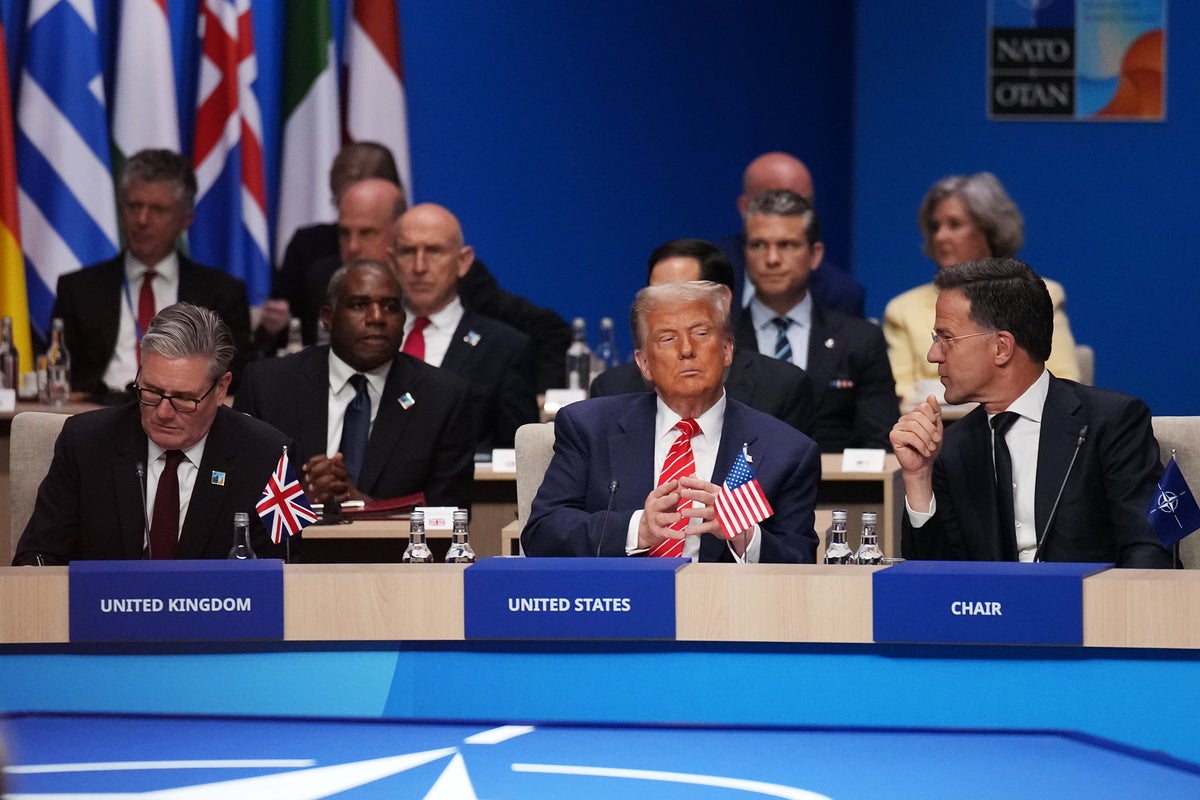
For decades, the public narrative surrounding the North Atlantic Treaty Organization revolved around a simple, magic number: 2%. Every member state was supposed to spend at least that share of its economic output on defense. Western leaders treated it as a sacred benchmark, while American presidents used it as a blunt instrument to bash lagging allies. But as leaders gather for the high-stakes summit in Ankara, that old baseline has been completely blown apart. The numbers released by the alliance tell a story not of unified resolve, but of a widening fracture between the nations living under the immediate shadow of Russian hardware and those insulated by geography and fiscal denial.
The primary truth of modern European security is that meeting a spreadsheet target does not automatically equal combat readiness. Under intense pressure from Washington, European allies and Canada are projected to spend a collective $634 billion on defense, a substantial jump from past years. Yet, behind this historic surge lies a deeply troubling reality. The alliance has quietly moved its goalposts, establishing an ambitious new target at the Hague summit to hit 5% of GDP by 2035, split between a 3.5% core military requirement and a 1.5% security and resilience allotment. While frontline states are already tearing past these benchmarks, a core group of Western European nations remains stuck in a cycle of creative accounting and empty promises.
The Frontline Overachievers and the Continental Slackers
A glance at the hard data exposes the profound geographic disparity in how threat perception operates. The nations that share a border with Russia or sit directly in its potential path are treating this moment as an existential crisis. They are not merely meeting targets; they are emptying their treasuries.
Lithuania leads the alliance by a massive margin, projecting a core defense expenditure of 5.33% of its GDP. Estonia follows closely at 5.10%, with Latvia at 4.92% and Poland at 4.68%. These are staggering figures for economies of their size. For Warsaw and the Baltic states, buying tanks, artillery, and ammunition is not a theoretical exercise in multinational diplomacy. It is a race against time.
Then look at the other end of the spectrum. Slovenia sits at the bottom of the pile, projected to spend a mere 1.61% on core defense. Spain and Belgium are hovering right at the absolute floor of 2.0%. Czechia is barely crossing the line at 2.01%.
The problem is not just that these countries spend less. The problem is that their domestic political systems are fundamentally hostile to the kind of structural economic retooling required to sustain a wartime footing. For a country like Spain or Belgium, defense spending is viewed as a discretionary luxury item that can be traded away to balance domestic welfare budgets or appease coalition partners.
The Accounting Trick of the Two Percent Baseline
For years, defense analysts have known that the old 2% metric was heavily manipulated. Military pensions, paramilitary police forces, and even certain types of civil infrastructure have routinely been swept into defense budgets to make political leaders look good at summits.
The new framework, which separates core military spending from broader resilience investments like cybersecurity and critical infrastructure protection, was designed to stop this gaming of the system. It has not worked. Instead, it has given reluctant spenders a fresh set of categories to exploit. A highway built near a port can suddenly be classified under the 1.5% resilience bucket, allowing a government to claim it is contributing to collective defense without actually buying a single artillery shell.
Worse still is the lack of industrial capacity. Money does not fight wars; weapons and trained soldiers do. If a government increases its defense budget by 10% but domestic ammunition factories are backlogged for five years, that extra cash simply triggers inflation within the defense sector. The alliance is currently facing a massive capability gap where Western Europe has plenty of capital on paper but shockingly little industrial machinery ready to produce ammunition at scale.
The Transatlantic Breaking Point
The United States currently spends roughly 3.17% of its GDP on defense, a figure that represents $954 billion. While Washington’s total spending dipped slightly, it still dwarfs the combined contributions of every other alliance member.
This asymmetry is becoming politically unsustainable. The rhetoric coming out of Washington is no longer about gentle encouragement. It is an ultimatum. American policymakers across the political spectrum are openly questioning why US taxpayers should underwrite the security of wealthy European nations that refuse to prioritize their own defense.
NATO Core Defense Expenditures 2026 (Selected Nations by % of GDP)
-----------------------------------------------------------------
Lithuania     | 5.33%
Estonia       | 5.10%
Latvia        | 4.92%
Poland        | 4.68%
Greece        | 3.65%
United States | 3.17%
Germany       | 2.69%
United Kingdom| 2.56%
France        | 2.22%
Spain         | 2.00%
Slovenia      | 1.61%
The friction points are moving beyond simple percentages. The real battle inside the alliance is over who controls the defense supply chains. The US wants Europe to buy American hardware to ensure immediate interoperability. France and Germany want European money to stay in Europe to build up a continental defense industrial base. The result of this infighting is a fragmented procurement strategy that leaves the alliance with dozens of different, incompatible weapon systems.
The Heavy Toll of Sustained Spending
Sustaining a defense budget above 3.5% or 4% of GDP requires brutal domestic choices. Poland is currently borrowing heavily to fund its massive military expansion, a strategy that risks fiscal instability down the road if economic growth slows. The Baltic states are small, nimble economies, but their tax bases are finite. They are cannibalizing other state services to ensure their borders remain secure.
Western European capitals watch these sacrifices with a mix of polite applause and profound reluctance. They argue that their broader economic stability is itself a national security asset, a position that sounds increasingly hollow to those stationed along the Suwalki Gap. The hard truth is that the alliance is operating on two entirely different speeds, driven by two entirely different realities. One side is preparing for a potential conflict, while the other is still treating defense as a line item to be negotiated away at the next budget cycle.
The Ankara summit will undoubtedly produce another glossy communique filled with platitudes about unity and shared sacrifice. But the raw data tells a far more cynical story. The illusion of equal burden sharing has vanished, leaving behind a fractured alliance where a handful of vulnerable nations are paying the price for the structural complacency of the rest.