Western diplomacy is chasing a ghost in Pyongyang. For decades, the foundational premise of American and allied policy in East Asia has been the eventual, negotiated denuclearization of North Korea. That premise is dead. When Kim Yo Jong, the influential sister of leader Kim Jong Un, released a blistering statement via state media, she did not just reject a boilerplate White House press release. She signaled a fundamental realignment of the geopolitical order in Northeast Asia, timed precisely to embarrass Washington on the eve of Chinese President Xi Jinping’s high-profile summit in Pyongyang.
The Western policy apparatus remains trapped in what Kim Yo Jong rightly mocked as an "escapist and anachronistic dream." North Korea will not trade its nuclear weapons for sanctions relief, economic aid, or security guarantees. The arsenal is no longer a bargaining chip. It is the permanent architecture of the regime’s survival and a central pillar in a mounting global coalition of revisionist states.
The Summit Spat and the Myth of Consensus
The immediate catalyst for Pyongyang’s latest diplomatic broadside was a seemingly routine post-summit briefing from Washington. Following a meeting between U.S. President Donald Trump and Chinese President Xi Jinping in Beijing, the White House issued a fact sheet claiming both leaders had "confirmed their shared goal to denuclearize North Korea."
Pyongyang did not let the assertion stand for even forty-eight hours. Kim Yo Jong called the American claim "false information," declaring that North Korea possessed "the most accurate information" regarding what actually transpired behind closed doors. Beijing’s own official readout of the Xi-Trump summit notably omitted any mention of North Korean denuclearization.
This public disagreement reveals a deep friction point. Washington continues to project the illusion of a global consensus on non-proliferation, while Beijing quietly shifts its priorities toward regional stability and bloc preservation. By publicly calling out the American narrative right before Xi Jinping arrived in Pyongyang for his first visit in seven years, Kim Yo Jong demonstrated that the regime feels secure enough to dictate the rhetorical boundaries of its relationship with both superpowers.
Behind the Factory Gates
While the diplomatic theater occupies headlines, the material reality is shifting rapidly inside North Korea’s closed military complexes. Dictators do not build massive industrial supply chains simply to dismantle them for Western economic incentives.
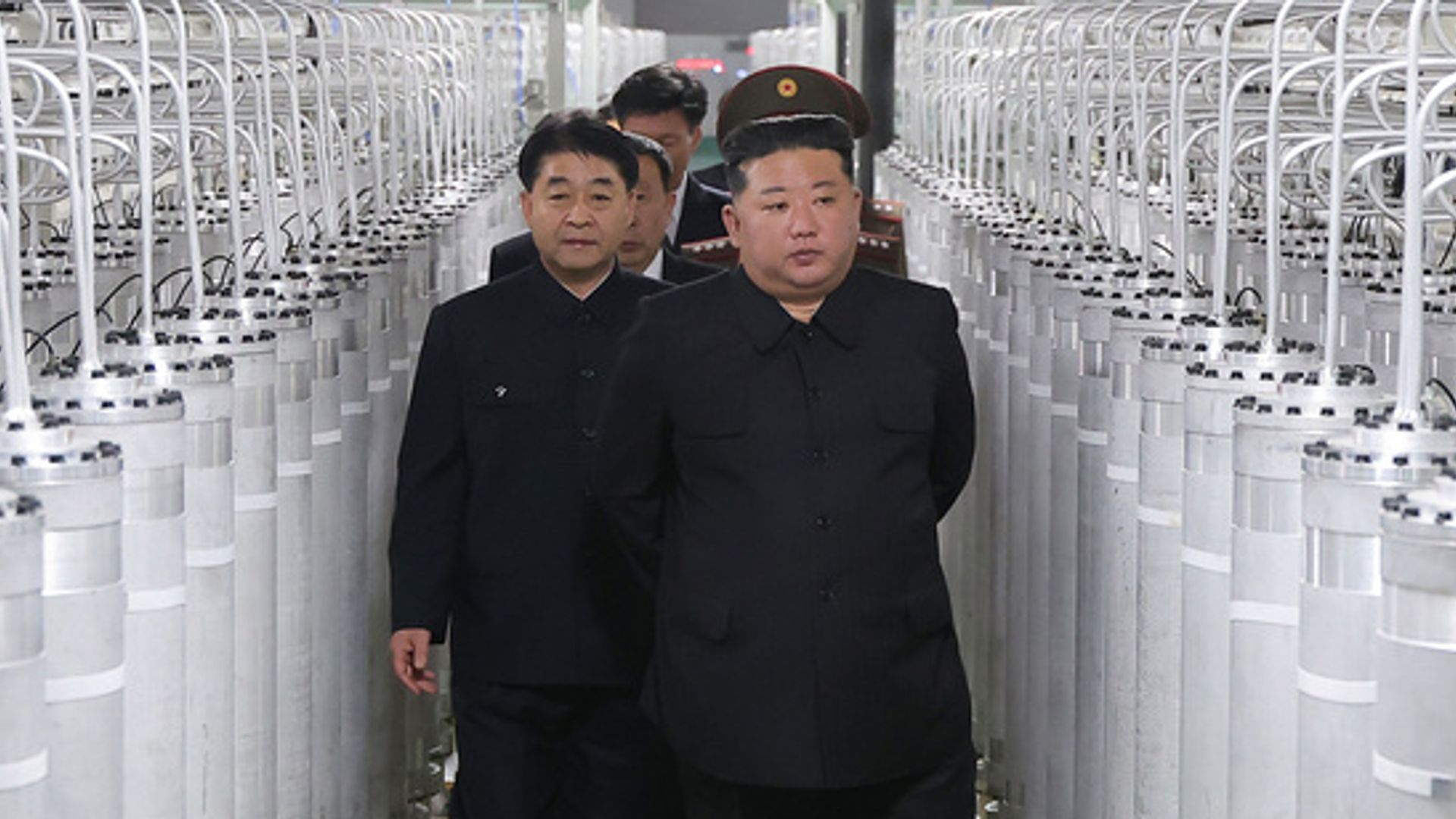
Just hours after his sister’s statement hit the wires, Kim Jong Un toured a major munitions industrial enterprise to personally review weapons production. This was not a routine photo opportunity. State media detailed explicit directives to boost the existing production capacity of various ballistic and cruise missiles by 2.5 times within the current five-year defense plan.
This aggressive scaling correlates with the recent unveiling of a new, undisclosed nuclear material production facility designed for the "exponential" increase of tactical nuclear warheads. This industrial expansion serves three distinct operational purposes:
- Sustaining the Domestic Deterrent: Establishing a credible, survivable second-strike capability that renders any pre-emptive Western military intervention impossible.
- Export and Logistics: Mass-producing conventional munitions and missile systems to supply foreign buyers, building on the precedent set by North Korea's deployment of equipment and troops to assist Russian operations in Europe.
- Sovereignty as Law: Codifying the nuclear status into the state constitution, transforming an illicit weapons program into an immutable legal mandate of the state.
The Axis of Convenience
The true reason North Korea will never surrender its nuclear status lies in the collapse of the unipolar international order. During the failed 2019 Hanoi summit, Pyongyang still operated under the assumption that its economic isolation could only be broken via Washington. The geopolitical landscape of today offers entirely new avenues for survival.
Pyongyang has successfully integrated itself into a functional counter-weight network alongside Moscow and Beijing. The war in Ukraine has transformed North Korea from a diplomatic pariah into a critical defense-industrial partner for a nuclear-armed superpower. In exchange for artillery shells and ballistic missiles, the Kim regime has secured vital energy shipments, food security, and advanced military technology transfers from Russia.
Consequently, the leverage of Western sanctions has eroded. When Beijing and Moscow hold veto power in the UN Security Council, the threat of further international isolation loses its teeth. Xi Jinping's visit to Pyongyang is a vivid illustration of this protective umbrella. Beijing views a nuclear-armed, stable North Korea as infinitely preferable to a collapsed regime that would bring a unified, U.S.-allied Korea directly to the Chinese border.
The Strategy of Forced Acceptance
The diplomatic goal for Pyongyang has fundamentally changed. The regime is no longer seeking a grand bargain to trade weapons for peace. Instead, it is executing a long-term strategy of forced acceptance.
By building an arsenal so vast and deeply integrated into its state identity, North Korea aims to wear down the political will of the West until Washington is forced to abandon the rhetoric of "complete, verifiable, and irreversible denuclearization." Pyongyang wants to be treated exactly like India or Pakistan: a nation that defied the non-proliferation framework, endured the initial backlash, and was ultimately accepted as a permanent nuclear power due to the realities of geography and hard power.
Kim Yo Jong’s assertion that their nuclear status "carries no legal force" under Western interpretation is a direct challenge to the legitimacy of U.S.-led international order. It is an acknowledgment that in the current international system, possession of raw power matters far more than compliance with treaties.
The Policy Deadlock
Western capitals now face a stark, uncomfortable reality. The traditional policy toolkit—combining incremental sanctions with conditional offers of diplomatic normalization—has completely failed to deter Pyongyang's ambitions.
Continuing to demand denuclearization as a prerequisite for meaningful talks ensures that no talks will happen at all. Yet, formally recognizing North Korea as a nuclear state carries immense risks, potentially fracturing the U.S. alliance system in Asia and triggering a dangerous regional arms race that could prompt South Korea and Japan to reconsider their own nuclear options.
The regime has made its calculations. With an expanded missile production line, a growing stockpile of fissile material, and the backing of powerful allies in Moscow and Beijing, Pyongyang has no incentive to retreat from its current course. The era of non-proliferation negotiation on the Korean Peninsula is over, replaced by a permanent state of nuclear deterrence that the West must now learn to manage rather than resolve.