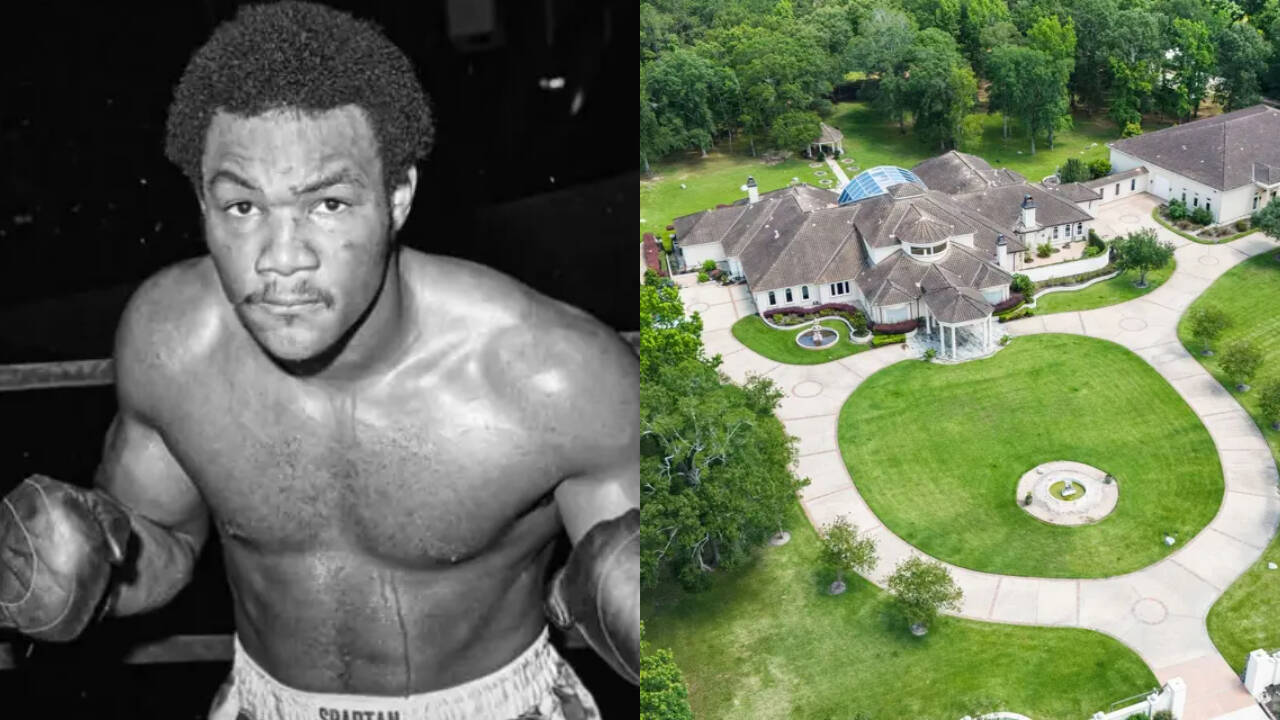
George Foreman did not just build a house in Huffman, Texas; he built a monument to industrial-scale reinvention. Now, nearly two years after the heavyweight champion and entrepreneurial titan passed away at age 76, his 13.5-acre estate northeast of Houston has returned to the market at a heavily slashed price of $6 million. When it first appeared for public acquisition shortly before his death, the tag sat at an ambitious $9.5 million. The drop looks like a standard luxury real estate correction on paper, but the architectural and emotional reality of the property tells a much heavier story about the architecture of accumulation.
The main residence spans nearly 12,000 square feet, anchored by a steel-framed glass atrium that acts as the physical heart of the compound. Romanesque columns rise toward a domed skylight, casting light across formal living spaces that feel entirely divorced from modern minimalist trends. This is heavy, uncompromised traditional luxury built at the turn of the millennium. There are two distinct kitchens, including a wood-trimmed workspace bearing Foreman’s personal "G.F." initials burned into the island. This specific room served a functional purpose far beyond domestic meal preparation. It was the exact staging ground where Foreman filmed early commercial spots for the iconic fat-reducing grill that ultimately generated far more wealth than his decades inside the prizefighting ring.
Yet the most striking feature of the Martelly Way property is not the atrium or the commercial-grade kitchen. It is the detached, 11,000-square-foot climate-controlled garage.
Engineered to house upwards of fifty vehicles, this massive steel-framed structure was constructed to shelter Foreman's legendary personal collection of classic cars, luxury cruisers, and rare imports. There was just one vital catch for any prospective buyer walking the grounds today: the cars are entirely gone.
Months before Foreman's death, the family partnered with Hagerty Marketplace to liquidate the entire collection at no reserve. Fifty-one lots went under the digital hammer, clearing roughly $2.8 million. Pristine centerpieces like his low-mileage 2005 Ford GT and his rare Topaz Blue 2000 BMW Z8 were shipped off to new bidders across the country. What remains for the next owner is an immaculate, climate-controlled automotive cathedral completely stripped of its congregation.
Buying a sprawling estate with an empty vehicle warehouse highlights a peculiar luxury real estate dilemma. The structure itself is a marvel of industrial engineering, complete with polished floors and commercial ventilation, designed for a collector who viewed automobiles as sculptural art. Without that specific intent, an 11,000-square-foot steel shed adjacent to a single-story Mediterranean home transforms into a massive maintenance liability. The annual property tax burden on the estate hovers around $63,000 against a county-assessed baseline of roughly $3.5 million, meaning the family's current $6 million ask demands a steep premium for the legacy attached to the land.
Real estate markets outside major metropolitan cores rarely reward sentimental value. Huffman is a quiet, unincorporated community, far removed from the hyper-inflated enclaves of River Oaks or exclusive gated zip codes in Dallas. Buyers shopping in the multi-million-dollar bracket often look for turnkey modernism or acreage with working agricultural utility. Foreman's estate offers neither. It offers a deeply personal, idiosyncratic compound outfitted with fish ponds, dog kennels, sports courts, and a shrine to an extraordinary life that operated entirely on its own terms.
The next owner will not inherit a turnkey trophy. They will inherit an empty hangar and a ghost of American commercial history, left waiting for someone else to fill the bays.
The video above provides a walkthrough of the Huffman estate grounds and the expansive garage space.