The brochure promises an escape from reality. It features photographs of impossibly blue water, white sand that never burns your feet, and rows of pristine, palm-thatched roofs swaying gently against a twilight sky. For decades, the all-inclusive beach resorts of the Dominican Republic have sold this exact dream to millions of travelers seeking to unplug from the friction of modern life. We buy the ticket because we want to believe that paradise is a place where nothing bad can ever happen.
But paradise is built by human hands, maintained by human labor, and governed by the same volatile laws of nature that we try so hard to leave behind at the departure gate.
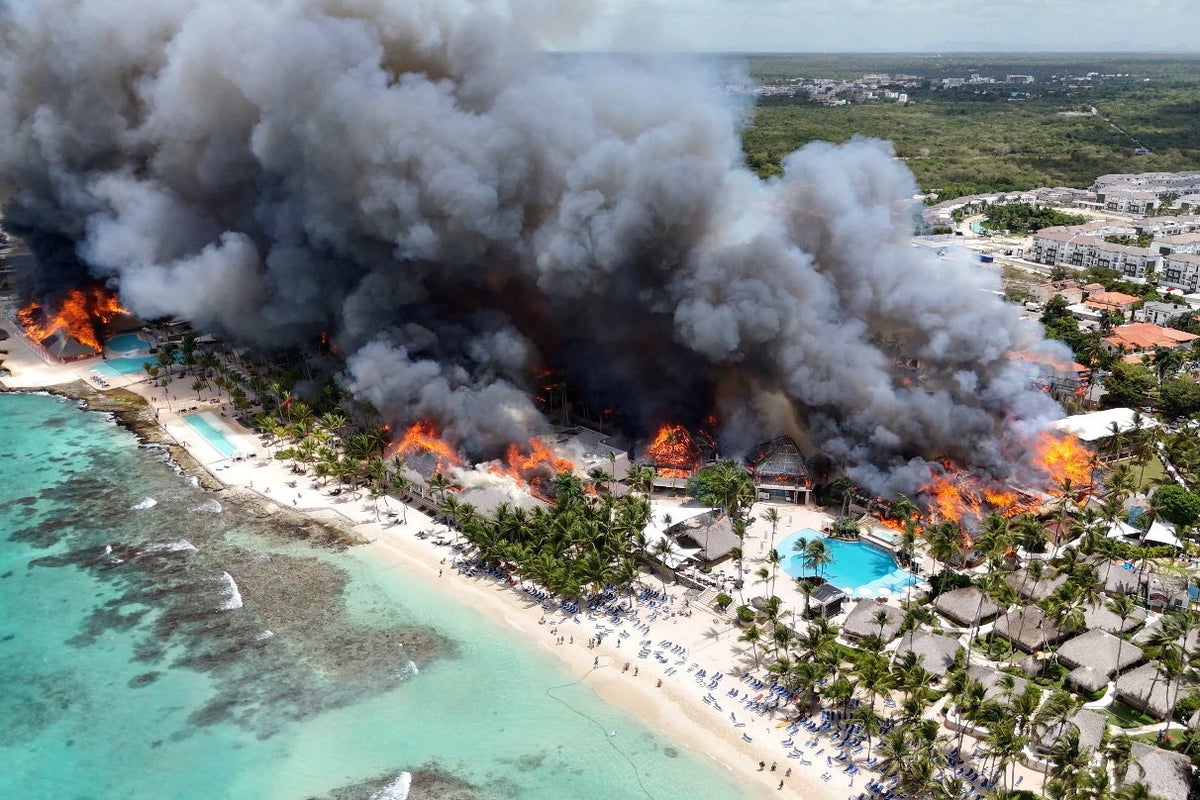
On a Friday afternoon in the coastal tourist town of Bayahibe, that illusion vanished in a matter of minutes. A massive fire erupted at the Viva Wyndham Dominicus Beach Hotel, a sprawling luxury complex on the country’s southeastern coast. What began as an ordinary day for nearly 1,700 international tourists and resort workers quickly descended into a terrifying battle against a fast-moving wall of flame. By the time the local emergency crews brought the blaze under control, a luxury destination had been heavily compromised, an entire community was shaken, and one life was lost.
To read the standard headlines, the event was a collection of cold, mechanical metrics: 1,690 evacuations, a handful of injuries, and a single fatality identified as Francesca Valentino, a 46-year-old tourist from Italy.
The wire services tell you what happened, but they rarely tell you what it felt like. They do not capture the sudden, sickening realization that the smell of smoke on the breeze is not a beachside barbecue. They omit the sensory shock of watching a postcard-perfect view get choked out by thick, pitch-black clouds billowing over the Caribbean shoreline. When we look past the dry statistics, we find the true human weight of the Bayahibe fire—a stark reminder of how quickly the thin veneer of a care-free vacation can give way to the raw, unpredictable chaos of survival.
The Flammable Architecture of a Dream
Consider what happens when design priorities clash with environmental realities. The very features that draw us to a tropical resort are often the precise elements that make it vulnerable when something goes wrong.
In the Dominican Republic, the aesthetic of the cana—the traditional palm-thatched roof—is an essential part of the architectural identity. It feels authentic. It connects the traveler to a romanticized idea of island living, providing natural shade and a rustic charm that a concrete ceiling simply cannot replicate.
But beneath that rustic charm lies a severe engineering hazard. Dried palm thatch is essentially tinder. It is incredibly light, highly combustible, and packed with pockets of air that invite fire to breathe.
According to the Dominican Republic’s Emergency Operations Center, this traditional roofing material was the primary catalyst for the disaster. When the spark occurred—the exact source remains under active investigation—the fire did not crawl; it leaped. Fueled by strong, unrelenting coastal winds blowing off the water, the flames raced across the interconnected thatched structures of the Viva Wyndham Dominicus Beach.
Imagine standing on a balcony, watching a small plume of gray smoke on the horizon, and seeing it transform into a roaring, golden furnace above your head in the span of a few breaths. The wind, which tourists usually welcome as a cool relief from the midday heat, became an accelerant. It pushed the fire forward, jumping from roof to roof, raining embers down onto lounge chairs, wooden boardwalks, and manicured lawns.
This is the invisible compromise of luxury travel. We demand an aesthetic of unblemished nature, but nature uncontained is inherently hazardous. The materials used to cultivate an atmosphere of relaxation are the exact materials that accelerate a crisis.
The Geography of Panic and Mercy
When a crisis hits an all-inclusive resort, the psychological shift is brutal. You are in a foreign country, wearing swimwear, separated from your passport, your wallet, and your medication, which are all sitting in a digital safe box inside a room that may currently be turning to ash.
The logistical challenge of evacuating almost 1,700 people from a burning beachfront properties is an exercise in managed chaos.
Think about the sheer diversity of the crowd at a major Caribbean destination on any given weekend. You have elderly couples moving at a slower pace, parents franticly scanning the smoke for children who were at the kids' club five minutes ago, and international travelers who do not speak the language of the local staff trying to direct them to safety.
Witnesses described a scene of surreal contrasts. On one side of the property, the idyllic turquoise waves rolled onto the shore as they always do. On the other side, an apocalyptic wall of black smoke blocked out the afternoon sun.
Yet, amidst the terror, a profound network of human solidarity took over. Resort employees, many of whom make modest wages serving drinks and changing linens, instantly shifted into emergency responders. They ran toward the smoke, knocking on heavy wooden doors to ensure no one was sleeping through the alarms. They guided confused guests through the labyrinth of the property's pathways, away from the burning thatch and down toward the safety of the open sand.
The surrounding community of Bayahibe responded with a collective maternal instinct. Tourism is the lifeblood of this region—the Dominican Republic welcomed over 5.6 million visitors in the first five months of this year alone—but this was not about protecting an industry. It was about protecting people. Nearby hotels immediately opened their doors, coordinating with the Emergency Operations Center to absorb the displaced masses. The adjacent sister property, the Viva Wyndham Dominicus Palace, escaped the fire entirely and became a makeshift sanctuary, providing water, medical triage, and a place for panicked families to count heads.
The Cost We Do Not Calculate
We pack our bags with the assumption that safety is an implicit part of the luxury price tag. We trust that the fire suppression systems are flawless, that the building codes are absolute, and that the distance between our temporary paradise and emergency medical care is negligible.
But a tragedy like the one in Bayahibe forces a heavy dose of vulnerability upon us. It exposes the fragile reality of being a stranger in a beautiful land.
For the vast majority of the 1,700 people evacuated that day, the fire will eventually become a dramatic story told at dinner parties—a harrowing memory of a vacation gone wrong, wrapped in the relief of survival. They lost their luggage, their clothes, and their peace of mind, but they kept their lives.
For the family of Francesca Valentino, the story has no such resolution. A 46-year-old woman traveled across an ocean from Italy, seeking the same restoration we all seek when we stare at pictures of white-sand beaches on a cold winter night. She ended her journey in a burning room on a Caribbean coast, a stark and devastating reminder that when paradise breaks, the cost is paid in human life.
The smoke over Bayahibe has cleared now. The local authorities have noted that tourist activities in the surrounding area continue to operate normally, a necessary economic reassurance for a nation that relies heavily on international travelers to keep its citizens employed. The sun still shines, the water remains clear, and new flights are landing at the airport every hour, carrying a fresh wave of hopeful vacationers.
But for those who were there, the horizon will always look a little different. The next time they walk into a luxury lobby, their eyes will not just appreciate the high ceilings and the elegant décor. They will look for the exits. They will look closely at the materials above their heads. They will remember that paradise is never a permanent guarantee; it is just a beautiful arrangement of fragile things, waiting for the wind to change.