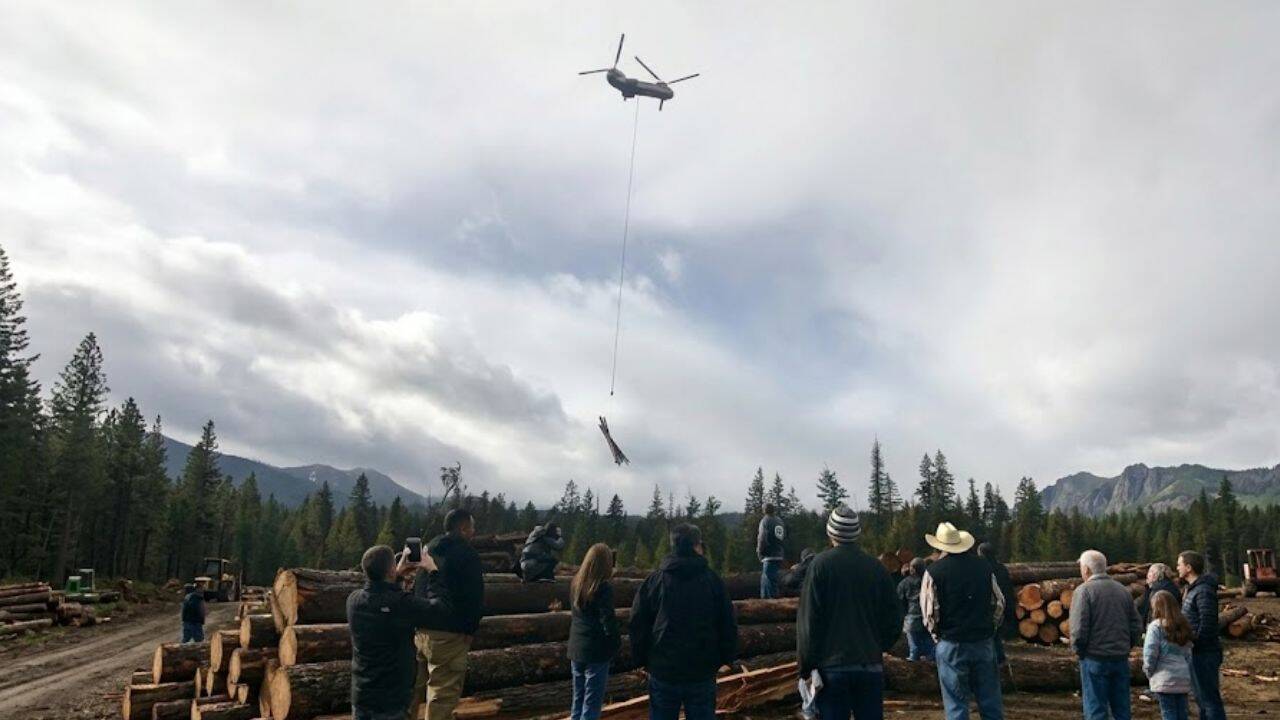
Heavy-lift aircraft are currently air-dropping thousands of massive old-growth logs into remote waterways across Washington State, a radical engineering intervention designed to rescue collapsing wild salmon populations. Decades of heavy timber harvest, stream cleaning, and human development stripped the Pacific Northwest river basins of the natural woody debris that once choked healthy aquatic ecosystems. Without fallen trees to anchor gravel beds, slow water velocity, and create deep resting pools, winter floods routinely scour spawning grounds and wash away salmon eggs before they hatch. Wildlife managers now rely on skycranes and heavy-lift helicopters to reverse this historical damage in wilderness areas where logging roads no longer exist.
Environmental restoration rarely looks like quiet conservation work anymore. In many watersheds, it looks like an industrial logging operation operating in reverse. Heavy helicopters lift entire Douglas firs and cedars, complete with root wads intact, carrying them miles over roadless wilderness before dropping them directly into pristine or recovering river channels.
The strategy addresses a foundational deficit in modern rivers. For more than a century, logging companies and state authorities cleared rivers of log jams to ease timber transit and prevent flooding. That tidy housekeeping destroyed the physical architecture of the stream. Rivers were straightened, sped up, and starved of complexity. Wild salmon evolved alongside complex, obstructed rivers. They need slow water to escape raging winter currents, deep pools to hide from predators, and complex gravel bars to lay their eggs.
When a massive tree falls into a river naturally, it acts as a permanent anchor. It traps smaller branches, collects drifting sediment, and forces the current to carve out deep pools. These pools serve as thermal refuges during hot summer months and safe harbors during winter deluges. Reintroducing these structures manually restores the hydraulic sorting mechanisms that clean gravel and provide diverse micro-habitats for juvenile fish.
Doing this work via helicopter is expensive, logistically complex, and entirely necessary. Many of the degraded streams sit within protected wilderness zones or roadless national forests where heavy machinery is legally barred from entering. Building temporary access roads would cause more sedimentation and environmental damage than the restoration project itself could ever fix. Aviation becomes the only viable tool for heavy lifting in fragile ecosystems.
Pilots flying heavy-lift aircraft face punishing flying conditions. Maneuvering multi-ton timber loads into narrow river canyons requires precise coordination between ground crews, spotters, and the flight deck. Wind shear off mountain ridges, sudden weather shifts, and heavy suspended payloads make each drop a high-stakes calculation. One miscalculation can wedge a log incorrectly, altering stream flow in unintended ways or damaging riparian zones.
Fisheries biologists spend months surveying target reaches before a single log is dropped. They map stream gradients, calculate bank full widths, and identify exact hydraulic pinch points where wood placement will yield the maximum biological benefit. The logs are often engineered into complex jams designed to withstand high-flow flood events without washing away downstream or blocking migrating adult fish.
This physical rehabilitation directly addresses the freshwater bottlenecks facing Pacific salmon. While ocean conditions, climate change, and warming waters present massive regional challenges, juvenile salmon must survive their first year or two in freshwater streams before heading to sea. If winter floods wash them out or summer heat kills them in shallow, unshaded water, adult returns plummet regardless of ocean survival rates.
Critics sometimes question the permanence of these interventions. Natural log jams shift, rot, and rearrange over decades. Restoration engineers design modern placements to mimic these natural life cycles, using root wads to anchor the structure into the streambed while allowing smaller wood to rack up organically over time. The goal is not to freeze a river in an artificial state, but to restart natural ecological processes that can sustain themselves once the initial scaffolding is in place.
As funding for aquatic restoration shifts toward large-scale physical engineering, the sight of helicopters hauling timber over remote mountain ranges will become a familiar fixture of conservation biology. Saving wild salmon requires meeting the scale of the original industrial disruption with an equally ambitious commitment to structural repair.